
TDM Neo Hybrid Headphone Speakers: The $249 Twist That Stole CES 2026
Discover the TDM Neo Hybrid Headphone Speakers revealed at CES 2026. A $249 device that twists from headphones to speakers with a 200-hour battery life.
Every now and then, a piece of tech clicks so perfectly it feels like genius. At CES 2026, that moment belonged to the TDM Neo. As reported by Mashable, these aren't just headphones; they're a transformative audio system that bridges the gap between personal listening and social sharing with a simple twist.
TDM Neo Hybrid Headphone Speakers: A Seamless Transformation
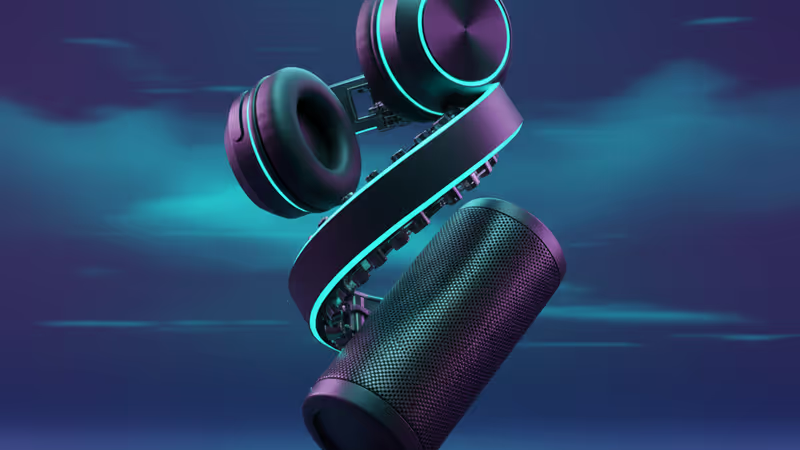
The TDM Neo functions as a high-quality pair of over-ear headphones until you bring the two sides together and twist. They snap into place, instantly turning into a shared speaker. It's a seamless transition that automatically redirects the audio from your ears to the external environment. Unlike other 2-in-1 products that often look awkward in one of their forms, the Neo remains stylish and ergonomic whether it's on your head or sitting on a table.
200-Hour Battery Life and Smart Features

Battery anxiety won't be an issue for Neo users. TDM claims the device lasts for more than 200 hours in headphone mode and up to 10 hours in speaker mode. This utility is perfect for those moments when you want to share a new track with a friend without the hygiene concerns of sharing earbuds. You just twist, play, and experience the music together.
The TDM Neo Hybrid Headphone Speakers will be available later this month for $249. Customers can choose between classic Black and White color options. For many at CES, this was the standout 'lifestyle' tech that actually solves a real-world problem.
Authors
Related Articles

Motorola unveils the Razr Fold at CES 2026, featuring an 8.1-inch screen, triple 50MP cameras, and the new Qira AI assistant for a unified ecosystem.

Shokz unveils the OpenFit Pro at CES 2026, featuring groundbreaking Open-Ear Noise Reduction tech. Priced at $249.95 with Dolby Atmos support and 50-hour battery life.

Samsung Electronics' union branch revealed that 84% of survey respondents oppose the government's roughly $290 billion (₩400 trillion) semiconductor megaproject in Gwangju. Government, management, the union and shareholders are all reading the same national project in sharply different ways.

Nvidia shipped roughly a billion RISC-V cores in 2024, then announced it would run CUDA on the open standard. We break down how royalty-free instruction sets and open software stacks are trying to route around CUDA's lock-in. Part 2 of the Semiconductor Sovereignty series.
Motorola unveils the Razr Fold at CES 2026, featuring an 8.1-inch screen, triple 50MP cameras, and the new Qira AI assistant for a unified ecosystem.
Shokz unveils the OpenFit Pro at CES 2026, featuring groundbreaking Open-Ear Noise Reduction tech. Priced at $249.95 with Dolby Atmos support and 50-hour battery life.
Samsung Electronics' union branch revealed that 84% of survey respondents oppose the government's roughly $290 billion (₩400 trillion) semiconductor megaproject in Gwangju. Government, management, the union and shareholders are all reading the same national project in sharply different ways.
Nvidia shipped roughly a billion RISC-V cores in 2024, then announced it would run CUDA on the open standard. We break down how royalty-free instruction sets and open software stacks are trying to route around CUDA's lock-in. Part 2 of the Semiconductor Sovereignty series.
Thoughts
Share your thoughts on this article
Sign in to join the conversation