
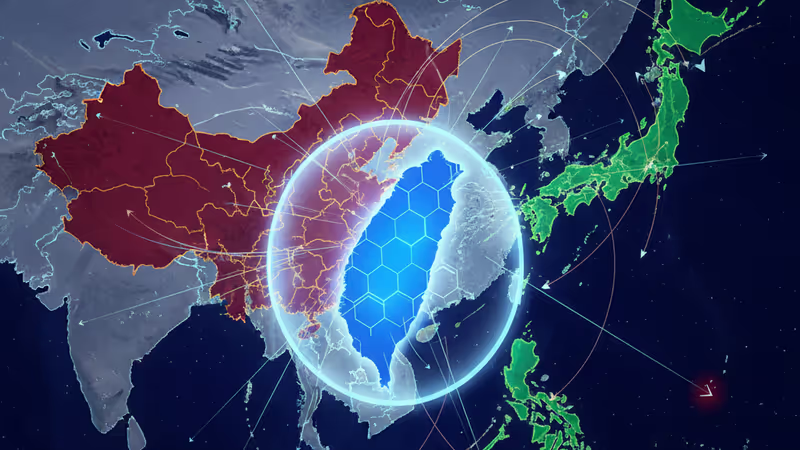
Taiwan's T-Dome Under Fire: Geopolitical Chessboard Shifts in Air Defense Strategy
Taiwan's T-Dome missile shield faces critical scrutiny from mainland China, revealing deep geopolitical tensions and driving the tech-military race in the Indo-Pacific.
The Lede: Beyond the Shield – A Strategic Flashpoint
Taiwan's proposed T-Dome missile defense system, unveiled with the promise of intercepting hostile threats, has immediately drawn critical scrutiny from mainland Chinese military strategists. This isn't just about the technical specifications of an air defense platform; it's a critical barometer of escalating tensions in the Indo-Pacific, revealing deeper insights into the strategic deterrence calculus and the ongoing tech-military race. For global executives, understanding this dynamic is crucial for anticipating supply chain vulnerabilities, regional instability, and shifts in defense technology investment.
Why It Matters: Stability, Supply Chains, and Strategic Signaling
The debate surrounding T-Dome's efficacy carries significant weight beyond military circles. Taiwan is a linchpin in the global technology supply chain, particularly for advanced semiconductors. Any perceived shift in its defensive capabilities – or vulnerabilities – directly impacts market stability, investor confidence, and the potential for disruptive geopolitical events. A credible defense system could bolster Taiwan's deterrence posture, potentially discouraging aggression, while a perceived weakness could embolden adversaries, increasing regional risk.
The ripple effects include:
- Investment Climate: Heightened uncertainty could deter foreign direct investment into Taiwan, impacting its critical tech sectors.
- Defense Spending Trends: The development and criticism of T-Dome will likely spur further defense expenditure across the region, fueling an arms race.
- Technological Innovation: The push for advanced indigenous defense systems underscores a global trend towards self-reliance in critical military technologies, potentially leading to new breakthroughs in AI-driven defense, counter-drone systems, and missile interception.
The Analysis: Layered Defense in a Complex Threat Landscape
Historical Context and Strategic Imperatives
Taiwan's pursuit of a sophisticated air defense system like T-Dome is rooted in decades of strategic necessity. Positioned directly across the Taiwan Strait from a rapidly modernizing People's Liberation Army (PLA), Taiwan has consistently sought to develop or acquire capabilities that could deter an invasion or at least inflict prohibitive costs. Previous efforts have included substantial investments in Patriot missile systems and indigenous development. The T-Dome concept, drawing inspiration from Israel's Iron Dome and America's proposed Golden Dome, represents a shift towards a more integrated, potentially layered defense network capable of addressing a wider spectrum of threats, from ballistic missiles to swarms of drones.
Competitive Dynamics: Beijing's Critique and Taipei's Resolve
Mainland China's swift dismissal of T-Dome as having “critical vulnerabilities and flaws” is a predictable element of psychological warfare and strategic posturing. Beijing consistently aims to undermine confidence in Taiwan's defensive capabilities, both domestically and internationally. This narrative serves to project overwhelming PLA superiority, potentially demoralize Taiwanese forces, and deter external support for Taiwan's defense.
However, the critique also highlights a critical strategic challenge: modern air defense against a numerically superior and technologically advanced adversary. Taiwan faces a multi-dimensional threat, including ballistic missiles, cruise missiles, advanced fighter jets, and an increasingly sophisticated drone fleet. The effectiveness of any shield relies not just on its intercept capability but on its resilience against saturation attacks, electronic warfare, and cyber intrusion.
Taiwanese leader William Lai Ching-te's emphasis on T-Dome guarding against “hostile threats” underscores Taipei's determination to enhance its self-defense. The development of indigenous systems like T-Dome aims to reduce reliance on foreign suppliers and tailor defenses specifically to Taiwan's unique geographic and strategic challenges. The question isn't solely whether T-Dome can stop *every* threat, but whether it can significantly complicate an invasion scenario, thereby increasing deterrence.
PRISM Insight: The Future of Integrated Defense and AI
The T-Dome initiative is indicative of a broader trend in defense technology: the move towards highly integrated, AI-powered multi-layered defense systems. Future air defense won't be about a single silver bullet, but rather a network of sensors, interceptors, and command-and-control systems that can rapidly identify, track, and engage multiple targets simultaneously. This necessitates advances in machine learning for threat detection, autonomous response systems, and sophisticated data fusion to manage the immense data flow from various sensors.
Investment implications abound in areas like advanced radar technology, high-speed computing, secure communications, and novel effector technologies (e.g., directed energy weapons, swarm defense). Furthermore, the debate highlights the critical importance of cyber resilience in these interconnected systems; a technologically advanced defense system is only as strong as its weakest digital link.
PRISM's Take: A Crucible of Geopolitics and Technological Warfare
The controversy surrounding Taiwan's T-Dome is far more than a technical dispute; it's a microcosm of the intense geopolitical struggle shaping the 21st century. Beijing's assertions, while serving a propaganda purpose, also highlight the immense challenge of creating an impenetrable defense against a determined, technologically advanced adversary. For Taiwan, developing such a system is not just about protection, but about asserting sovereignty, building resilience, and maintaining deterrence in the face of persistent threats.
Ultimately, the true measure of T-Dome's impact may lie less in its unproven combat performance and more in its psychological effect. Does it sufficiently complicate a PLA invasion calculus? Does it signal to the international community Taiwan's resolve and capacity for self-defense? The answers to these questions will significantly influence the delicate balance of power in the Indo-Pacific, with profound implications for global stability, supply chain resilience, and the future of defense innovation.
Related Articles
An analysis of Australia's Bondi Beach attack, exploring its geopolitical implications, impact on global security, and the role of technology in fostering societal resilience.

Analyze the post-2024 U.S. political landscape, its impact on global tech, trade, and geopolitics. Understand implications for businesses and investments.

A federal judge's order to redraw electoral maps in a US state underscores the judiciary's role in safeguarding democratic integrity and has implications for global trust and investment.
US foreign policy in the Middle East is pivoting towards economic diplomacy over military might. Analyze the geopolitical implications, new investment opportunities, and tech trends.