
Taiwan's 'Mission Command' Pivot: Rewriting the Rules of War to Counter a Chinese Blitz
Taiwan is adopting a decentralized 'mission command' strategy to counter a no-warning Chinese invasion. A deep dive into the geopolitical and tech implications.
The Lede: Beyond the Headlines
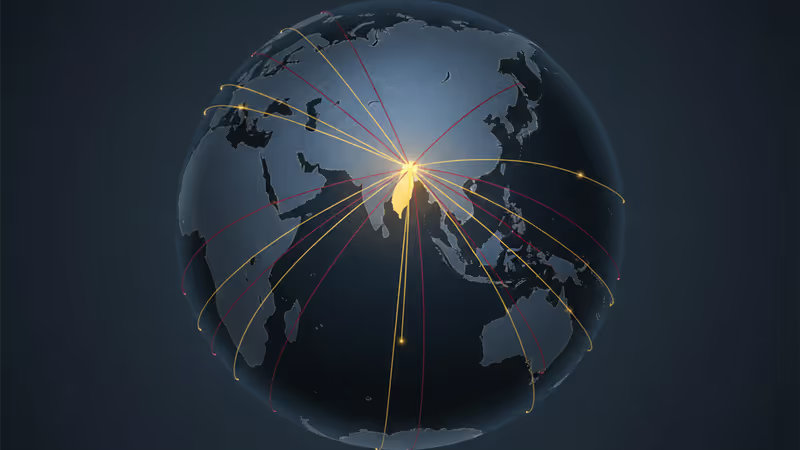
A tactical shift in Taiwan's military training is sending a strategic shockwave across the globe. By empowering frontline units to fight independently, Taipei is publicly acknowledging a stark new reality: the warning time for a Chinese invasion could be hours, not weeks. For global executives, this isn't just a regional military matter; it's a fundamental stress test on global supply chains, geopolitical stability, and the very nature of modern conflict. This move transforms Taiwan's defense from a rigid, centralized structure—a single point of failure—into a resilient, distributed network designed to survive a decapitation strike and make the island ungovernable for an invading force.
Why It Matters: Second-Order Effects
This pivot from a traditional, top-down command structure to a decentralized 'mission command' philosophy carries significant implications far beyond the Taiwan Strait. It represents a calculated response to the People's Liberation Army's (PLA) evolving doctrine, which emphasizes speed, surprise, and overwhelming force to achieve a swift victory.
- Geopolitical Signaling: This is a clear message to Beijing and Washington. To Beijing, it signals that a quick, clean invasion is not an option and that any conflict will descend into a costly, protracted quagmire. To Washington, it demonstrates Taiwan's commitment to its own defense, making a stronger case for continued international support.
- Economic Resilience Test: The strategy implicitly accepts that initial attacks will be disruptive. For the global economy, particularly the semiconductor industry reliant on TSMC, this means the risk profile has shifted from preventing a war to surviving the opening salvos of one. Business continuity plans must now account for a scenario of widespread, chaotic, and localized fighting rather than a single, predictable frontline.
- A New Model for Asymmetric Warfare: Nations facing larger, more powerful adversaries—from the Baltics to Southeast Asia—are watching closely. Taiwan is creating a real-world playbook for a 'porcupine strategy' in the 21st century, leveraging agility and distributed lethality to counter overwhelming mass.
The Analysis: Lessons from Ukraine, Reality of the PLA
Taiwan's strategic evolution is not occurring in a vacuum. It is a direct result of two primary drivers: the PLA's modernization and the battlefield lessons of Ukraine.
Historically, Taiwan's defense posture focused on defeating a conventional amphibious assault in a centralized, set-piece battle. However, Beijing has spent two decades building a military capable of circumventing this. The PLA's 'joint firepower strike' doctrine is designed to use missile, air, and cyber attacks to instantly neutralize Taiwan's central command, airfields, and ports—paralyzing the island's ability to mount a coordinated defense.
The initial phase of the 2022 Ukraine invasion provided a powerful proof of concept for the alternative. Ukrainian forces, often cut off from high command, successfully used their operational autonomy to disrupt Russian logistics, ambush armored columns, and thwart a rapid decapitation of Kyiv. Taiwan's military planners have clearly absorbed this lesson: a defense that can function without its head is infinitely more resilient. This shift requires a profound cultural change, investing trust and decision-making authority in junior officers—a difficult transition for any traditional military hierarchy.
PRISM Insight: The Tech Stack of a Decentralized Defense
This strategic pivot creates immediate demand for a specific class of military and dual-use technology. The focus shifts from large, exquisite platforms to systems that enhance the lethality and survivability of small, dispersed units. Key investment and development areas include:
- Resilient Communications: Secure, low-probability-of-intercept mesh networks, satellite terminals (like Starlink), and anti-jamming technologies become mission-critical. When central command is down, the network is the command structure.
- Tactical-Edge ISR: Small, man-portable drones for reconnaissance, loitering munitions, and AI-powered sensor fusion tools are essential to give isolated units 'over-the-hill' awareness without relying on a central intelligence hub.
- Distributed Lethality: Increased investment in modern anti-tank guided missiles (ATGMs), man-portable air-defense systems (MANPADS), and sea drones to empower small teams to inflict disproportionate damage on an invading force.
PRISM's Take: A Calculated Gamble on Strategic Chaos
Taiwan's embrace of decentralized command is one of the most significant, yet under-reported, developments in modern military strategy. It is a tacit admission that a traditional defense against the PLA is no longer viable. Instead of trying to prevent a landing, the new goal is to ensure that a successful landing does not equal a successful invasion.
The strategy is to turn the island into a nightmare for an occupying force, trading territory for time and imposing unsustainable costs on Beijing. It is a high-risk, high-reward gamble. Its success hinges not just on acquiring the right technology, but on mastering the human element: fostering a culture of initiative, adaptability, and trust at the lowest levels. While this shift increases the chances of Taiwan surviving an initial onslaught, it also raises the prospect of a more brutal, chaotic conflict that would have profound and lasting consequences for the global order.
Related Articles

Analysis: US retaliatory strikes in Syria signal a new era. We break down the geopolitical shift, the fragile US-Syria alliance, and what it means for global security.
The Trump administration halts the Diversity Visa Lottery after a tragic shooting. PRISM analyzes the geopolitical fallout and the impact on global talent.
Analysis: A massive new EU aid package and a US policy shift signal the Ukraine war is entering a new phase focused on a negotiated settlement, not total victory.
Our historical view of war is a cognitive trap. The next global conflict will be fought with code, data, and AI, not just tanks. Are we prepared?