
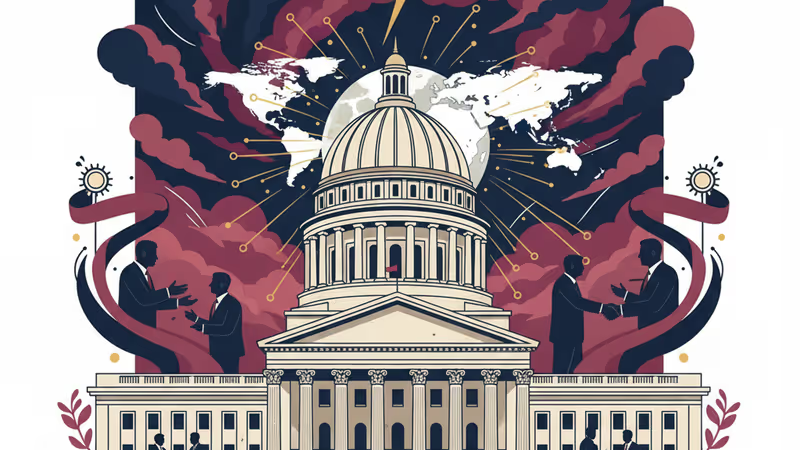
Taiwan's Constitutional Crisis: The Political Storm Threatening the Global Chip Supply
Taiwan's political gridlock triggers a constitutional crisis, creating new risks for TSMC, the global semiconductor supply chain, and US-China relations.
The Lede: Why This Matters Now
A constitutional crisis is brewing in Taipei, and while it may seem like a distant political drama, its shockwaves could directly impact global markets and every piece of advanced technology you use. Taiwan's new government is locked in an unprecedented power struggle, creating a political paralysis that threatens the stability of the world's most critical industry: semiconductors. For any leader relying on a stable tech supply chain, this internal conflict is a more immediate and insidious risk than military posturing in the Taiwan Strait.
Why It Matters: The Ripple Effect
The standoff between Taiwan's DPP-led executive branch and the KMT-controlled legislature is not just political theater; it has tangible consequences. This is a direct threat to the operational certainty that underpins the global economy.
- Tech Sector Paralysis: Political gridlock could stall vital budgets for infrastructure, energy policy, and R&D—the very lifelines of semiconductor giants like TSMC. With fabs requiring immense, stable power and water resources, any disruption to government planning introduces significant operational risk.
- Geopolitical Vulnerability: A government consumed by internal fighting is a government distracted from external threats. Beijing watches with keen interest, as a divided Taiwan is less capable of presenting a united, resilient front. This complicates US strategy, which relies on a stable and decisive partner in Taipei.
- Investor Confidence Shock: Uncertainty is poison for markets. Protracted instability could lead to a 'governance discount' on Taiwanese assets, impacting the Taiwan Stock Exchange (TWSE) and creating new headaches for global investors who have long seen Taiwan as a reliable tech powerhouse.
The Analysis: A System Under Stress
This crisis was triggered when Premier Cho Jung-tai, appointed by President Lai Ching-te (DPP), refused to sign legislation passed by the opposition-controlled legislature. The bill, which increases funding for local governments, was deemed unconstitutional by the Premier for breaching the national debt ceiling. The opposition KMT party, in response, is threatening impeachment.
A Test of Taiwan's Democracy
This is a fundamental clash rooted in Taiwan's semi-presidential system, which often produces a divided government—a president from one party and a legislative majority from another. Unlike the U.S. system, Taiwan's executive branch lacks a formal veto power over legislation. The Premier's refusal to sign is an unprecedented attempt to create a de facto veto, setting up a constitutional showdown with no clear resolution.
Ideology, Not Just Procedure
This isn't merely a procedural dispute. It reflects the deep ideological chasm between the pro-sovereignty DPP and the more China-friendly, fiscally conservative KMT. The KMT and its allies argue they are exercising their legislative mandate to control spending, while the DPP frames it as a partisan effort to hamstring the new administration. This conflict over fiscal policy is a proxy war for the future direction of Taiwan's economy and its relationship with Beijing.
PRISM Insight: The New Supply Chain Risk
For years, the C-suite and Pentagon have stress-tested supply chains for a potential military conflict in the Taiwan Strait. This crisis reveals a more immediate vulnerability: political risk. The stability required for multi-billion dollar, decade-long investments in advanced semiconductor manufacturing is being eroded not by missiles, but by parliamentary maneuvers.
This will inevitably accelerate diversification strategies. Companies and countries will see this as another data point proving the urgent need to de-risk their supply chains. Expect renewed momentum for 'friend-shoring' initiatives and increased pressure on companies like TSMC to expedite the operational capacity of their fabs in Arizona, Japan, and Germany. The key variable is no longer just geopolitics, but governance.
PRISM's Take: The World Is Watching
This constitutional standoff is a profound stress test of Taiwan's young and vibrant democracy. The immediate danger is not a successful impeachment—a high bar to clear—but a sustained period of legislative and executive paralysis. Such a deadlock would severely hobble Taiwan's ability to navigate a complex global economy and manage the ever-present threat from Beijing.
The world, and particularly the tech industry, has made an enormous bet on Taiwan's stability and reliability. This crisis is a stark reminder that the greatest near-term threat to that stability may not come from across the strait, but from within its own government. The critical question is whether Taiwan's political leaders can find a constitutional off-ramp before this internal conflict inflicts lasting damage on international confidence and the global economy.
Related Articles
As US-led peace talks intensify, a potential Trump-brokered deal to end the Russia-Ukraine war could redefine European security and global markets. An analysis.
Silicon Valley's libertarian roots are evolving into a well-funded political movement. PRISM analyzes this ideological shift and its impact on global policy.
A massive blood-smuggling bust in China is more than a crime story. It's a signal of Beijing's new biosecurity state and a new front in the US-China tech war.

Beyond headlines, a new US strategy is hardening Taiwan's defenses with advanced tech. This isn't just geopolitics; it's about securing the global economy.