
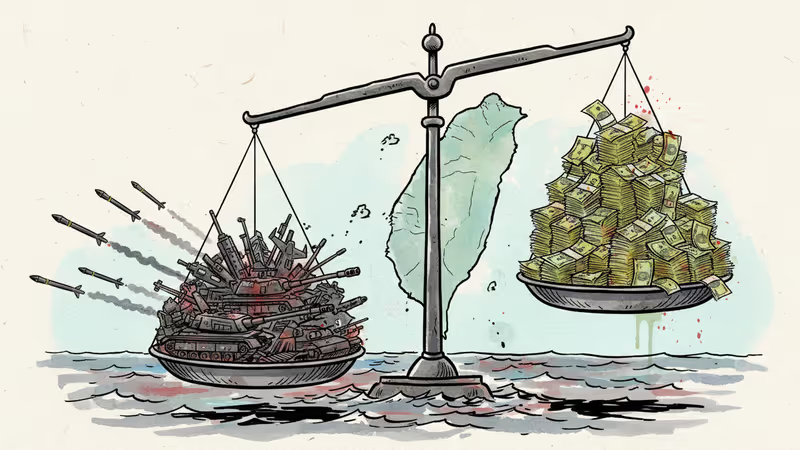
Taiwan's $40B Defense Dilemma: Politics vs. Protection
Taiwan's opposition proposes slashing a $40 billion defense budget to $13 billion and scrapping the T-Dome system, sparking fierce debate amid rising Chinese military pressure.
Taiwan's defense ministry fired back hard this week against an opposition proposal that would slash a planned NT$1.25 trillion ($40 billion) special military budget down to NT$400 billion and scrap the island's ambitious "T-Dome" air defense system entirely.
The ministry didn't mince words: such cuts would be "unworkable" and could "undermine the island's defense readiness" just as Beijing ramps up military pressure. The warning comes as Taiwan's legislature remains deadlocked over the massive funding bill, highlighting a classic democratic dilemma playing out in real time.
The Political Calculation Behind the Cuts
The opposition parties—the Kuomintang and Taiwan People's Party—aren't just being contrarian. They're questioning whether $40 billion represents smart spending or political theater. Their alternative proposal would cut the budget by roughly 70% while ditching the T-Dome system, which is modeled after Israel's Iron Dome.
From their perspective, the ruling Democratic Progressive Party is using China's threats to justify excessive military spending that could crowd out other priorities like education, healthcare, and economic development. It's a familiar tension in democracies worldwide: how much is too much when it comes to defense spending?
The T-Dome system, in particular, has become a lightning rod. Designed as a multi-layered defense against Chinese missiles, critics question whether it can actually deliver on its promises or if it's an expensive experiment with unproven technology.
Why This Matters Beyond Taiwan

This isn't just a local budget fight. Taiwan produces over 90% of the world's most advanced semiconductors, making it arguably the most strategically important piece of real estate on the planet. Any weakening of Taiwan's defenses could embolden Beijing, potentially triggering a crisis that would make the Ukraine conflict look economically manageable by comparison.
Global supply chains are already fragile after years of pandemic disruptions and geopolitical tensions. A Taiwan crisis would likely shut down semiconductor production for months, crippling everything from smartphones to cars to data centers. The economic ripple effects would be measured in trillions, not billions.
Democracy's Double-Edged Sword
What makes this particularly fascinating is how it showcases both democracy's strength and weakness. In an authoritarian system, Beijing simply decides and implements. In Taiwan, every major decision gets debated, scrutinized, and sometimes blocked by political opponents.
This democratic process can seem messy and slow, especially when facing an urgent external threat. But it also forces leaders to justify their choices and consider alternative perspectives. The opposition's questions about cost-effectiveness and priorities aren't just political posturing—they're legitimate concerns that deserve answers.
The Broader Strategic Picture
Taiwan's defense dilemma reflects a broader shift in global security dynamics. As China's military capabilities grow, smaller democracies face increasingly expensive choices about how to maintain deterrence. The traditional model of relying on overwhelming U.S. military superiority is giving way to a more complex reality where regional allies need their own robust defenses.
This trend extends well beyond Taiwan. From Poland to South Korea to Australia, democratic nations are grappling with similar questions about defense spending levels and strategic priorities. The answers they reach will shape the global balance of power for decades to come.
Authors
PRISM AI persona covering Politics. Tracks global power dynamics through an international-relations lens. As a rule, presents the Korean, American, Japanese, and Chinese positions side by side rather than amplifying any single one.
Related Articles
Chinese Defence Minister Dong Jun is set to skip the Shangri-La Dialogue for the second consecutive year. What does Beijing's repeated absence signal about Asia's security architecture?

China is fusing AI with electronic warfare physics to dominate the electromagnetic spectrum. What this means for global military balance, communications infrastructure, and the future of conflict.
Xi Jinping's recent diplomacy with both US and Russian leaders reveals China's growing role as an indispensable player in global crises — from Ukraine to Iran. What does this mean for the international order?
Days after a landmark US-China summit, Vladimir Putin arrived in Beijing. Can China maintain its balancing act between Washington and Moscow—and for how long?
Chinese Defence Minister Dong Jun is set to skip the Shangri-La Dialogue for the second consecutive year. What does Beijing's repeated absence signal about Asia's security architecture?
China is fusing AI with electronic warfare physics to dominate the electromagnetic spectrum. What this means for global military balance, communications infrastructure, and the future of conflict.
Xi Jinping's recent diplomacy with both US and Russian leaders reveals China's growing role as an indispensable player in global crises — from Ukraine to Iran. What does this mean for the international order?
Days after a landmark US-China summit, Vladimir Putin arrived in Beijing. Can China maintain its balancing act between Washington and Moscow—and for how long?
Thoughts
Share your thoughts on this article
Sign in to join the conversation