
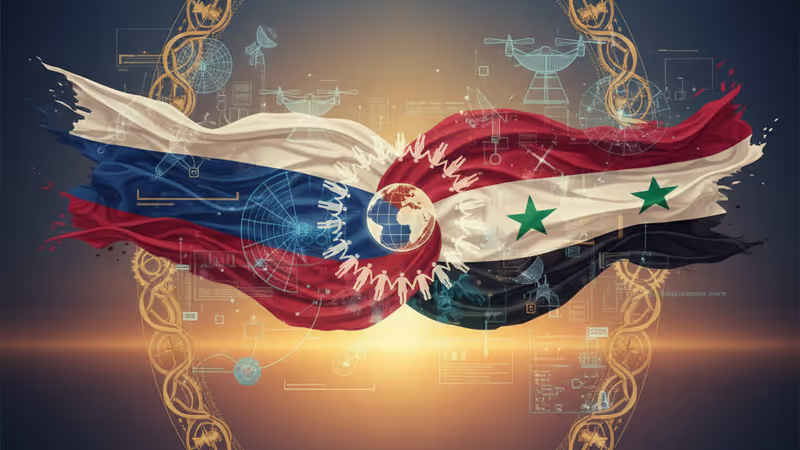
Syria's New Government Deepens Military Ties With Russia in Post-Assad Era
Syria's new foreign and defence ministers met with Vladimir Putin in Moscow to deepen military cooperation, focusing on modernizing the Syrian army in the post-Assad era.
A new chapter for Syria, but its old alliance with Russia is proving more durable than ever. Top Syrian ministers met with President Vladimir Putin in Moscow to expand 'strategic cooperation' in military industries, signaling a significant deepening of ties after the ouster of Bashar al-Assad.
According to Syria’s state-run SANA news agency, the meeting on Tuesday, December 23rd, with Foreign Minister Asaad Hassan Al-Shaibani and Defence Minister Murhaf Abu Qasra had a “particular emphasis” on defence, alongside other political and economic issues.
Modernizing the Syrian Army
The discussions reportedly covered a wide range of defence matters, including strengthening the Syrian army’s capabilities, modernising its equipment, transferring expertise, and cooperating on research and development. SANA reported that both sides reviewed ways “to advance military and technical partnership in a manner that strengthens the defensive capabilities of the Syrian Arab Army.”
During the meeting, Putin reaffirmed Russia’s “steadfast support” for Syria and its territorial integrity. He also renewed Moscow’s condemnation of repeated Israeli violations of Syrian territory, describing them as a “direct threat to regional security,” according to the agency.
Russia's Strategic Calculus in a New Syria
This visit is the latest move by Syria’s new authorities to solidify relations since the removal of longtime ruler Bashar al-Assad last December. Russia, a key backer of the Assad regime, is eager to build strong relations with the new government in Damascus.
A primary goal for Moscow is securing continued access to its critical military installations: the Khmeimim airbase and the Tartous naval base. In October, Syria’s new president, Ahmed al-Sharaa, reassured Russia by pledging to honor all past deals, effectively securing the future of the two bases.
This content is AI-generated based on source articles. While we strive for accuracy, errors may occur. We recommend verifying with the original source.
Related Articles

The British Empire is gone, but its legacy continues to shape 21st-century geopolitics and culture. An analysis of what 'Rule the Waves' means today.

Mali, Burkina Faso, and Niger have formed a 5,000-strong joint military force to combat armed groups. This analysis explores whether their deepening alliance with Russia can solve the region's security crisis.
Iran rejects IAEA inspections of its nuclear facilities bombed by the U.S. in June, demanding the UN watchdog first define "post-war conditions." The move escalates tensions as the legal status of the JCPOA is also contested at the UN.

A second deadly explosion in Moscow in less than a week has killed three people, including two police officers. The blast follows a car bombing that killed a senior general, heightening security fears in the Russian capital.
The British Empire is gone, but its legacy continues to shape 21st-century geopolitics and culture. An analysis of what 'Rule the Waves' means today.
Mali, Burkina Faso, and Niger have formed a 5,000-strong joint military force to combat armed groups. This analysis explores whether their deepening alliance with Russia can solve the region's security crisis.
Iran rejects IAEA inspections of its nuclear facilities bombed by the U.S. in June, demanding the UN watchdog first define "post-war conditions." The move escalates tensions as the legal status of the JCPOA is also contested at the UN.
A second deadly explosion in Moscow in less than a week has killed three people, including two police officers. The blast follows a car bombing that killed a senior general, heightening security fears in the Russian capital.