

Supreme Court FCC Regulatory Authority: A Landmark Battle Over Corporate Fines
The US Supreme Court reviews the FCC's authority to fine companies like AT&T and Verizon. This landmark case could reshape regulatory enforcement for all federal agencies.
The authority of the administrative state is under fire. The US Supreme Court agreed to hear a case that could strip the Federal Communications Commission (FCC) of its power to issue fines against regulated companies. This legal showdown follows a massive controversy where AT&T, Verizon, and T-Mobile were penalized for selling customer location data without consent.
Supreme Court FCC Regulatory Authority Under the Spotlight
According to Reuters, the justices will resolve a circuit split that has left the telecom industry in limbo. AT&T successfully convinced the 5th Circuit Court of Appeals to overturn its fine, while Verizon and T-Mobile lost their respective battles in the 2nd Circuit and the DC Circuit. Now, the Supreme Court has consolidated these petitions into a single high-stakes review.

It's not just about the money; it's about who gets to hold the gavel. The FCC and the Justice Department are fighting to preserve the commission's enforcement powers, arguing that administrative fines are essential for consumer protection. Meanwhile, the carriers contend that such punitive authority belongs to the judiciary, not an unelected federal agency.
Authors
Related Articles

Microsoft Copilot bug exposed customers' confidential emails to AI processing for weeks, bypassing data protection policies. Privacy implications explored.
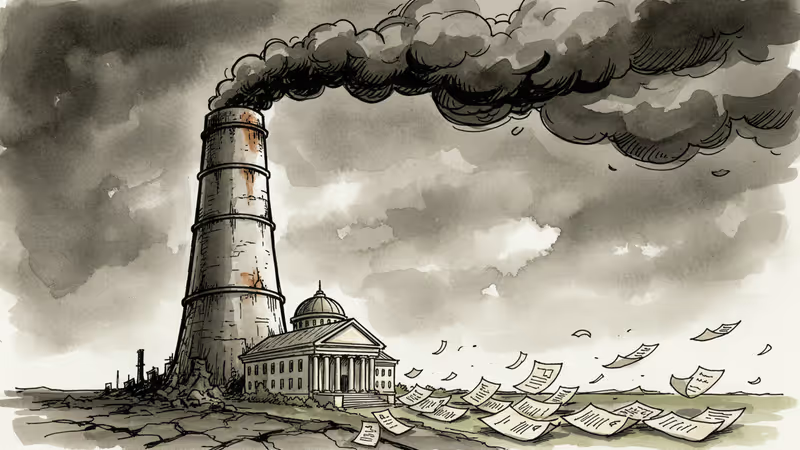
EPA enforcement cases drop 76% in Trump's second term first year, falling far below even his first presidency. What this means for corporate accountability and environmental protection.
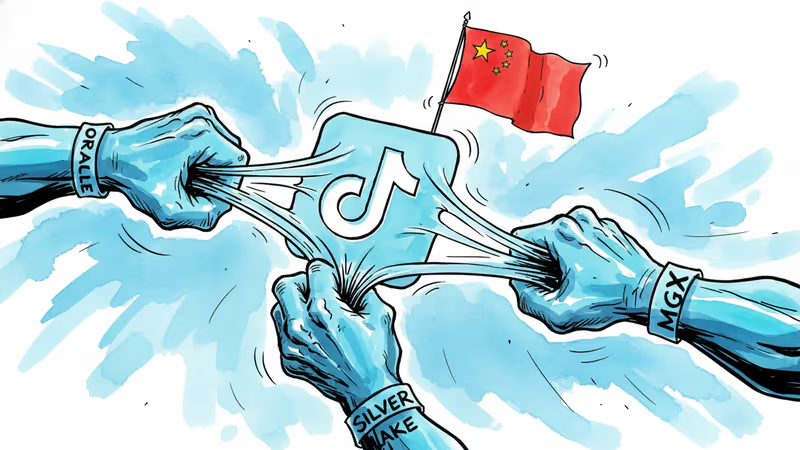
ByteDance sells 80% of TikTok US to Oracle, Silver Lake, and MGX in a complex deal that raises questions about true independence from Chinese influence. Here's what the new ownership structure really means.
TikTok's updated 2026 privacy policy has triggered widespread alarm over the collection of sensitive data like immigration status. Explore the legal reasons behind it.
Microsoft Copilot bug exposed customers' confidential emails to AI processing for weeks, bypassing data protection policies. Privacy implications explored.
EPA enforcement cases drop 76% in Trump's second term first year, falling far below even his first presidency. What this means for corporate accountability and environmental protection.
ByteDance sells 80% of TikTok US to Oracle, Silver Lake, and MGX in a complex deal that raises questions about true independence from Chinese influence. Here's what the new ownership structure really means.
TikTok's updated 2026 privacy policy has triggered widespread alarm over the collection of sensitive data like immigration status. Explore the legal reasons behind it.
Thoughts
Share your thoughts on this article
Sign in to join the conversation