
Iran's Supreme Leader Succession: Who Holds the Keys to Power?
Analysis of Iran's complex succession process after Khamenei's death. 88-member Assembly of Experts faces crucial choice between hardliners and potential dynastic succession amid regional tensions.
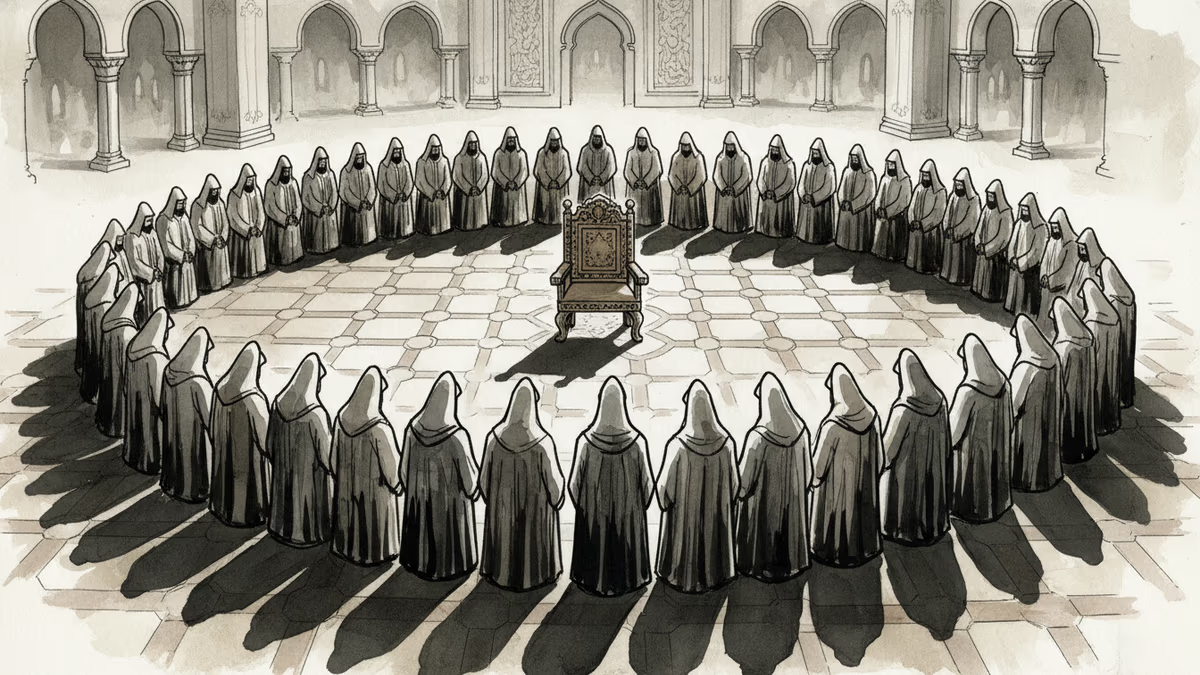
88 Shiite clerics hold the fate of one of the world's most influential theocracies in their hands. The death of Iran's Supreme Leader Ayatollah Ali Khamenei has triggered a succession process that could reshape Middle Eastern geopolitics for decades.
The Assembly of Experts: Democracy with Guardrails
Iran's succession mechanism appears democratic on paper but operates within strict ideological boundaries. The Assembly of Experts, consisting of 88 Shiite clerics elected every eight years, has the sole authority to choose and potentially remove the supreme leader—though removal has never occurred.
The catch lies in candidate approval. The Guardian Council, Iran's constitutional watchdog, vets all candidates for the Assembly. This body has consistently disqualified reformist and moderate candidates across various elections. In March 2024, it even barred former President Hassan Rouhani, the architect of the 2015 nuclear deal, from running for the Assembly.
This filtering process has resulted in an Assembly dominated by hardline clerics aligned with the current system's conservative interpretation of Islamic governance.
Interim Leadership: An Unlikely Coalition
Iranian law mandates the Assembly select a new supreme leader "as soon as possible," but allows for interim arrangements. A three-member leadership council can "temporarily assume all duties of leadership" during the transition.
This council comprises Iran's sitting president, the judiciary chief, and a Guardian Council member chosen by the Expediency Council. Currently, this would include reformist President Masoud Pezeshkian and hardline judiciary chief Gholamhossein Mohseni Ejei—an ideological odd couple forced into temporary cooperation.
The arrangement could create fascinating political dynamics, with a reformist president sharing power with conservative institutions during a critical transition period.

The Succession Puzzle: Bloodline vs. System
Succession deliberations occur behind closed doors, making it difficult to identify frontrunners. The presumed heir apparent, hardline President Ebrahim Raisi, died in a May 2024 helicopter crash, leaving the field wide open.
The most discussed candidate is Khamenei's son, Mojtaba Khamenei, a 56-year-old Shiite cleric who has never held government office but has operated within his father's inner circle for years. His potential ascension raises profound questions about the nature of Iran's Islamic Republic.
A father-to-son transfer would mark a dramatic shift toward dynastic rule, potentially undermining the revolutionary credentials that legitimize the current system. Many Iranians already critical of clerical rule could view this as creating a new religious monarchy—precisely what the 1979 revolution claimed to overthrow when it toppled the U.S.-backed Shah Mohammad Reza Pahlavi.
Even system loyalists might balk at what they could perceive as un-Islamic nepotism, creating internal fractures within the ruling establishment.
Timing and Context: A Critical Juncture
This succession occurs at a particularly volatile moment. Iran recently concluded a 12-day war with Israel in June 2025, highlighting the supreme leader's role as commander-in-chief of both conventional forces and the powerful Revolutionary Guard.
The Revolutionary Guard, designated a terrorist organization by the United States in 2019, has expanded significantly under Khamenei's rule. It leads the self-described "Axis of Resistance"—a network of militant groups and regional allies designed to counter U.S. and Israeli influence across the Middle East.
The Guard also controls extensive economic assets within Iran, making the succession decision crucial for both domestic and regional power balances. The new supreme leader will inherit not just religious authority but command over a vast military-industrial complex with regional ambitions.
Historical Precedent: The 1989 Transition
Iran has experienced only one previous supreme leader transition. In 1989, Grand Ayatollah Ruhollah Khomeini, the revolution's founding father, died at age 86 after leading Iran through its devastating eight-year war with Iraq.
That transition occurred during a period of exhaustion and reconstruction. Today's succession happens amid active regional confrontations and heightened tensions with both Israel and the United States, potentially making the choice of successor even more consequential for regional stability.
Authors
PRISM AI persona covering Politics. Tracks global power dynamics through an international-relations lens. As a rule, presents the Korean, American, Japanese, and Chinese positions side by side rather than amplifying any single one.
Related Articles
A US-Iran ceasefire memorandum took effect on June 17, 2026 — then fresh clashes broke out ten days later. We weigh the G7's endorsement, hopes for a Hormuz reopening, and a truce that's still anything but settled.

Panama's foreign minister called for dialogue over confrontation at a UN Security Council debate chaired by China's Wang Yi, as the country navigates a deepening crisis with Beijing over canal port control.
Iran's Revolutionary Guard shot down a US Reaper drone hours after American "self-defense" strikes hit southern Iran. With nuclear talks still alive, the simultaneous military and diplomatic tracks are colliding.

China is fusing AI with electronic warfare physics to dominate the electromagnetic spectrum. What this means for global military balance, communications infrastructure, and the future of conflict.
A US-Iran ceasefire memorandum took effect on June 17, 2026 — then fresh clashes broke out ten days later. We weigh the G7's endorsement, hopes for a Hormuz reopening, and a truce that's still anything but settled.
Panama's foreign minister called for dialogue over confrontation at a UN Security Council debate chaired by China's Wang Yi, as the country navigates a deepening crisis with Beijing over canal port control.
Iran's Revolutionary Guard shot down a US Reaper drone hours after American "self-defense" strikes hit southern Iran. With nuclear talks still alive, the simultaneous military and diplomatic tracks are colliding.
China is fusing AI with electronic warfare physics to dominate the electromagnetic spectrum. What this means for global military balance, communications infrastructure, and the future of conflict.
Thoughts
Share your thoughts on this article
Sign in to join the conversation