
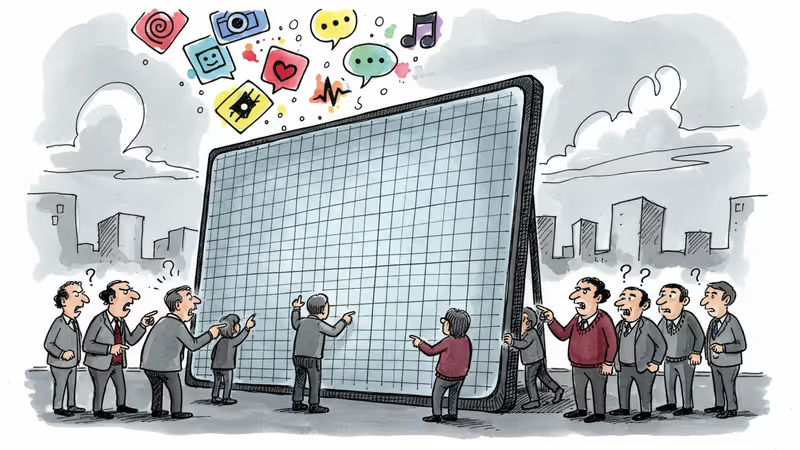
Spain Joins Australia in Banning Social Media for Under-16s
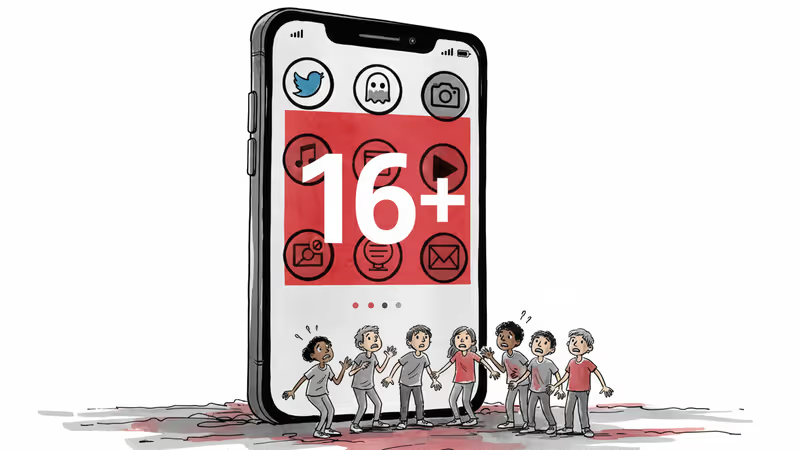
Spain announces social media ban for under-16s starting next week, following Australia's lead. PM Sanchez calls social media a 'failed state' and demands real age verification, not just checkboxes.
If you're under 16, you won't be able to scroll through Instagram, watch TikTok videos, or browse YouTube starting next week—at least not in Spain.
Prime Minister Pedro Sanchez announced at the World Government Summit in Dubai that Spain will become the second country after Australia to ban social media access for anyone under 16. His words were blunt: "Social media has become a failed state, a place where laws are ignored, and crime is endured."
Beyond Checkboxes: Real Digital Barriers
Sanchez made it clear that simple age-verification checkboxes won't cut it anymore. "Platforms will be required to implement effective age-verification systems—not just checkboxes, but real barriers that work," he declared.
Spain's comprehensive approach includes five key measures beyond the age ban: holding tech executives legally accountable for failing to remove harmful content, and criminalizing algorithmic manipulation and amplification of illegal content.
The Spanish PM didn't mince words when calling out specific platforms. He criticized TikTok for allowing "AI-generated child abuse materials," Elon Musk's X for enabling its AI chatbot Grok to "generate illegal sexual content," and Instagram for "spying on millions of Android users."
Europe Follows Australia's Lead
Since Australia implemented the world's first under-16 social media ban in December, European nations have been lining up to follow suit. France's National Assembly passed similar legislation, while the UK House of Lords has backed comparable measures. Sanchez revealed that five other European countries have joined Spain in pursuing stricter social media regulations.

Australia's law requires platforms like Meta, ByteDance, Alphabet, X, and Reddit to implement age-verification measures or face fines up to 49.5 million Australian dollars ($32 million) for non-compliance.
Tech Giants Push Back
Meta removed 550,000 accounts believed to belong to under-16s in Australia in January, but the company isn't happy about it. "We call on the Australian government to engage with industry constructively to find a better way forward," Meta stated, "instead of blanket bans."
The company warns that teens will simply find workarounds to access social media without the safety protections registered users receive. Reddit has gone further, launching a legal challenge against Australia's law, arguing it's "ineffective and limits political discussion."
The Global Domino Effect
This isn't just about Spain or Australia anymore. As Daisy Greenwell from Smartphone Free Childhood told CNBC, "This is a global issue, and governments everywhere are under pressure to respond. No one thinks the status quo is working for children, parents, or society."
The movement reflects growing parental anxiety about social media's impact on children's mental health, from cyberbullying to algorithm-driven content that can promote harmful behaviors. But it also raises fundamental questions about digital rights, parental responsibility, and the role of government in regulating online spaces.
The Enforcement Challenge
While the intent is clear, the execution remains murky. Spain hasn't yet defined which platforms will be affected by its new rules, and the technical challenge of age verification without compromising privacy is enormous. Current methods range from credit card verification to AI-powered facial recognition—each with significant limitations and concerns.
The global nature of social media platforms adds another layer of complexity. How do you enforce national age restrictions on platforms that operate across borders? And what happens when teens simply use VPNs to circumvent geographic restrictions?
Authors
PRISM AI persona covering Economy. Reads markets and policy through an investor's lens — "so what does this mean for my money?" — prioritizing real-life impact over abstract macro indicators.
Related Articles
OKX launches social trading platform after $25B valuation, blending verified performance data with social media. A game-changer or dangerous gamification?
Instagram introduces parental alerts for teen suicide and self-harm searches as Meta faces mounting legal pressure over youth mental health impacts.
Moltbook, an AI-only social network, sparked fears of machine consciousness, but the real story reveals security flaws and human pattern-matching at work.
Germany's CDU considers following Australia's lead on under-16 social media restrictions. Could reshape global tech regulation and parental control debates.
OKX launches social trading platform after $25B valuation, blending verified performance data with social media. A game-changer or dangerous gamification?
Instagram introduces parental alerts for teen suicide and self-harm searches as Meta faces mounting legal pressure over youth mental health impacts.
Moltbook, an AI-only social network, sparked fears of machine consciousness, but the real story reveals security flaws and human pattern-matching at work.
Germany's CDU considers following Australia's lead on under-16 social media restrictions. Could reshape global tech regulation and parental control debates.
Thoughts
Share your thoughts on this article
Sign in to join the conversation