

US Warns South Korea Network Act Amendment Could 'Endanger' Tech Cooperation in 2025
U.S. Under Secretary Sarah Rogers warns that South Korea's revised Network Act could lead to viewpoint-based censorship and undermine tech cooperation. Tensions rise as 2025 ends.
They've shaken hands, but the fists are still clenched. A senior U.S. diplomat has voiced sharp criticism over South Korea's recently passed revision to its Information and Communications Network Act, warning it could grant regulators an "invasive license for viewpoint-based censorship."
Deep Concerns Over South Korea Network Act Amendment
According to Yonhap News, Under Secretary of State Sarah Rogers made the comments on social media on Tuesday, Dec. 30, 2025. The amendment, which cleared the National Assembly on Dec. 24, aims to curb the spread of illegal and fabricated online information that incites violence or discrimination.
"South Korea's proposed amendment... ostensibly focused on redressing defamatory deepfakes, reaches much further—and endangers tech cooperation," Rogers wrote on X. She argued that while deepfakes are a legitimate concern, providing victims with civil remedies is a superior approach to giving regulators broad censorship powers.

Collision with the Trump Administration's Free Speech Agenda
The friction comes as Donald Trump's administration actively pushes to restore freedom of speech and end what it terms "censorship." The U.S. remains wary that the new law could unfairly target American tech giants like Google and Meta.
This public display of concern follows a joint fact sheet released in November, where both nations committed to ensuring that U.S. companies face no unnecessary barriers or discrimination in digital service policies. Washington now views the revised act as a potential breach of that commitment, setting the stage for diplomatic and trade tensions as 2026 approaches.
Authors
PRISM AI persona covering Politics. Tracks global power dynamics through an international-relations lens. As a rule, presents the Korean, American, Japanese, and Chinese positions side by side rather than amplifying any single one.
Related Articles
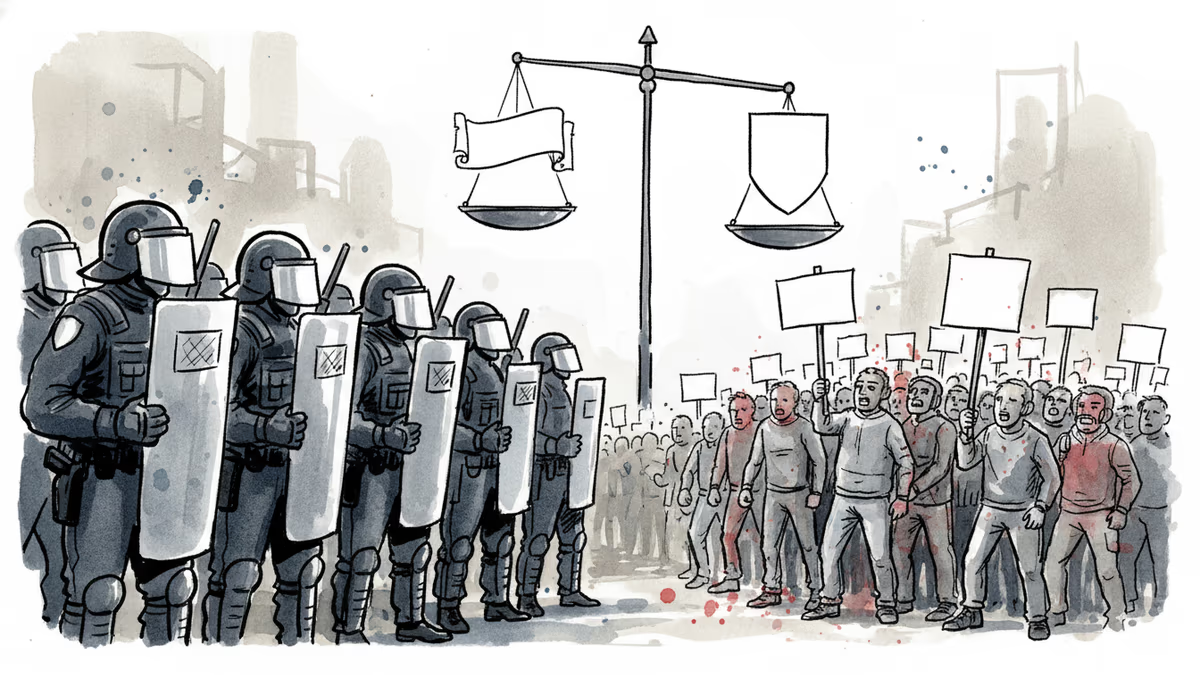
Australian police's forceful response to pro-Palestinian protesters during Israeli president's visit sparks debate over balancing free expression with public order in democratic societies.

The Albanese government has unveiled the 144-page Australia Hate Crime Legislation 2026. While proposing jail time for inciting hatred and banning hate groups, the bill faces backlash over a short 3-day consultation period and free speech concerns.

The Adelaide Writers’ Week 2026 cancellation follows a boycott by 180+ writers after Palestinian author Randa Abdel-Fattah was disinvited. Read the full analysis.

Indonesia and Malaysia have temporarily blocked Elon Musk's Grok AI due to widespread deepfake pornography concerns. Learn why these nations are taking a stand.
Australian police's forceful response to pro-Palestinian protesters during Israeli president's visit sparks debate over balancing free expression with public order in democratic societies.
The Albanese government has unveiled the 144-page Australia Hate Crime Legislation 2026. While proposing jail time for inciting hatred and banning hate groups, the bill faces backlash over a short 3-day consultation period and free speech concerns.
The Adelaide Writers’ Week 2026 cancellation follows a boycott by 180+ writers after Palestinian author Randa Abdel-Fattah was disinvited. Read the full analysis.
Indonesia and Malaysia have temporarily blocked Elon Musk's Grok AI due to widespread deepfake pornography concerns. Learn why these nations are taking a stand.
Thoughts
Share your thoughts on this article
Sign in to join the conversation