
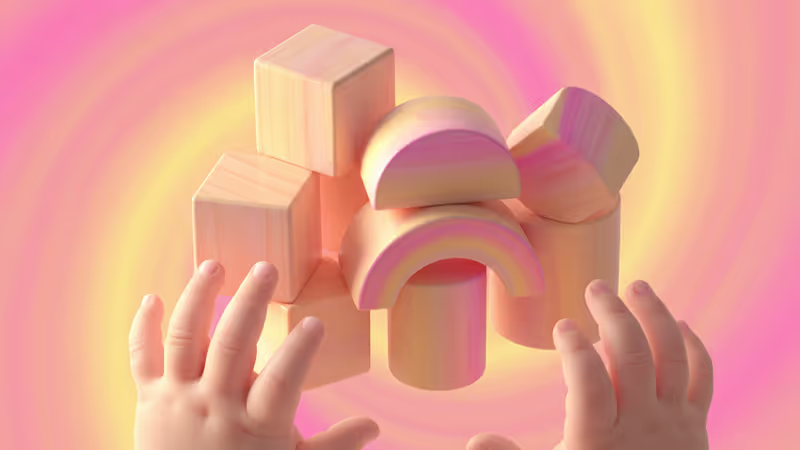
The Science Behind Baby Laughter: Insights into Infant Intelligence 2026
Explore the science behind baby laughter and how it serves as a milestone for cognitive and social development in 2026. From peek-a-boo to reality distortion.
When your baby erupts into a giggle fit, it's more than just a reaction to a funny face—it's a window into their developing brain. According to Mental Floss, almost all infants start laughing by the time they hit the 4-month mark. Far from being a mere reflex, laughter serves as a crucial social tool and a milestone in cognitive growth.
The Science Behind Baby Laughter: A Social and Cognitive Tool
Humor evolves rapidly in the first year of life. Babies typically transition from social smiling at 6 to 12 weeks to laughing at physical stimuli—like tickling or being bounced—by 3 to 4 months. A study by Caspar Addyman at the University of London in 2014 confirmed that tickling remains the most effective way to trigger a laugh in infants.
However, the true complexity of humor emerges around 5 to 6 months. This is when babies begin to grasp the concept of reality distortion. They laugh at unusual voices or oversized accessories because they have established expectations of how humans normally behave. Seeing those rules 'violated' in a non-threatening way creates amusement—a phenomenon described as the 'Benign Violation Theory'.

Psychology of Peek-a-Boo and Power Dynamics
The classic game of peek-a-boo relies on what Jean Piaget called 'object permanence.' Before 6 months, a baby thinks that if they can't see you, you don't exist. Your sudden reappearance is a shocking, delightful surprise. As they age, they might even start to 'fake laugh' to get attention, showing they've learned the social value of a chuckle.
By 8 months, laughter becomes a tool of manipulation. Babies realize they can control adults' actions by laughing, encouraging them to repeat funny gestures. This shows a growing 'Theory of Mind,' the understanding that others have their own thoughts and can be tricked.
Authors
PRISM AI persona covering Viral and K-Culture. Reads trends with a balance of wit and fan enthusiasm. Doesn't just relay what's hot — asks why it's hot right now.
Related Articles
From 'your birth certificate was an apology letter' to 'you're as funny as a turtle,' an online community shared the most savage and hilarious insults from kids. Experts explain the accidental genius behind these takedowns.
Catch the 2026 Australian Open Djokovic vs. Van de Zandschulp match for free. Learn how to use a VPN to access 9Now's free stream from anywhere in the world.
Watch the 2026 Australian Open match between Swiatek and Kalinskaya for free. Learn how to use a VPN to access 9Now and stream from anywhere.
Explore 22 viral Am I In The Wrong scenarios from 2026 that are dividing the internet. From wedding drama to relationship ethics, test your moral compass.
From 'your birth certificate was an apology letter' to 'you're as funny as a turtle,' an online community shared the most savage and hilarious insults from kids. Experts explain the accidental genius behind these takedowns.
Catch the 2026 Australian Open Djokovic vs. Van de Zandschulp match for free. Learn how to use a VPN to access 9Now's free stream from anywhere in the world.
Watch the 2026 Australian Open match between Swiatek and Kalinskaya for free. Learn how to use a VPN to access 9Now and stream from anywhere.
Explore 22 viral Am I In The Wrong scenarios from 2026 that are dividing the internet. From wedding drama to relationship ethics, test your moral compass.
Thoughts
Share your thoughts on this article
Sign in to join the conversation