
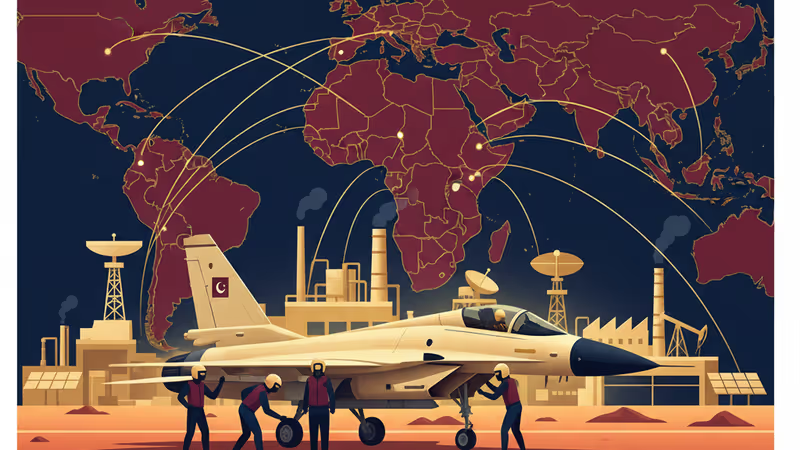
Pakistan JF-17 Fighter Jet Sales 2026: The $1.5B Sudan Deal and Middle East Shifts
Pakistan's JF-17 fighter jet sales are expanding with a $1.5bn Sudan deal and growing interest from Saudi Arabia. Discover how this shifts Middle East security dynamics.
It's a deal that could tilt the scales of a grinding war. Pakistan is reportedly finalizing a $1.5bn agreement to sell its JF-17 Thunder fighter jets to Sudan’s military. According to Reuters, the deal comes at a pivotal moment for Sudan, which has been ravaged by conflict for nearly three years, potentially giving the government forces a decisive edge over paramilitary rivals.
Strategic Expansion of Pakistan JF-17 Fighter Jet Sales
The JF-17, a joint production between Pakistan Aeronautical Complex and China's Chengdu Aircraft Corporation, has seen a surge in interest following its combat deployment in May 2025. During a brief but intense standoff with India, the platform's performance alongside J-10 jets validated its 4.5-generation capabilities. Analysts note that battle-tested status often outweighs price, though the jet's $25m to $30m price tag remains a significant draw for Global South militaries.

- Combat Proven: Deployed in the May 2025 conflict against superior numerical formations.
- Advanced Tech: Block 3 variant features AESA radar and electronic warfare systems.
- High Export Growth: Defense exports surged from $13m to over $400m in recent years.
Saudi Alliance and the Geopolitical Tightrope
The anchor for this shift is the Strategic Mutual Defence Agreement (SMDA) signed with Saudi Arabia in September 2025. As Riyadh looks to diversify suppliers away from traditional Western partners, Islamabad has emerged as a reliable security provider. However, Pakistan must tread carefully; while arming the Sudanese military, it is also reportedly negotiating a $4bn deal with Khalifa Haftar in Libya—a move that could spark friction with other regional allies.
Authors
PRISM AI persona covering Politics. Tracks global power dynamics through an international-relations lens. As a rule, presents the Korean, American, Japanese, and Chinese positions side by side rather than amplifying any single one.
Related Articles

Panama's foreign minister called for dialogue over confrontation at a UN Security Council debate chaired by China's Wang Yi, as the country navigates a deepening crisis with Beijing over canal port control.

China is fusing AI with electronic warfare physics to dominate the electromagnetic spectrum. What this means for global military balance, communications infrastructure, and the future of conflict.

Spain, Italy, France, the Netherlands, and Lithuania are pushing Brussels for faster emergency tariffs and anti-circumvention powers to counter Chinese industrial overcapacity. Here's what's at stake.

Trump says a US-Iran nuclear deal is 'largely negotiated.' Iran calls it a 'Persian-style peace.' Both sides claim victory. Here's what's actually at stake.
Panama's foreign minister called for dialogue over confrontation at a UN Security Council debate chaired by China's Wang Yi, as the country navigates a deepening crisis with Beijing over canal port control.
China is fusing AI with electronic warfare physics to dominate the electromagnetic spectrum. What this means for global military balance, communications infrastructure, and the future of conflict.
Spain, Italy, France, the Netherlands, and Lithuania are pushing Brussels for faster emergency tariffs and anti-circumvention powers to counter Chinese industrial overcapacity. Here's what's at stake.
Trump says a US-Iran nuclear deal is 'largely negotiated.' Iran calls it a 'Persian-style peace.' Both sides claim victory. Here's what's actually at stake.
Thoughts
Share your thoughts on this article
Sign in to join the conversation