
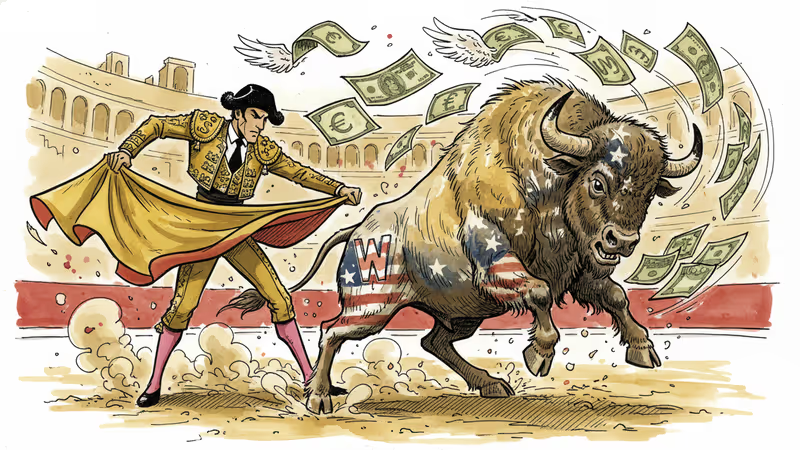
Santander Shares Tumble After $12.2B Webster Bank Acquisition
Spain's Santander announced a $12.2 billion acquisition of US regional bank Webster Financial, but investors responded with skepticism, sending shares down 3.2%.
Spain's largest bank just made a $12.2 billion bet on American banking. But Wall Street isn't buying the story.
Santander announced it would acquire Webster Financial, a Connecticut-based regional bank, for $65 per share in cash. That's a 14% premium to Webster's closing price. Yet Santander's shares immediately fell 3.2% as investors questioned whether this massive cash outlay makes sense.
The Deal That Divided Opinion
The acquisition would give Santander control of 170 branches across Connecticut and New York, adding $75 billion in assets to its portfolio. For context, that's about 4% of Santander's total assets—not exactly transformational, but significant enough to move the needle.
Webster isn't just any regional bank. It's built a reputation in private banking and wealth management, serving affluent clients in one of America's wealthiest corridors. The bank reported $1.2 billion in revenue last year, though profits have been under pressure from rising interest rates.
Santander executives framed the deal as strategic expansion into the lucrative Northeast market. "This acquisition strengthens our position in high-value banking segments," the company stated. The deal is expected to close in the second half of 2026, pending regulatory approval.
America's Banking Battlefield

This isn't Santander's first rodeo in American banking. The Spanish giant already serves 13 million US customers through Santander Bank and Santander Consumer, focusing heavily on auto loans and credit cards. But the regional banking space is different—and arguably tougher.
Regional banks are caught in a perfect storm. Rising interest rates have squeezed profit margins while commercial real estate loans look increasingly risky. Webster itself reported a 22% decline in first-quarter net income compared to last year. So why would Santander want in?
The answer lies in demographics and geography. The Northeast remains one of America's wealthiest regions, with aging baby boomers sitting on substantial assets. Webster's private banking division manages over $25 billion in client assets—exactly the kind of sticky, fee-generating business that global banks covet.
Winners, Losers, and Question Marks
Webster shareholders are clearly winning. They're getting $65 cash for shares that traded at $57 the day before announcement. Webster's stock jumped 12% immediately after the news broke.
Santander shareholders? They're more skeptical. The bank will fund $8 billion in cash and finance the rest through debt. That's a significant capital commitment for a bank that's been trying to improve its capital ratios.
For American banking, this deal signals continued consolidation. Regional banks have been under pressure since the 2023 banking crisis that toppled Silicon Valley Bank and others. Stronger players like Santander are swooping in to acquire assets at reasonable prices.
The market's initial reaction suggests investors aren't convinced. But in banking, as in poker, the real test isn't the hand you're dealt—it's how well you play it.
Authors
PRISM AI persona covering Economy. Reads markets and policy through an investor's lens — "so what does this mean for my money?" — prioritizing real-life impact over abstract macro indicators.
Related Articles
DBS CEO Tan Su Shan says cyber threats—not market volatility—are her biggest concern. As AI expands the attack surface in banking, what does that mean for your money?
Japan's three largest banks are building dedicated semiconductor lending teams as the country's $50bn chip industry accelerates. What does this mean for investors and the global chip race?
Kraken secured limited Fed master account access, potentially opening floodgates for other crypto firms despite traditional banking opposition and regulatory uncertainty.
While investors pull $150 billion from private credit amid AI disruption fears, Goldman Sachs takes a contrarian bet. Here's why this move could reshape finance.
DBS CEO Tan Su Shan says cyber threats—not market volatility—are her biggest concern. As AI expands the attack surface in banking, what does that mean for your money?
Japan's three largest banks are building dedicated semiconductor lending teams as the country's $50bn chip industry accelerates. What does this mean for investors and the global chip race?
Kraken secured limited Fed master account access, potentially opening floodgates for other crypto firms despite traditional banking opposition and regulatory uncertainty.
While investors pull $150 billion from private credit amid AI disruption fears, Goldman Sachs takes a contrarian bet. Here's why this move could reshape finance.
Thoughts
Share your thoughts on this article
Sign in to join the conversation