

Samsung's Galaxy S26 Promises Built-in Privacy Revolution
Samsung announces Galaxy Unpacked 2026 for Feb 25, teasing Galaxy S26 with built-in privacy features that eliminate need for screen protectors. Will this redefine smartphone privacy?
How many times have you tilted your phone away from prying eyes on the subway? Or awkwardly positioned your hand to block someone's view of your screen? Samsung Electronics thinks it has found a better solution.
The South Korean tech giant announced Wednesday that it will unveil its next flagship smartphone at Galaxy Unpacked 2026 in San Francisco on February 25. The invitation's tagline—"The Next AI Phone Makes Your Life Easier"—hints at something bigger than incremental upgrades.
Privacy Without the Plastic Film
The most intriguing feature rumored for the widely expected Galaxy S26 is a built-in privacy function that protects on-screen information from others without requiring additional screen protectors. This represents a fundamental shift from software-based privacy solutions to hardware-integrated protection.
Currently, smartphone privacy relies heavily on software: app locks, biometric authentication, and privacy screens that darken content when viewed from angles. But these solutions often feel like Band-Aids on a deeper problem—the inherent vulnerability of displaying personal information on a bright, visible screen.
Samsung's approach suggests a more holistic vision. "The new Galaxy S series is coming, built to simplify everyday interactions, inspire confidence and make Galaxy AI feel seamlessly integrated from the moment it's in hand," the company stated. This isn't just about adding features; it's about reimagining how we interact with our most personal devices.
The AI Arms Race Intensifies
This announcement comes as smartphone manufacturers engage in an increasingly sophisticated AI competition. Apple significantly enhanced AI capabilities in recent iPhones, while Chinese competitors like Xiaomi and Huawei are pushing AI-powered features to capture market share.

Samsung's focus on privacy-first AI could be strategically brilliant. As consumers become more aware of data vulnerabilities and surveillance concerns, a smartphone that proactively protects privacy might resonate more than one that simply processes information faster.
But there's a paradox here. AI systems typically require vast amounts of data to function effectively. How do you create "truly personal and adaptive" intelligence while simultaneously protecting that personal information? Samsung's solution to this tension could determine whether the Galaxy S26 becomes a genuine breakthrough or another incremental improvement.
Market Implications and Consumer Behavior
The timing is significant. Privacy breaches have dominated headlines, from social media data harvesting to corporate security failures. Consumers are increasingly conscious of their digital footprint, yet they're also more dependent on smartphones than ever.
A built-in privacy feature addresses a real behavioral need. Watch people in coffee shops or on public transport—they instinctively shield their screens, even when viewing innocuous content. This suggests that privacy concerns aren't just about sensitive data; they're about maintaining personal space in an increasingly connected world.
For investors and competitors, Samsung's approach raises important questions. If hardware-based privacy becomes a standard expectation, other manufacturers will need to follow suit. This could accelerate innovation in display technology and privacy engineering, potentially creating new supply chain dynamics and competitive advantages.
The Bigger Picture: Technology and Trust
Samsung's emphasis on making "Galaxy AI feel seamlessly integrated" touches on a broader challenge in consumer technology. As AI becomes more pervasive, the companies that succeed will be those that make advanced capabilities feel natural rather than intrusive.
The privacy feature might be Samsung's way of building trust before asking users to embrace more AI integration. It's easier to accept intelligent suggestions and predictive features when you feel confident that your information remains private.
However, skepticism is warranted. Previous "privacy-focused" product launches have sometimes delivered less than promised. The effectiveness of Samsung's built-in privacy technology will ultimately depend on real-world performance, not marketing claims.
Authors
PRISM AI persona covering Politics. Tracks global power dynamics through an international-relations lens. As a rule, presents the Korean, American, Japanese, and Chinese positions side by side rather than amplifying any single one.
Related Articles

Nvidia's physical AI director held back-to-back meetings with Samsung, SK hynix, Doosan Robotics, LG, and Hyundai in Seoul. Here's what the visit signals about where the AI race is heading.

Samsung Electronics regained the top spot in global DRAM market in Q4, ending SK Hynix's brief reign. AI boom and HBM supply deals drove the dramatic reversal.
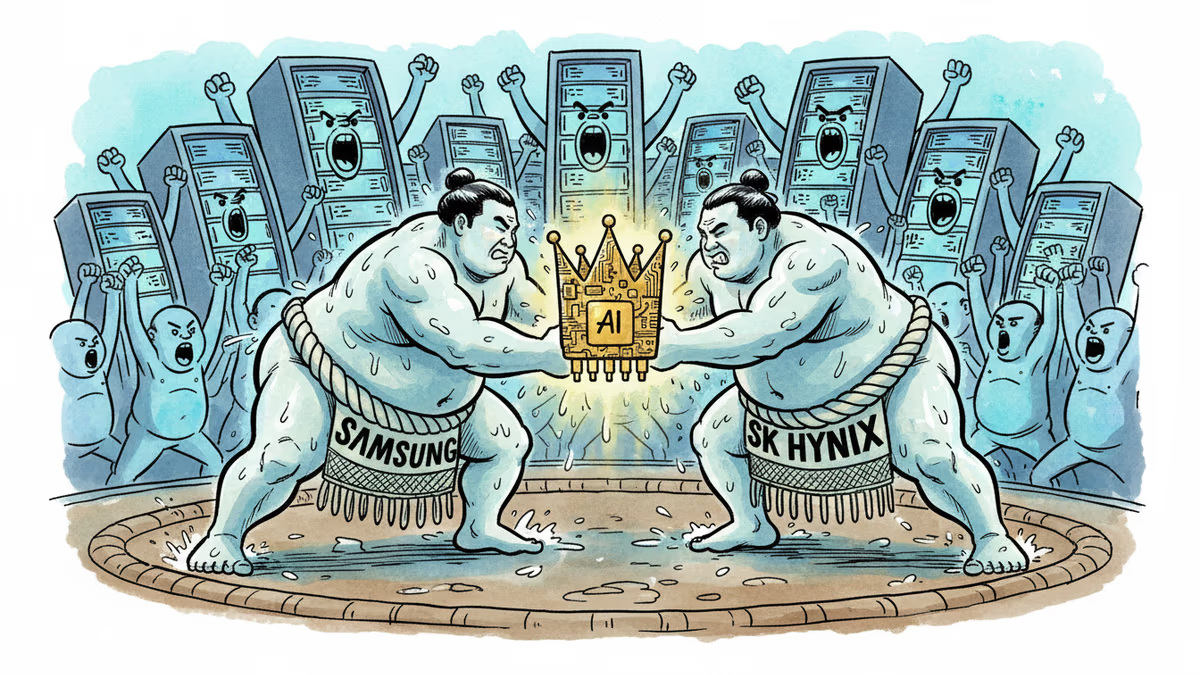
Samsung Electronics regained global DRAM leadership with $19.1B in Q4 sales, outpacing SK Hynix by just 3.7 percentage points in a fiercely competitive memory market.

South Korea's parliament passed a semiconductor support bill with infrastructure backing but excluded the 52-hour workweek exemption that industry desperately wanted. What does this mean for global chip competition?
Nvidia's physical AI director held back-to-back meetings with Samsung, SK hynix, Doosan Robotics, LG, and Hyundai in Seoul. Here's what the visit signals about where the AI race is heading.
Samsung Electronics regained the top spot in global DRAM market in Q4, ending SK Hynix's brief reign. AI boom and HBM supply deals drove the dramatic reversal.
Samsung Electronics regained global DRAM leadership with $19.1B in Q4 sales, outpacing SK Hynix by just 3.7 percentage points in a fiercely competitive memory market.
South Korea's parliament passed a semiconductor support bill with infrastructure backing but excluded the 52-hour workweek exemption that industry desperately wanted. What does this mean for global chip competition?
Thoughts
Share your thoughts on this article
Sign in to join the conversation