
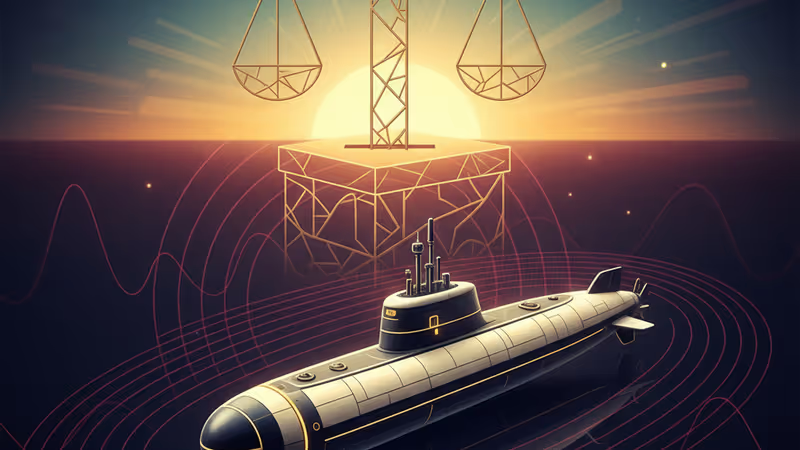
South Korea and US Agree to Pursue Stand-Alone Nuclear-Powered Submarine Pact
South Korea and the U.S. have agreed to pursue a stand-alone pact for nuclear-powered submarine cooperation, with working-level talks slated for early 2026. The plan involves using low-enriched uranium to address non-proliferation concerns.
A new chapter for the US-Korea alliance, or a Pandora's box for nuclear proliferation? South Korea and the United States have agreed to pursue a stand-alone agreement on cooperation for nuclear-powered submarines, a landmark move with working-level talks expected to begin early next year. The announcement signals a significant deepening of the bilateral security partnership.
A Deal Takes Shape
National Security Adviser Wi Sung-lac confirmed the development on December 24, 2025, following a trip to the U.S., Canada, and Japan. According to a Yonhap report, Wi stated he held "practical and in-depth consultations" in Washington with U.S. Secretary of State Marco Rubio and Energy Secretary Chris Wright. "We shared the view that a stand-alone agreement on cooperation over nuclear-powered submarines is necessary, and agreed to move forward with discussions," Wi told reporters.
This agreement builds on security commitments made during the summit between President Lee Jae Myung and U.S. President Donald Trump on the sidelines of the APEC summit in Gyeongju in late October.
Navigating Non-Proliferation Waters
Addressing the sensitive issue of nuclear fuel, Wi reaffirmed Seoul's commitment to nuclear non-proliferation. He stressed that South Korea plans to use low-enriched uranium (LEU) at levels below 20 percent to power the submarines and that highly enriched uranium is not under consideration. Under the current bilateral nuclear accord with the U.S., South Korea is prohibited from enriching its own uranium and must import its supply.
What's Next on the Agenda
The path forward will be paved quickly. A working-level U.S. delegation is expected to visit South Koreaearly in 2026 to begin formal consultations. Key discussion points will likely include the scope of technology transfer, fuel supply arrangements, and the specific terms of the new agreement.
This content is AI-generated based on source articles. While we strive for accuracy, errors may occur. We recommend verifying with the original source.
Related Articles
Former Trump adviser Robert O'Brien calls South Korea's probe into Coupang's 33.7M user data leak an "aggressive targeting," sparking fears of a US-Korea trade dispute.

Experts predict the Russia-Ukraine war could last another 12 to 18 months. The conflict is shifting to a war of attrition, with tactics like "creating fear" becoming more prominent.
Venezuela has accused the U.S. of 'extortion' at the UN Security Council after the seizure of two oil tankers. With a U.S. naval blockade in place, tensions in the Caribbean are reaching a boiling point.

The Trump administration plans to set a quota to denaturalize up to 200 American citizens monthly starting in 2026, sparking fears of legal challenges and a chilling effect on immigrant communities.
Former Trump adviser Robert O'Brien calls South Korea's probe into Coupang's 33.7M user data leak an "aggressive targeting," sparking fears of a US-Korea trade dispute.
Experts predict the Russia-Ukraine war could last another 12 to 18 months. The conflict is shifting to a war of attrition, with tactics like "creating fear" becoming more prominent.
Venezuela has accused the U.S. of 'extortion' at the UN Security Council after the seizure of two oil tankers. With a U.S. naval blockade in place, tensions in the Caribbean are reaching a boiling point.
The Trump administration plans to set a quota to denaturalize up to 200 American citizens monthly starting in 2026, sparking fears of legal challenges and a chilling effect on immigrant communities.