
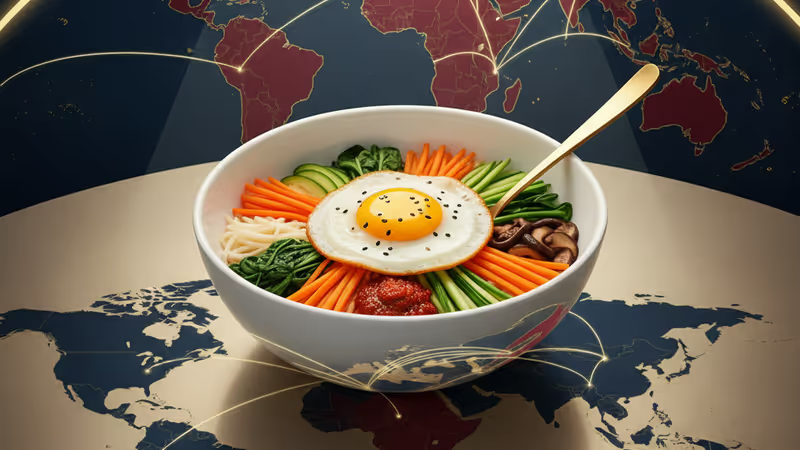
South Korea Sets $21 Billion Annual Food Export Target for 2030, Riding K-Culture Wave
South Korea's government has announced a comprehensive strategy to boost annual food exports to $21 billion by 2030, leveraging the global popularity of K-culture. The plan includes targeted product strategies, educational initiatives, and cultural integration.
Seoul,– Thegovernment announced Tuesday it aims to achieve, capitalizing on the soaring global popularity of Korean culture. The ambitious target was unveiled at a "K-food global vision declaration ceremony" by the Ministry of Agriculture, Food and Rural Affairs, which vowed to develop the sector into a strategic export industry.
The push comes as K-food exports are already on a strong trajectory. According to the ministry, exports from January to November this year reached a record high of. The government now seeks to elevate Korean cuisine to the same level of global recognition as its tech and entertainment industries.
A Multi-Pronged Strategy for Global Palates
To achieve its goal, the ministry outlined five key strategies, including a market-specific approach. It plans to designate strategic items for different regions, such as barbecue sauce for the, high-value health foods for, and Halal-certified beef for the Middle East.
The government also plans to bolster infrastructure and training. A new culinary school focused on Korean cuisine will be established, alongside collaborations with prestigious institutions like the Culinary Institute of America and Le Cordon Bleu to open K-food classes. To support exporters, a one-stop support center will be created to navigate non-tariff trade barriers, and export vouchers for food companies will be doubled next year to.
Weaving Food into Culture and Tourism
A central pillar of the strategy is the integration of food with cultural content and tourism. The ministry said it will create various cultural content centered on Korean cuisine and promote it through international cultural and sports festivals. It also aims to develop tourism programs with a culinary focus, hoping to turn foreign visitors into long-term advocates for K-food.
In a congratulatory message, President stated that "the government will provide firm support to help K-food grow into a strategic export industry," according to the ministry.
This K-food initiative is a clear blueprint for converting cultural influence—soft power—into tangible economic returns. Seoul isn't just selling food; it's building a self-reinforcing ecosystem where K-dramas drive demand for kimchi, and tourism focused on cuisine boosts the nation's brand. If successful, this model could offer a valuable lesson for other nations seeking to monetize their own cultural appeal.
This content is AI-generated based on source articles. While we strive for accuracy, errors may occur. We recommend verifying with the original source.
Related Articles

In a historic first, families of Korean WWII conscripts have filed a lawsuit in a Seoul court against Japan and the Yasukuni Shrine, seeking removal of names and $593,700 in damages over historical grievances.

Former South Korean President Yoon Suk Yeol denies allegations he sent drones into North Korea to create a pretext for martial law, citing a phone call with Donald Trump as part of his defense.

South Korea's ruling party floor leader, Rep. Kim Byung-ki, has apologized after a report revealed he accepted free hotel accommodation from Korean Air while overseeing its merger.

U.S. Forces Korea conducted the first live-fire drill of the new M270A2 MLRS. The 'Steel Rain' exercise highlights alliance modernization and enhanced deterrence capabilities on the Korean Peninsula.