
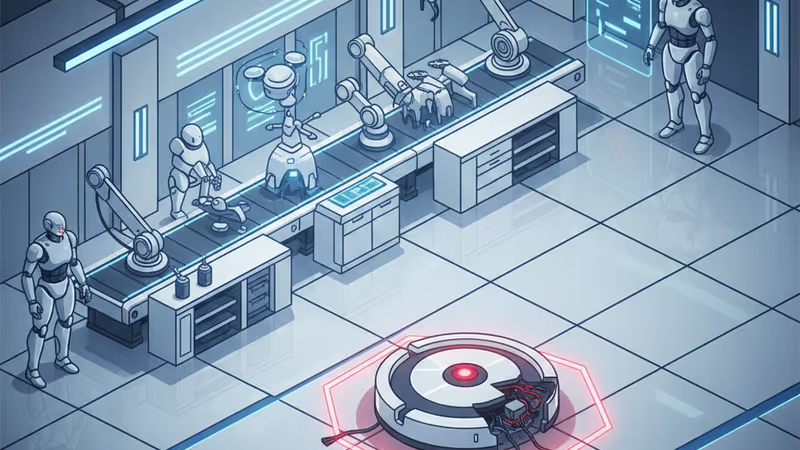
Roomba's Reboot: Why iRobot's Bankruptcy is a Warning for Every Hardware Pioneer
iRobot, the pioneer behind Roomba, has filed for bankruptcy. Our analysis breaks down why the tech icon failed and what its fall means for consumer robotics.
The Lede: A Pioneer Hits Reset
The bankruptcy of iRobot, the company that put a robot in millions of homes, isn't just another corporate failure. It's a critical case study in how a market pioneer can lose its throne not to a superior invention, but to faster, more aggressive competitors and the shifting tectonics of global regulation. For any executive in the hardware space, iRobot's journey from market-maker to bankruptcy court is a stark reminder: first-mover advantage has a dangerously short half-life.
Why It Matters: The End of an Era
iRobot’s restructuring under a new owner, Picea Robotics, sends powerful signals across the tech landscape:
- The Power Shift in Hardware: This marks a symbolic victory for a new wave of consumer electronics giants, primarily from China (like Roborock and Ecovacs), who have outmaneuvered a Western incumbent through rapid innovation cycles and aggressive pricing. The playbook has changed.
- The Big Tech M&A Chill: The collapse of the planned $1.7 billion acquisition by Amazon, due to intense regulatory scrutiny in Europe, was the final catalyst. This demonstrates that even for non-dominant players, relying on a Big Tech exit is now a high-risk strategy. Regulators are looking at data access and market consolidation, not just unit sales.
- The Future of the Smart Home: Roomba wasn't just a vacuum; it was a mapping and data collection device for the home. Amazon wanted that data. iRobot's failure to secure that deal shows the immense strategic value—and regulatory peril—of in-home sensor platforms.
The Analysis: How the Inventor Got Out-Invented
iRobot didn't fail because the Roomba is a bad product. It failed because it became a complacent leader. Originating from MIT's AI Lab and hardened by building military-grade robots, iRobot created the entire consumer robotics category. For years, "Roomba" was synonymous with "robot vacuum."
This dominance bred inertia. While iRobot focused on incremental improvements and its brand, nimbler rivals fundamentally changed the game. Competitors like Roborock integrated advanced LiDAR navigation, sophisticated mopping capabilities, and all-in-one, self-cleaning docking stations years ahead of iRobot's comparable offerings. They delivered more features, better performance, and often, a lower price. iRobot was selling a brand; its competitors were selling a better, more complete solution. The company was caught in a classic innovator's dilemma, protecting its core product while the market sprinted ahead.
PRISM Insight: Don't Mistake Survival for a Turnaround
The acquisition by "Picea Robotics"—likely a special-purpose vehicle for financial investors—signals a shift from innovation to asset management. The new strategy won't be about moonshots or creating the next category-defining product. It will be about financial engineering. Expect a leaner iRobot focused on:
- Brand Licensing: Leveraging the powerful Roomba name on other products.
- Patent Portfolio: Monetizing its vast portfolio of intellectual property through litigation or licensing.
- Streamlined Operations: Cutting R&D and focusing on the most profitable product lines to maximize cash flow for a future sale.
CEO Gary Cohen’s talk of a “new chapter” and “greener territory” is classic turnaround rhetoric. The reality is that iRobot’s future is likely as a brand to be managed, not a technology leader to be followed.
PRISM's Take: A Ghost in the Machine
The story of iRobot is a eulogy for an era of Western hardware dominance. The company that taught us to trust a robot in our living rooms forgot the cardinal rule of technology: you are either disrupting or you are being disrupted. The bankruptcy isn't the end of the Roomba, but it is the end of iRobot as a force of innovation. The new entity will carry the name, but its soul—the relentless, category-creating drive—has been hollowed out by market reality and strategic missteps. It now serves as a powerful warning: legacy is not a strategy, and a powerful brand is no shield against relentless execution.
Related Articles
Flagship phones are losing their edge. Our expert analysis reveals how the mid-range market is becoming the new hub of innovation, delivering premium value for less.

Analysis of the recent iOS update backlash. Discover why user frustration signals a deeper strategic risk to Apple's brand and competitive moat.
Apple's SE, Series 11, and Ultra 3 aren't just choices; they're a calculated strategy to dominate the wearables market. Our expert analysis decodes the gambit.
Roomba pioneered home robotics but now faces an existential crisis. Our analysis breaks down the strategic failures that led to its decline and the hard lessons for the tech industry.