
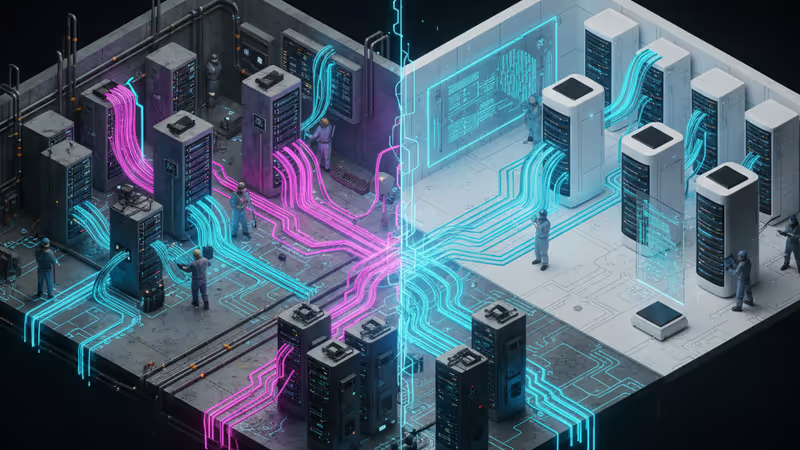
Retrofit or Rebuild: The High-Stakes Gamble Facing the $500B Data Center Industry
The AI boom is fueling a data center construction frenzy. But can we retrofit old facilities? PRISM analyzes the tech, finance, and multi-trillion dollar risks.
The Lede
The AI gold rush has a dirty, physical secret: it's running out of road. While Big Tech announces multi-billion dollar AI initiatives, the physical infrastructure to power them is hitting a wall. The industry is in a construction frenzy, with 377 hyperscale projects announced in just four years. But the source text poses a seductive question: can we simply upgrade what we already have? The answer will create a new class of winners and losers in the data center market, and the stakes are measured in trillions.
Why It Matters
This isn't just an engineering debate; it's a fundamental strategic crossroads for the digital economy. The decision to retrofit existing data centers or build new AI-native facilities has massive second-order effects:
- The Rise of Stranded Assets: Thousands of data centers built before 2020 are at risk of becoming functionally obsolete. Their power and cooling infrastructure cannot handle the demands of modern AI hardware, potentially stranding billions in real estate and infrastructure investments.
- A New Market Divide: The industry is bifurcating. On one side, a new class of advanced, liquid-cooled, AI-ready facilities commanding premium prices. On the other, a vast inventory of legacy centers fighting for a shrinking pool of low-intensity workloads. This will reshape the colocation and cloud markets.
- The Supply Chain Bottleneck: The bottleneck isn't just land and power; it's specialized equipment. A global push to retrofit would create unprecedented demand for liquid cooling systems, high-density power distribution units, and switchgear, putting immense pressure on an already strained supply chain.
The Analysis
The Physics of the Problem: From Cloud Racks to AI Furnaces
To understand the challenge, you must understand the physics. A traditional data center built for the cloud era was designed for rack densities of 5-15 kilowatts (kW). These facilities rely on air conditioning—essentially massive, cold rooms—to manage heat. This model is fundamentally broken by AI.
A single rack of NVIDIA's latest GPUs can draw over 100 kW, generating heat more akin to a blast furnace than a server. This isn't an incremental change; it's a phase shift. Air cooling is no longer sufficient. The solution is direct-to-chip liquid cooling, a technology that requires entirely different plumbing, pumping, and heat exchange infrastructure. Retrofitting isn't a matter of installing a new AC unit; it's a heart-and-lung transplant for the entire building, often while the patient is still running.
The Economics of Obsolescence: CapEx vs. Crisis
From a CFO's perspective, the math is brutal. Building a new hyperscale data center is a $1 billion+, multi-year endeavor. Retrofitting an existing facility in a prime metro location with established fiber optic connectivity seems like a bargain. But this is a dangerous oversimplification.
A deep retrofit to support high-density AI can cost 50-70% of a new build. It involves tearing out concrete floors to strengthen them, replacing entire electrical substations, and installing complex coolant distribution networks. For most operators of facilities older than 5-7 years, the ROI is simply not there. They are caught in a vise: they can't afford the massive CapEx to modernize, but their assets will lose value every quarter they fail to do so. This is creating a ripe environment for consolidation and private equity buyouts of distressed data center portfolios.
PRISM Insight: The Tiered Infrastructure of the AI Era
The future isn't a simple binary of 'retrofit' or 'rebuild.' The most astute operators and investors understand that a tiered infrastructure is emerging. The market will segment into distinct classes of data centers:
- Tier 1 (AI Training Supercenters): These will be new, purpose-built facilities, often located in remote areas with access to massive power resources (hydro, nuclear, solar). They will house the highest-density AI training clusters and will be almost exclusively liquid-cooled.
- Tier 2 (Inference & Edge Hubs): These are the prime candidates for retrofitting. Existing data centers in major urban centers will be upgraded to handle the less-intense, but latency-sensitive, work of AI inference. They won't need 100 kW racks, but they'll need to upgrade from 10 kW to 30-50 kW, which is a significant but more manageable engineering feat.
- Tier 3 (Legacy & Low-Density): Older facilities that are financially or technically impossible to upgrade will become the home for legacy enterprise applications, storage, and disaster recovery. They will compete on price and face steady margin compression.
Actionable Insight for Investors: The key is not to bet on 'retrofitting' as a monolith, but to identify which assets can realistically be upgraded to serve the Tier 2 inference market. These facilities, especially in power-constrained Tier 1 cities, represent a significant value-add opportunity.
PRISM's Take
The 'retrofit' narrative is a comforting illusion for an industry facing a painful reckoning. While surgical upgrades will happen, the idea that we can simply retool our existing digital factories for the AI revolution is wishful thinking. The technical and financial hurdles are, in most cases, insurmountable.
The quadrupling of data centers since 2010 was for a different technological paradigm. The AI era requires a new foundation. The current construction boom isn't a 'feverish race'—it's a rational, necessary response to a once-in-a-generation platform shift. The real story is the great divergence: a small number of elite, AI-native facilities will power the future, while a vast legacy of older data centers faces a slow, managed decline. The smart money knows the difference.
Related Articles
The AI boom is fueling a data center construction frenzy. But can we retrofit old facilities? PRISM analyzes the tech, finance, and multi-trillion dollar risks.
Last Energy's $100M raise signals a major shift: solving AI's power crisis with mass-produced nuclear reactors based on old tech. This is a manufacturing play, not an R&D one.
Last Energy's $100M raise signals a major shift: solving AI's power crisis with mass-produced nuclear reactors based on old tech. This is a manufacturing play, not an R&D one.
Ford's $2B pivot to battery storage is more than a retreat from EVs. Our analysis shows it's a strategic move to power the AI boom and data center economy.