
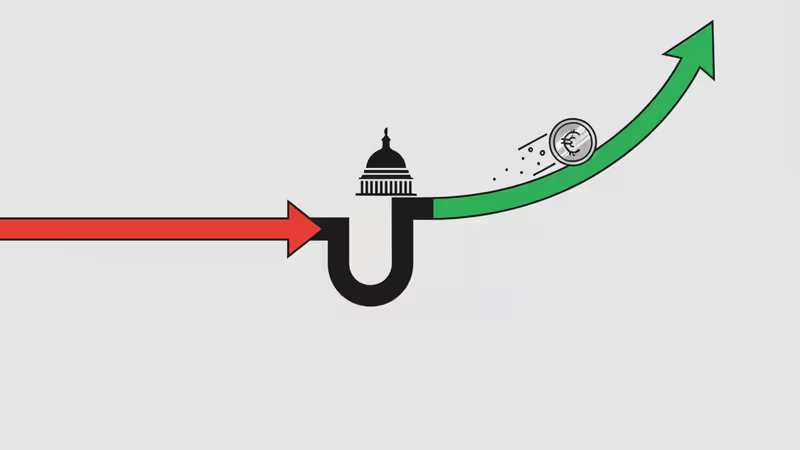
Regime Change: Trump's New Crypto Chiefs Signal a US Policy Pivot from Containment to Competition
The confirmation of new crypto-friendly chiefs at the CFTC and FDIC signals a major US policy shift. Our analysis breaks down the market impact and what it means for investors.
The Lede: A Green Light for a Stalled Industry
The Senate's confirmation of Mike Selig to lead the Commodity Futures Trading Commission (CFTC) and Travis Hill for the Federal Deposit Insurance Corp. (FDIC) is far more than a routine administrative update. For institutional investors and fintech executives, this is the most significant signal yet of a deliberate regime change in U.S. digital asset policy. The era of regulation-by-enforcement that defined the early 2020s is officially over. We are now entering a new phase where fostering domestic innovation and competing on the global stage are the primary objectives. This pivot unlocks strategic opportunities but also introduces a new calculus of risk.
Why It Matters: The Second-Order Effects
These appointments are not just about new faces; they are about dismantling the core barriers that have throttled institutional crypto adoption in the United States.
- The Banking Choke Point Unlocks: Travis Hill's leadership at the FDIC directly addresses the industry's single greatest operational threat: access to banking. Under the previous 'whole-of-government' approach, firms faced de-risking from banks under immense pressure from regulators. A crypto-friendly FDIC chair can rewrite the guidance, providing the cover for banks to service digital asset firms and, more critically, to directly custody assets and hold stablecoin reserves. This is the bedrock for integrating crypto into the traditional financial system.
- The End of the SEC's Unilateral War: Mike Selig, an SEC veteran, taking the helm at the CFTC is a strategic masterstroke. It positions the CFTC, which has long advocated for a principles-based framework for crypto as a commodity, to formally seize the regulatory initiative from a historically hostile Securities and Exchange Commission. This move will accelerate the push for legislative clarity that favors the CFTC's jurisdiction, ending the ambiguity that has kept trillions of institutional dollars on the sidelines.
- A Magnet for Global Capital: For years, capital and talent have fled the U.S. for more welcoming jurisdictions like the UAE and Singapore. These appointments act as a powerful re-shoring signal. The promise of a stable, and likely favorable, regulatory environment in the world's largest economy will reverse this trend, creating a 'U.S. premium' for domiciled projects and exchanges.
The Analysis: From 'Choke Point' to 'Sprint'
This policy shift is a direct response to the perceived overreach of the post-FTX crackdown, which critics argued stifled innovation without making investors meaningfully safer. While the previous administration viewed crypto through a lens of consumer protection and illicit finance, the new administration clearly sees it as a frontier of financial competition, particularly against China's advancements in digital currency.
The groundwork was already laid by Acting Chair Caroline Pham's "crypto sprint" at the CFTC, which explored using stablecoins as collateral and pushed for new product approvals like spot leveraged offerings. Selig's confirmation institutionalizes this pro-growth agenda. His SEC background is a critical feature, not a bug; he understands the SEC's playbook and can effectively build a competing—and legislatively empowered—regulatory moat around the assets the CFTC will govern.
Meanwhile, the detail of Pham's planned move to crypto infrastructure firm MoonPay underscores the increasingly blurred lines between Washington and the digital asset industry. This 'revolving door' dynamic, while common in finance, suggests a future where rulemaking will be heavily influenced by industry insiders, leading to faster innovation but raising legitimate concerns about regulatory capture.
PRISM Insight: The Investment Thesis Changes
This is the trigger for a portfolio rotation towards U.S.-centric digital assets. The investment implications are immediate and clear:
- U.S. Exchanges and Custodians: Companies like Coinbase and U.S.-based custodians are the primary beneficiaries. Regulatory clarity de-risks their business models and solidifies their appeal to large, conservative institutions.
- Regulated Stablecoins: With a friendlier FDIC, the pathway for fully regulated, bank-issued stablecoins is now wide open. This threatens the dominance of offshore issuers and creates a massive opportunity for U.S. financial institutions.
- Real-World Asset (RWA) Tokenization: The biggest long-term trend this unlocks is the tokenization of traditional assets. With clear banking and commodities frameworks, the plumbing required for Wall Street to put trillions in real estate, credit, and private equity on-chain can finally be built at scale.
PRISM's Take: The Calculated Gamble
The market is getting the regulatory thaw it has desperately lobbied for. The confirmation of Selig and Hill marks the U.S. pivot from a position of crypto containment to one of active competition. This will undoubtedly unleash a wave of innovation and investment that has been dammed up for years.
However, the risk is that in the rush to reclaim global leadership, the pendulum swings too far from prudent oversight to unchecked permissiveness. The challenge for the new leadership is not to simply dismantle the old regime but to build a durable and intelligent new one. Fostering innovation requires clear rules, not a regulatory vacuum. The lessons of past collapses were painful and costly. This new era is a bet that the industry, and its new regulators, have learned from them. For investors, the green light is on, but the road ahead still requires vigilance.
Related Articles

A top US regulator's move to a crypto firm isn't just a job change. It's a major signal about the industry's maturation and the new premium on compliance.
US crypto bill delay into 2026 extends regulatory uncertainty. Discover the key risks and strategic portfolio adjustments savvy investors must consider now.

Vanguard dismisses Bitcoin as a speculative 'toy' but grants 50M clients access to rival ETFs. Our analysis breaks down this strategic contradiction and what it means for your portfolio.

China is no longer a pharma copycat. With $1B R&D cycles and a massive data advantage, it's building a new global innovation engine. A PRISM analysis for investors.