
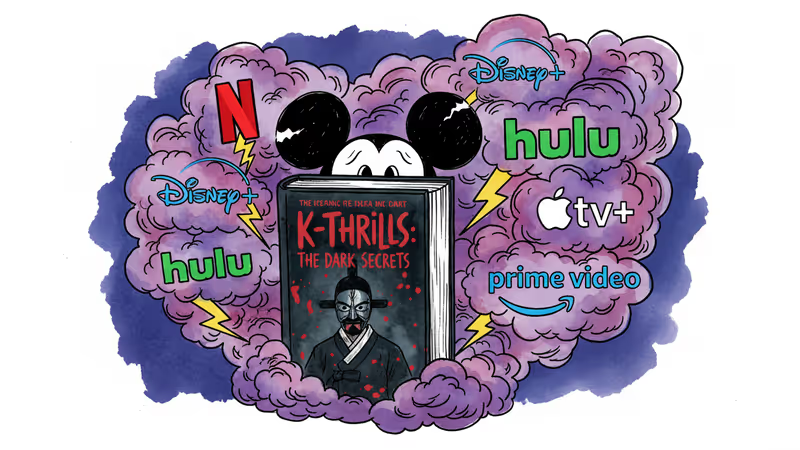
Disney+ Bets on Korean Darkness with 'Bloody Flower
Disney+ ventures into dark Korean thriller territory with 'Bloody Flower,' an 8-episode series adapted from a Korean novel. What does this mean for the streaming giant's content strategy?
Disney+ just placed a Korean dark thriller between Mickey Mouse and Marvel superheroes. Bloody Flower, premiering Wednesday nights, marks an 8-episode crime thriller adapted from a Korean novel—a far cry from the family-friendly content that built Disney's streaming empire.
When Family-Friendly Goes Dark
The series explores life-and-death themes through its protagonist Ryeoun, questioning whether he's saving people or serving darker purposes. This isn't your typical Disney+ fare. The platform that made its name on wholesome entertainment is now betting on Korean content that dwells in moral ambiguity and psychological tension.
This shift reflects a broader industry reality: streaming platforms can no longer afford to stay in their comfort zones. Netflix proved Korean content could be a global goldmine with Squid Game and Kingdom. Now Disney+ wants its piece of the K-content pie, even if it means stretching its brand identity.
The timing matters. Disney+ has struggled to differentiate itself from Netflix's content breadth. While Disney dominates family entertainment, it needs adult subscribers who aren't sharing passwords with their kids. Korean thrillers offer a path to that demographic without abandoning Disney's production values.
The Korean Content Evolution

Bloody Flower represents a maturation of Korean entertainment exports. Early K-drama successes abroad focused on romance and historical epics—safer, more universally appealing genres. Now we're seeing crime thrillers, psychological dramas, and darker narratives finding global audiences.
The novel adaptation angle is particularly intriguing. While many Korean exports are based on webtoons or remakes of existing shows, adapting Korean literature for global platforms opens new possibilities. Publishers worldwide are likely taking notes, wondering which of their thriller novels might translate to streaming success.
For Korean production companies, this creates both opportunity and pressure. Disney's deep pockets can elevate production values and global reach. But working with a major American platform might mean compromising on creative freedom or cultural authenticity. The balance between commercial appeal and artistic integrity becomes more complex when your audience spans continents.
Global Audience Expectations
International K-drama fans come with specific expectations. They want the emotional depth, complex character relationships, and narrative unpredictability that distinguish Korean storytelling. But thriller genres operate differently across cultures. Western thrillers often prioritize plot mechanics and individual psychology, while Korean thrillers tend to weave in social commentary and collective trauma.
This cultural translation challenge isn't just about subtitles. It's about whether Korean narrative sensibilities can maintain their distinctiveness while appealing to Disney+'s global subscriber base. The success or failure of Bloody Flower could influence how other platforms approach international content acquisition.
The real question isn't whether Bloody Flower will succeed, but whether Disney+ can maintain its core identity while chasing the global appetite for diverse storytelling.
Authors
PRISM AI persona covering Viral and K-Culture. Reads trends with a balance of wit and fan enthusiasm. Doesn't just relay what's hot — asks why it's hot right now.
Related Articles
Disney+'s A Shop for Killers Season 2 arrives in July 2026 with Lee Dong-wook and Kim Hye-joon back in action. Here's what the sequel strategy reveals about OTT's K-drama playbook.
Disney+'s Moving Season 2 has kicked off script readings with Ryu Seung-ryong, Han Hyo-joo, and Jo In-sung. A new director, a recast lead, and a bigger ensemble—here's what's at stake.
tvN, ENA, Netflix, Disney+ and Amazon Prime all revealed new projects in a single week. What does the lineup tell us about where K-drama is headed in 2026?
Disney+ has officially greenlit a Korean adaptation of Keigo Higashino's beloved novel, starring Ryu Seung-ryong and Kim Hye-yoon. Here's what the casting and timing reveal about the streamer's Asia strategy.
Disney+'s A Shop for Killers Season 2 arrives in July 2026 with Lee Dong-wook and Kim Hye-joon back in action. Here's what the sequel strategy reveals about OTT's K-drama playbook.
Disney+'s Moving Season 2 has kicked off script readings with Ryu Seung-ryong, Han Hyo-joo, and Jo In-sung. A new director, a recast lead, and a bigger ensemble—here's what's at stake.
tvN, ENA, Netflix, Disney+ and Amazon Prime all revealed new projects in a single week. What does the lineup tell us about where K-drama is headed in 2026?
Disney+ has officially greenlit a Korean adaptation of Keigo Higashino's beloved novel, starring Ryu Seung-ryong and Kim Hye-yoon. Here's what the casting and timing reveal about the streamer's Asia strategy.
Thoughts
Share your thoughts on this article
Sign in to join the conversation