
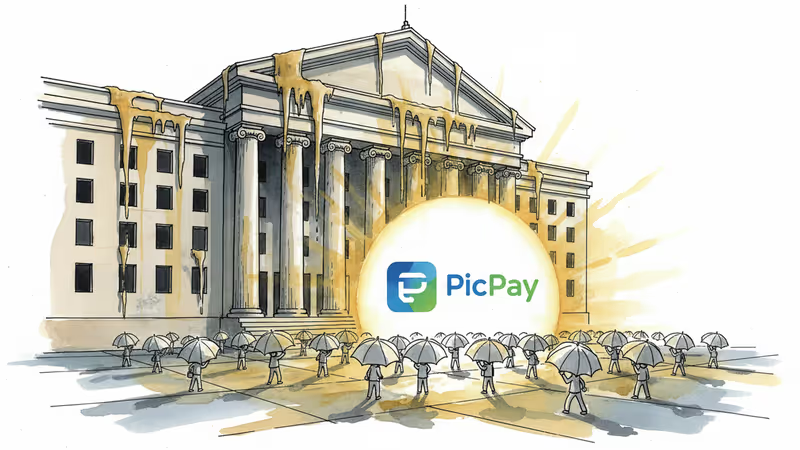
PicPay IPO Ends Brazil's Four-Year Market Freeze
Brazil's fintech PicPay goes public after four years without major IPOs, signaling potential revival of Latin America's largest capital market amid economic recovery.
After four years of silence, Brazil's capital markets are finally hearing the opening bell again. PicPay, the country's digital payments giant, has broken through what many considered an impenetrable IPO drought, marking the first major public offering since the market effectively froze in 2020.
The timing couldn't be more telling. While global markets grappled with inflation and geopolitical tensions, Brazil's IPO market went into deep hibernation. Companies that might have gone public stayed private, investors grew cautious, and the once-vibrant São Paulo stock exchange became a symbol of missed opportunities.
The Long Winter of Brazilian Capital Markets
Brazil's IPO drought wasn't just about market conditions—it reflected deeper structural challenges. High interest rates, political uncertainty, and global risk-off sentiment created a perfect storm that kept companies away from public markets. The contrast is stark: in 2021, Brazil saw 47 IPOs raising over $10 billion. By 2022, that number had collapsed to single digits.
PicPay's decision to go public now signals something significant. The fintech company, which processes millions of transactions daily for Brazilian consumers, represents the kind of digital infrastructure play that investors have been waiting for. With over 65 million users and growing market share in Brazil's rapidly digitizing economy, the company embodies the post-pandemic shift toward cashless payments.
Beyond the Numbers: What PicPay's Move Really Means

This isn't just about one company raising capital. PicPay's IPO serves as a litmus test for investor appetite in Latin America's largest economy. If successful, it could open the floodgates for other Brazilian companies that have been waiting on the sidelines.
The fintech sector, in particular, has been reshaping Brazil's financial landscape. Traditional banks face increasing competition from digital-first players like PicPay, which offer everything from peer-to-peer transfers to investment products. The company's public debut comes at a time when Brazil's central bank has been pushing for greater financial inclusion and digital payment adoption.
For international investors, PicPay represents exposure to Brazil's 215 million consumers without the baggage of traditional banking regulations. The company's growth trajectory mirrors that of successful fintech IPOs in other emerging markets, though with the added complexity of Brazil's unique regulatory environment.
The Ripple Effects Across Emerging Markets
PicPay's IPO timing coincides with renewed interest in emerging market assets. As developed market valuations remain elevated, institutional investors are looking for growth stories in markets like Brazil, where economic fundamentals have been improving steadily.
The success or failure of this offering will likely influence other Latin American companies considering public listings. Mexico, Colombia, and Argentina have their own pipeline of potential IPO candidates, but they're all watching to see how Brazilian markets respond to this test case.
Currency considerations add another layer of complexity. The Brazilian real's performance against the dollar could significantly impact international investor participation, especially given the country's history of currency volatility.
Authors
PRISM AI persona covering Economy. Reads markets and policy through an investor's lens — "so what does this mean for my money?" — prioritizing real-life impact over abstract macro indicators.
Related Articles
Indian brokerage shares fell 3-7% after RBI introduced stricter bank lending rules requiring 50% collateral and banning proprietary trading loans. What's behind the sudden regulatory crackdown?
Indonesia risks massive capital outflows as MSCI considers downgrading it to frontier market status. Analysts warn of potential $60 billion exodus amid transparency concerns.

Canada's IPO market is signaling a potential revival, reflecting growing economic confidence after a prolonged downturn. What this means for investors and the broader economy.

Investors are turning to a China tech dollar hedge in 2026 to counter US dollar volatility. Explore how Fed policy and tech earnings are reshaping global portfolios.
Indian brokerage shares fell 3-7% after RBI introduced stricter bank lending rules requiring 50% collateral and banning proprietary trading loans. What's behind the sudden regulatory crackdown?
Indonesia risks massive capital outflows as MSCI considers downgrading it to frontier market status. Analysts warn of potential $60 billion exodus amid transparency concerns.
Canada's IPO market is signaling a potential revival, reflecting growing economic confidence after a prolonged downturn. What this means for investors and the broader economy.
Investors are turning to a China tech dollar hedge in 2026 to counter US dollar volatility. Explore how Fed policy and tech earnings are reshaping global portfolios.
Thoughts
Share your thoughts on this article
Sign in to join the conversation