

IU and Byeon Woo Seok's Royal Gamble
MBC's Perfect Crown pairs IU and Byeon Woo Seok in an alternate-history monarchy romance. What does this casting say about K-drama's evolving star economy and the survival strategies of traditional broadcasters?
Two of K-drama's biggest names. One alternate-history monarchy. And a broadcaster quietly betting that star power alone can hold the line against streaming giants.
MBC has released a preview clip of IU and Byeon Woo Seok sharing their first night together as a married couple in the upcoming drama Perfect Crown. The show is set in a reimagined modern Korea that never abandoned its monarchy—a constitutional kingdom where Seong Hui Ju (IU), a chaebol heiress who is, paradoxically, a commoner by royal standards, falls for someone on the other side of that divide. The preview landed exactly as intended: fan communities lit up within hours, and the clip circulated across platforms that MBC doesn't officially control.
The Math Behind the Casting
Pairing IU and Byeon Woo Seok is not a creative accident—it's a calculated hedge.
IU has spent the better part of a decade building one of K-drama's most durable crossover profiles. Her 2019 turn in Hotel Del Luna became the benchmark for idol-to-actress transitions, and subsequent projects—My Mister, Dream—added dramatic range to a resume that already commanded premium brand deals and sold-out concert tours. She is, in industry shorthand, a reliable anchor for both domestic ratings and international licensing conversations.
Byeon Woo Seok operates on a different but complementary axis. His 2024 breakout in Lovely Runner didn't just produce strong viewership numbers—it converted directly into a sold-out Asian fan tour and a wave of brand endorsements that tracked his face across billboards from Seoul to Bangkok. He represents the newer model of K-drama stardom: the drama as IP launchpad, where the show's success is measured not only in ratings but in merchandise, events, and the actor's subsequent market value.
Together, they cover almost every demographic segment a broadcaster could want: IU's established domestic fanbase, Byeon Woo Seok's younger international following, and the overlap between them that makes a drama trend globally without needing a Netflix algorithm to push it.

What the Monarchy Setting Is Actually Doing
Alternate history isn't new to K-drama. Kingdom (2019) proved that recontextualizing Korean history could find a global audience. But "what if modern Korea kept its monarchy" is a different kind of premise. It's less about historical imagination and more about class architecture.
The setup gives the writers a structural mechanism to make a chaebol heiress feel like an underdog—she has money, but not the right kind of status. This is a refinement of a formula Korean melodrama has used for decades: love across a social gap. What's shifted is the framing. Rather than depicting the wealth gap that dominates contemporary Korean social anxiety—a subject that Parasite made globally legible and that shows like My Liberation Notes approached from the inside—Perfect Crown displaces that tension into a fantasy register. The monarchy isn't a critique of hierarchy; it's a costume for it.
That choice will appeal to viewers who want emotional stakes without social discomfort. Whether it satisfies audiences who've grown accustomed to K-drama's more structurally honest recent work is a separate question.
MBC's Streaming Calculus
The more consequential story here may be the one happening off-screen. Perfect Crown has not announced a simultaneous streaming deal with any major OTT platform as of publication—a notable absence given that Netflix, Disney+, and Tving have all moved aggressively to co-produce or pre-license high-profile Korean dramas before broadcast.
MBC appears to be running a different play. By building pre-release buzz through strategic clip drops rather than a streaming platform's marketing apparatus, the broadcaster may be positioning itself to negotiate from strength after the drama airs—using confirmed ratings and fan engagement data to command better terms for international rights. This is the inverse of the Extraordinary Attorney Woo model, where Netflix's pre-purchase funded production but also set the ceiling on what MBC could extract later.
The risk is real. Without OTT distribution, international viewers in markets without MBC access face delays or unofficial channels—which historically fragments fandom momentum rather than building it. The window between a drama's domestic peak and its global streaming availability has proven costly for broadcasters before.
This content is AI-generated based on source articles. While we strive for accuracy, errors may occur. We recommend verifying with the original source.
Related Articles

MBC's action-comedy Fifties Professionals introduces Kwon Yul as an unpredictable new antagonist. Here's why this drama's premise matters beyond the casting news.
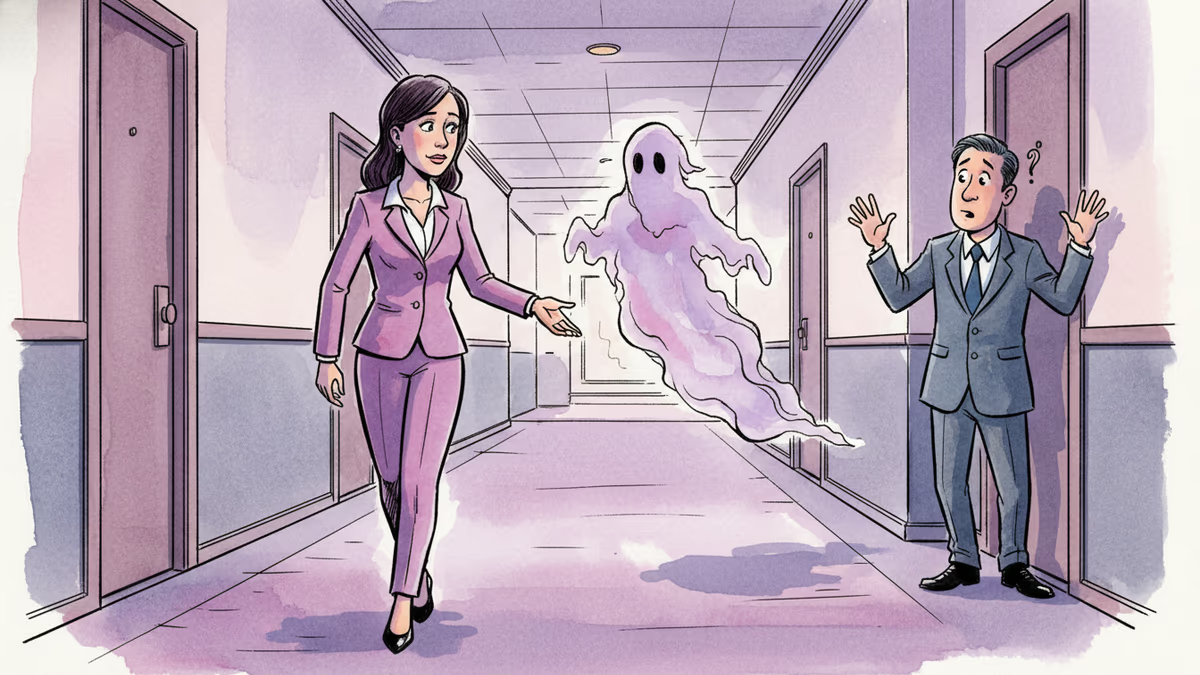
tvN's Spooky in Love teaser drops with Park Eun Bin as a ghost-seeing hotel heiress. Behind the occult romance lies a calculated industry strategy worth unpacking.
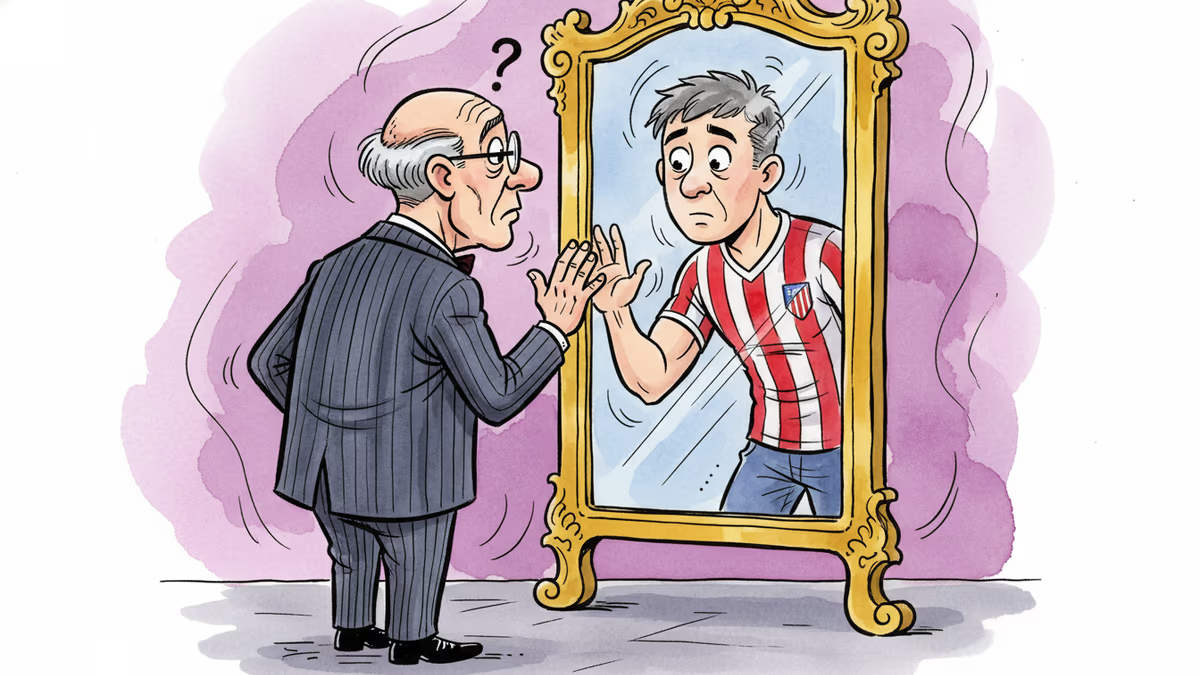
JTBC's Reborn Rookie pairs veteran actor Son Hyun Joo with idol-turned-actor Lee Jun Young in a body-swap drama. A look at the genre's industrial logic and what it signals about Korean TV's audience strategy.
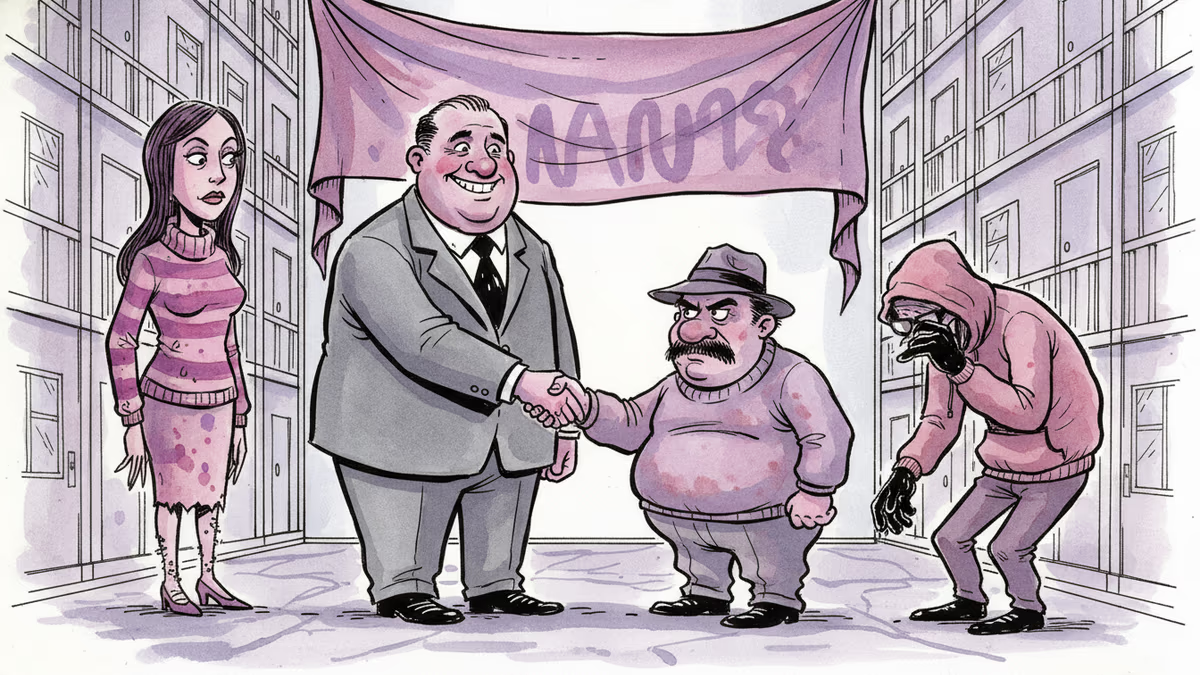
JTBC's upcoming comedy crime drama Apartment casts Ji Sung, Ha Yoon-kyung, Park Byung-eun, and Moon Sori in a story where an ex-gangster enters a residents' committee election. What does the project reveal about JTBC's 2026 strategy?
MBC's action-comedy Fifties Professionals introduces Kwon Yul as an unpredictable new antagonist. Here's why this drama's premise matters beyond the casting news.
tvN's Spooky in Love teaser drops with Park Eun Bin as a ghost-seeing hotel heiress. Behind the occult romance lies a calculated industry strategy worth unpacking.
JTBC's Reborn Rookie pairs veteran actor Son Hyun Joo with idol-turned-actor Lee Jun Young in a body-swap drama. A look at the genre's industrial logic and what it signals about Korean TV's audience strategy.
JTBC's upcoming comedy crime drama Apartment casts Ji Sung, Ha Yoon-kyung, Park Byung-eun, and Moon Sori in a story where an ex-gangster enters a residents' committee election. What does the project reveal about JTBC's 2026 strategy?
Thoughts
Share your thoughts on this article
Sign in to join the conversation