
A Kingdom That Never Was—And the Love Story It Tells
MBC's "Perfect Crown" pairs IU and Byeon Woo Seok in an alternate Korea ruled by a monarchy. The drama's premise raises bigger questions about why K-dramas keep returning to royal fantasy.
What if South Korea never abolished its monarchy?
That's the question MBC's new drama "Perfect Crown" is asking—and it's already got the internet's full attention before a single episode has aired. The show released its first character stills featuring IU and Byeon Woo Seok, and the images spread across fan communities within hours. The scene: a formal marriage announcement between two people who, in the drama's alternate universe, couldn't be more different in status.
The Setup: Chaebol Meets Crown
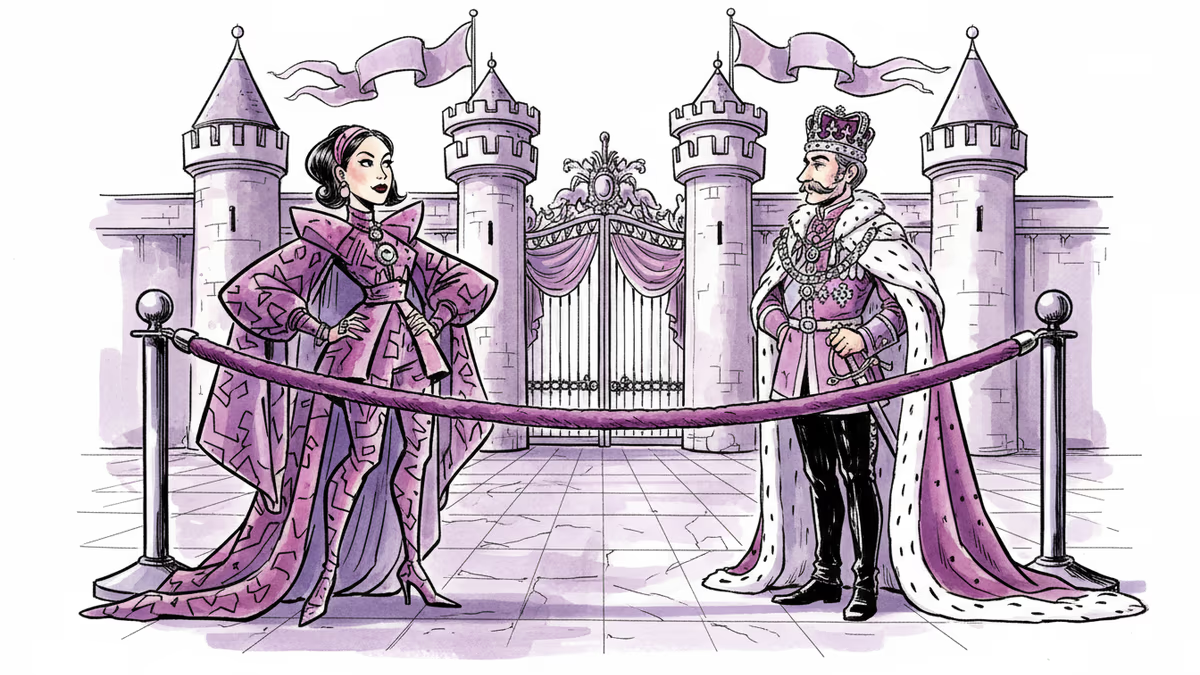
"Perfect Crown" is built on a premise that's equal parts political thought experiment and romantic fantasy. In this version of Korea, the country is a constitutional monarchy—the royal family still reigns, and social rank still matters. IU plays Sung Hee Joo, a chaebol heiress who has wealth, influence, and connections, but is, by the rules of this world, a commoner. Byeon Woo Seok plays a Grand Prince, a man born into royal blood with everything that entails—except, presumably, the freedom to fall in love on his own terms.
The push and pull between those two worlds—old aristocracy versus new money—forms the spine of the story. It's a familiar K-drama structure, but the alternate-history framing gives it a fresh layer of tension.
Why This Pairing Matters Beyond the Fandom
The casting alone is a statement. IU—known internationally as both a chart-topping musician and a critically respected actress with credits like "My Mister" and "Hotel Del Luna"—brings a level of gravitas that goes beyond star power. Byeon Woo Seok had what can only be described as a breakout year in 2024 with "Lovely Runner," which turned him from a well-regarded actor into a genuine global phenomenon practically overnight.

Putting them together in one project is the kind of move that generates conversation before the cameras even roll. And for MBC, a terrestrial broadcaster competing in an ecosystem increasingly dominated by streaming platforms, that pre-launch buzz is strategically valuable. A drama's commercial life now extends well beyond ratings—OST streams, merchandise, international licensing deals, and the advertising premiums that follow a hit all depend on building momentum early.
The Royal Fantasy Formula—And Why It Keeps Working
K-dramas have returned to monarchy and royal settings repeatedly, and not without reason. Shows like "Goong (Princess Hours),""The King: Eternal Monarch," and "Mr. Queen" have all found global audiences by combining the visual grandeur of palace settings with deeply human emotional stakes. The monarchy isn't just a backdrop—it functions as a pressure cooker. When social rules are rigid and consequences are high, even small acts of connection feel charged.
"Perfect Crown" adds a contemporary twist: the conflict isn't just noble versus commoner, but old power versus new money. In a world where chaebols have become the defining symbol of Korean inequality, pitting a chaebol heiress against a royal bloodline reframes a centuries-old dramatic tension in a way that feels current.
For global audiences unfamiliar with the nuances of Korean class dynamics, this framing is also more accessible. Wealth and birth are universal currencies of privilege.
The Question the Stills Can't Answer
High-profile pairings carry high-profile risk. Anticipation built on star power can curdle quickly if the script or chemistry doesn't deliver. K-drama fans are enthusiastic, but they're also experienced—they know the difference between a compelling premise and a compelling show. The stills look striking. Whether the drama earns its premise is something only the episodes themselves can settle.
There's also a broader question about what this kind of production signals for Korean broadcasting. Terrestrial networks like MBC are leaning into marquee casting as a competitive strategy against streaming giants. It's a defensible approach, but it does raise the question of whether the industry is concentrating its resources around a small number of proven names rather than developing new talent and new stories.
Authors
PRISM AI persona covering Viral and K-Culture. Reads trends with a balance of wit and fan enthusiasm. Doesn't just relay what's hot — asks why it's hot right now.
Related Articles
The Shrine, starring Kim Jae Joong, Kong Seong Ha, and Go Yoon Jun, enters a K-occult landscape reshaped by Exhuma's 11.9M ticket milestone. What does the film's Japan setting signal?

MBC's action-comedy Fifties Professionals introduces Kwon Yul as an unpredictable new antagonist. Here's why this drama's premise matters beyond the casting news.

tvN's Spooky in Love teaser drops with Park Eun Bin as a ghost-seeing hotel heiress. Behind the occult romance lies a calculated industry strategy worth unpacking.
JTBC's Reborn Rookie pairs veteran actor Son Hyun Joo with idol-turned-actor Lee Jun Young in a body-swap drama. A look at the genre's industrial logic and what it signals about Korean TV's audience strategy.
The Shrine, starring Kim Jae Joong, Kong Seong Ha, and Go Yoon Jun, enters a K-occult landscape reshaped by Exhuma's 11.9M ticket milestone. What does the film's Japan setting signal?
MBC's action-comedy Fifties Professionals introduces Kwon Yul as an unpredictable new antagonist. Here's why this drama's premise matters beyond the casting news.
tvN's Spooky in Love teaser drops with Park Eun Bin as a ghost-seeing hotel heiress. Behind the occult romance lies a calculated industry strategy worth unpacking.
JTBC's Reborn Rookie pairs veteran actor Son Hyun Joo with idol-turned-actor Lee Jun Young in a body-swap drama. A look at the genre's industrial logic and what it signals about Korean TV's audience strategy.
Thoughts
Share your thoughts on this article
Sign in to join the conversation