
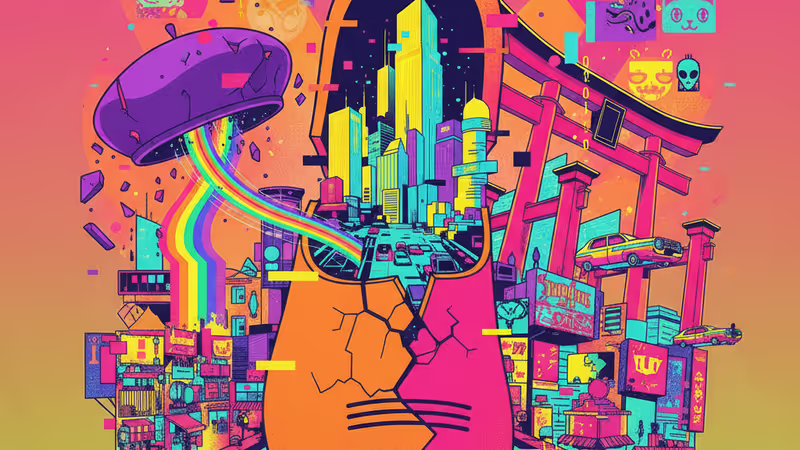
No, We Don't All Wear Berets: People Around the World Debunk Myths About Their Countries
Do all Germans wear lederhosen? Are Canadians constantly saying 'eh'? People from around the world set the record straight on the most common stereotypes about their homes.
Visiting a new country can feel like stepping into another world. But somewhere between the exciting food and fascinating new routines, you often realize that not everything you’ve heard about a place is true. Thanks to movies and social media, we often arrive with a long list of expectations already formed.
That’s exactly what sparked an online discussion when someone asked, “What’s something foreigners think is common in your country, but really isn’t?” People from around the globe chimed in to set the record straight, and the replies were a funny, surprising reminder that stereotypes rarely tell the full story.
Stereotypes vs. Reality: From Polar Bears to Berets
Many of the most common myths are tied to national symbols. For instance, while many people associate Finland with the indestructible Nokia 3310, one user stated simply, “People don’t use [them] anymore.” In Norway, you won't be running into polar bears; according to a local, they only live on the remote archipelago of Svalbard, and even there, the towns are safe.
Cultural clichés also took a hit. In France, berets are “usually only worn by bald people,” and mustaches are not so common. In Spain, bullfighting is far from a national pastime. A user explained that many of the country's bullrings are now used for concerts or are simply abandoned. And if you're in Germany, don't expect to see Lederhosen and Dirndl everywhere. As one German pointed out, “It’s Bavaria only!”
A Deeper Look: Beyond the 'Slumdog Millionaire' Myth
Sometimes, stereotypes are shaped by a single, powerful piece of pop culture. Rakesh, a 19-year-old who gives guided tours of Mumbai's Dharavi settlement, says many visitors arrive with ideas formed by the movie Slumdog Millionaire. “They wanted to see poverty the way it was shown in the movie,” he says.
The reality, Rakesh explains, is far more complex. “The first thing people tell me is that they didn’t know Mumbai was so developed,” he says, noting their shock at seeing massive malls and luxury buildings right next to Dharavi. He also challenges the misconception about employment. “Some tourists honestly believe that everyone here is unemployed or begging,” he explains. “They’re surprised when they learn about the small-scale industries we have,” from leather and textiles to recycling. But what surprises foreigners most, he adds, is the strong sense of community among the more than one million residents. It's a side of Dharavi that rarely makes headlines.
In a hyper-connected world, it's a paradox: while we have more access to information than ever, simplified narratives and stereotypes can spread just as quickly. The good news is that people are traveling again at a record pace. According to the UNWTO, more than 1.1 billion tourists traveled internationally in the first nine months of 2025 alone. Each of those journeys represents an opportunity for 'unlearning'—to replace a flat, digital caricature with the complex, nuanced reality of a place and its people.
This content is AI-generated based on source articles. While we strive for accuracy, errors may occur. We recommend verifying with the original source.
Related Articles

After a stellar 4-win season, Akari Sakuma has been named the 2025 JLPGA Player of the Year. Discover the details of her dominant performance with PRISM.

The AFCON 2025 Final is here as hosts Morocco take on Nigeria. Get the full match preview, key player analysis, and find out what's at stake in this battle for glory.

A family on Reddit has banned a grandmother from bringing gifts after she was caught hiding her 3-year-old grandson's favorite Santa toy out of jealousy, a move experts call 'narcissistic gift-giving.'

Hugh Jackman reveals he once sang a karaoke duet of 'Grease' with John Travolta—and he played Sandy. Read more from the cast of the new movie 'Song Sung Blue'.