

Pebble Founder Eric Migicovsky Reboot: Core Devices and Index 01 Ring
Pebble founder Eric Migicovsky returns with Core Devices. Discover how the Pebble founder Core Devices reboot is redefining hardware business models without VC funding through the new Index 01 AI ring.
The king of e-paper smartwatches is back, but don't call it a startup. Eric Migicovsky, the visionary behind the original Pebble, has officially returned with Core Devices. His mission? To prove that a hardware company can be sustainable, profitable, and fiercely independent without chasing the VC-fueled hyper-growth that nearly sank his previous venture.
The Pebble Founder Core Devices Reboot: Not a Startup Anymore
Speaking at CES 2026, Migicovsky told TechCrunch that he's structured the entire business around being a long-running enterprise rather than a temporary startup. With a tiny team of only 5 people, Core Devices avoids the massive overhead that led to Pebble's eventual sale to Fitbit in 2016 for $40 million.
The trauma of 2015 remains a guiding light. That year, Pebble hit $82 million in sales—missing its $102 million target. The resulting surplus of unsold inventory forced rapid layoffs. This time, there's no outside funding and no over-manufacturing. Every device is built with profitability in mind, targeting a niche audience of "nerds" who want a companion to their phone, not a replacement.

A $75 AI Ring and the Resurrection of PebbleOS
The product lineup includes the Pebble Time 2, the round-faced Pebble Round 2, and a surprise entry: the Index 01, a $75 AI-powered smart ring. The comeback was made possible by Google, which open-sourced PebbleOS following a personal request from Migicovsky. Without this existing foundation, recreating the software would have required dozens of engineers and years of work.
The market response is already strong. Core Devices has secured 25,000 preorders for its watches and 5,000 for the AI ring. With 15,000 apps and watch faces ready to go, the ecosystem is alive. Migicovsky claims the team is in a "comfortable spot" where expenses are paid and they can self-finance future hardware projects.
Authors
Related Articles
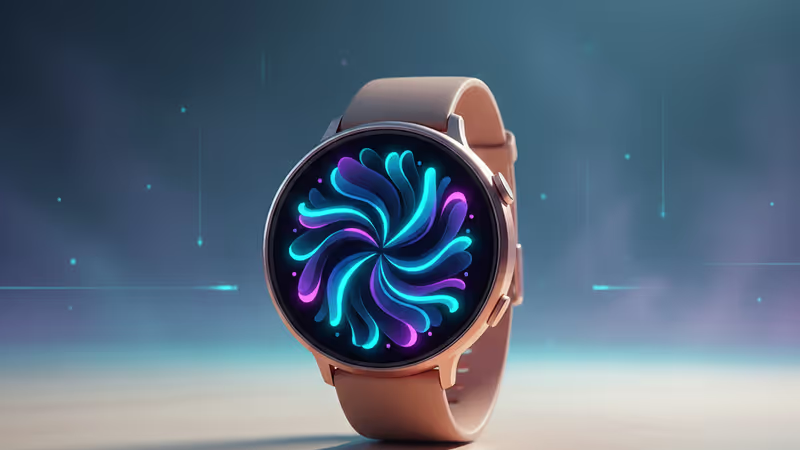
The Pebble Round 2 is here. Featuring a 1.3-inch touchscreen, improved battery life, and a $199 pre-order price. Expected to ship in May 2026.
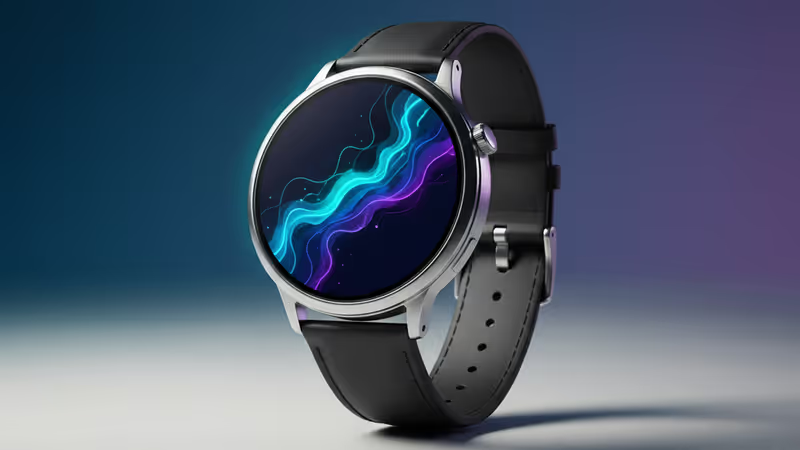
Pebble announces the Pebble Round 2 smartwatch, a $199 circular wearable with a 14-day battery life and slim 8.1mm design. Featuring a color e-paper display and AI assistant support.

Samsung Electronics' union branch revealed that 84% of survey respondents oppose the government's roughly $290 billion (₩400 trillion) semiconductor megaproject in Gwangju. Government, management, the union and shareholders are all reading the same national project in sharply different ways.
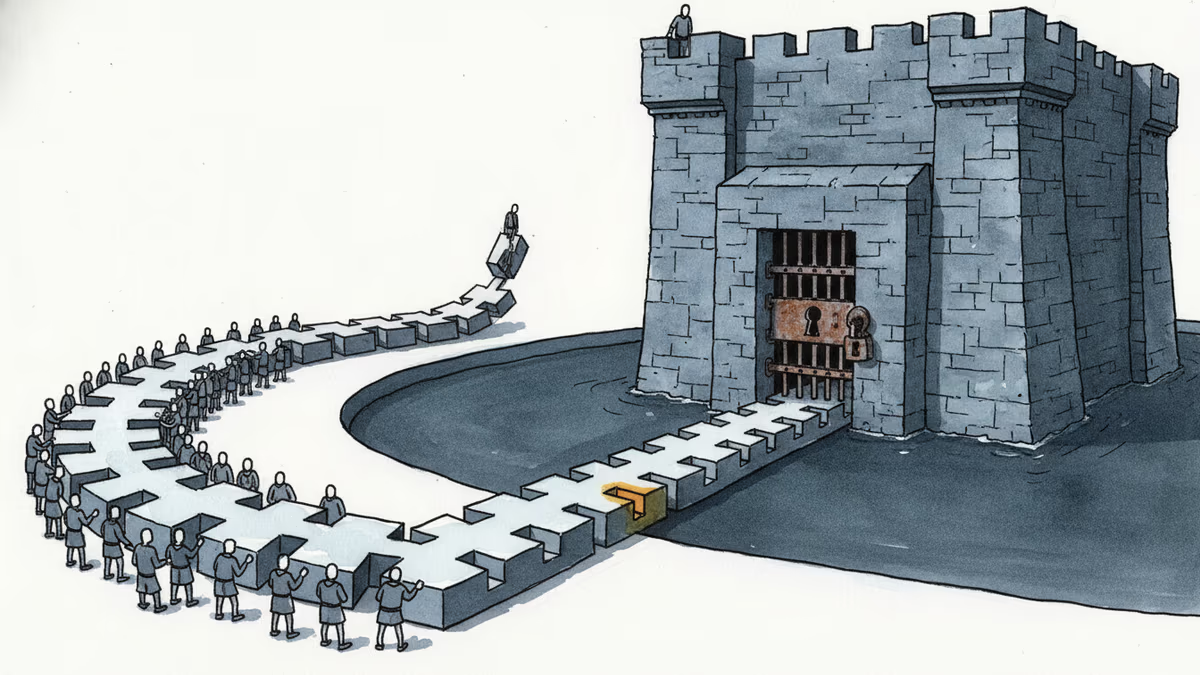
Nvidia shipped roughly a billion RISC-V cores in 2024, then announced it would run CUDA on the open standard. We break down how royalty-free instruction sets and open software stacks are trying to route around CUDA's lock-in. Part 2 of the Semiconductor Sovereignty series.
The Pebble Round 2 is here. Featuring a 1.3-inch touchscreen, improved battery life, and a $199 pre-order price. Expected to ship in May 2026.
Pebble announces the Pebble Round 2 smartwatch, a $199 circular wearable with a 14-day battery life and slim 8.1mm design. Featuring a color e-paper display and AI assistant support.
Samsung Electronics' union branch revealed that 84% of survey respondents oppose the government's roughly $290 billion (₩400 trillion) semiconductor megaproject in Gwangju. Government, management, the union and shareholders are all reading the same national project in sharply different ways.
Nvidia shipped roughly a billion RISC-V cores in 2024, then announced it would run CUDA on the open standard. We break down how royalty-free instruction sets and open software stacks are trying to route around CUDA's lock-in. Part 2 of the Semiconductor Sovereignty series.
Thoughts
Share your thoughts on this article
Sign in to join the conversation