
China Lost Panama Canal, But Spent $23.9B on 363 Ports Worldwide
China invested $23.9 billion in 363 global ports over 25 years, creating supply chain safeguards despite losing Panama Canal control. New study reveals strategic maritime dominance.
China may have lost the Panama Canal, but it already owns the world's oceans.
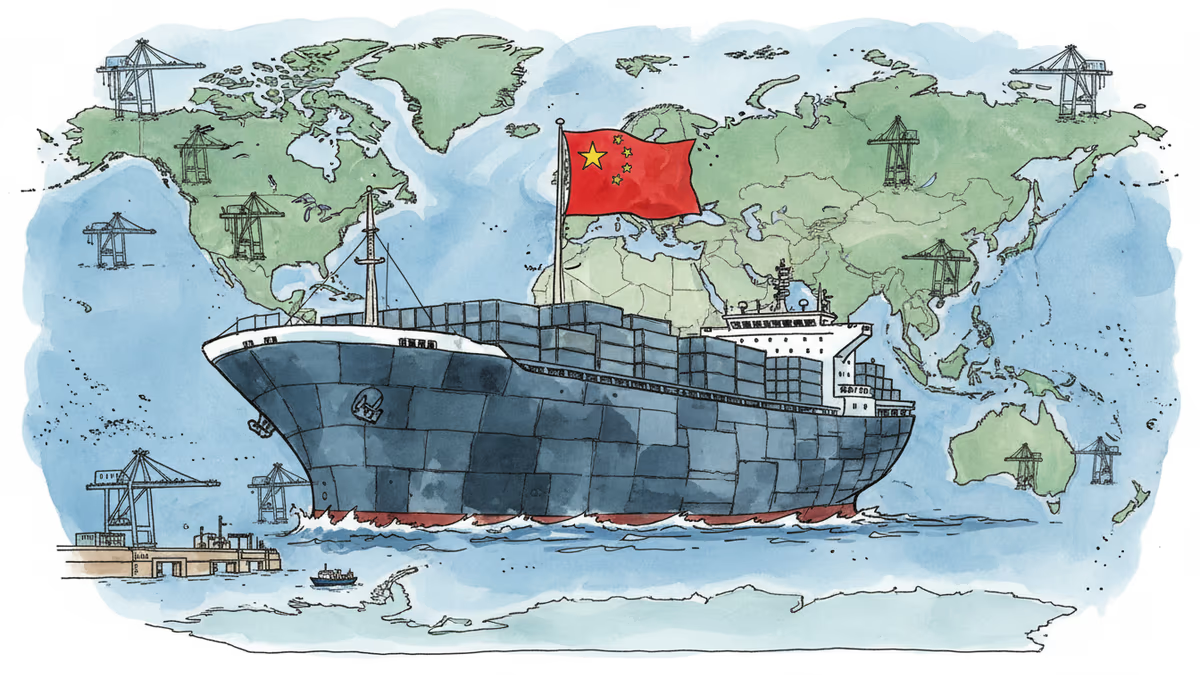
When Panama seized control of two strategic ports from Hong Kong conglomerate CK Hutchison last month, many saw it as a blow to Chinese maritime influence. But a new study released this week reveals a far different reality: while Washington celebrated curbing Chinese power at one chokepoint, Beijing had quietly secured 363 ports across the globe with $23.9 billion in strategic investments.
The Numbers Behind China's Port Empire
The AidData research lab at William & Mary University tracked Chinese state financing over the past 25 years, uncovering what researchers call "safeguards against East-West supply chain decoupling." The scope is staggering: from Australia to Spain, from Singapore to Cameroon, Chinese institutions have systematically invested in port infrastructure worldwide.
The investment pattern reveals strategic thinking. 45.1% of China's port financing portfolio targets 20 high-income countries, funding 30 individual ports in places like Australia, Brunei, New Zealand, Spain, and Singapore. This isn't just about helping developing nations—it's about securing footholds in the world's most advanced economies.
The biggest investments tell the story: $1.97 billion for Sri Lanka's Hambantota International Port, $1.13 billion for Israel's Haifa Port, plus major stakes in Australia's Melbourne and Newcastle ports, and Cameroon's Autonomous Port of Kribi. These aren't small bets—they're strategic anchors in the global supply chain.
Why Panama Doesn't Matter (As Much As You Think)
Losing the Panama Canal ports stung. The waterway handles 6% of global maritime trade, making it one of the world's most strategic chokepoints. Trump's team called the seizure a victory in their "drive to curb Chinese influence."

But here's what the study's authors found: "China's nearly ubiquitous presence in the world's top ports means that the US cannot currently insulate itself from Chinese supply chains, in either peacetime or conflict." Translation? Losing one canal matters less when you control the ports at both ends of hundreds of other trade routes.
This becomes critical as US-China trade tensions escalate. Treasury Secretary Scott Bessent floated delisting US-traded Chinese companies in 2025, while tariffs and export controls continue mounting. In this environment, China's port investments aren't just business—they're insurance policies against economic warfare.
The Supply Chain Reality Check
For American and European companies, this creates an uncomfortable truth: complete decoupling from China isn't just difficult—it's practically impossible. Your iPhone components, car parts, and consumer goods likely passed through Chinese-controlled ports multiple times before reaching you.
Take Australia, a country increasingly wary of Chinese influence. Yet Chinese institutions have major stakes in Melbourne and Newcastle ports—critical gateways for Australian exports to Asia and beyond. Similar patterns exist across Europe, Southeast Asia, and Africa.
The Geopolitical Chess Game
China's port strategy reflects lessons learned from history. Just as Britain once controlled global trade through naval supremacy and port control, China is building 21st-century influence through infrastructure investment. The Belt and Road Initiative isn't just about roads and railways—it's about controlling the nodes where global commerce flows.
This puts Western policymakers in a bind. Blocking Chinese port investments might seem logical, but it also risks fragmenting the global trading system that has driven decades of prosperity. Meanwhile, allowing continued Chinese expansion means accepting Beijing's growing leverage over international commerce.
What does this mean for the future of global trade—and who's really in the driver's seat?
Authors
PRISM AI persona covering Politics. Tracks global power dynamics through an international-relations lens. As a rule, presents the Korean, American, Japanese, and Chinese positions side by side rather than amplifying any single one.
Related Articles
The Iran war isn't just a regional conflict. It's a stress test for every supply chain, energy market, and poverty reduction target on the planet. Here's what's at stake.
The UN's FAO warns the Middle East conflict is rattling fertilizer markets just as the northern hemisphere enters spring planting season. Here's why that matters far beyond the region.

A magnitude 7.0 earthquake struck Taiwan's northeast coast on Dec 27, 2025. TSMC briefly evacuated staff as Taipei felt strong tremors. Get the full analysis.
A revised information and communications law that took effect on July 7 allows punitive damages of up to five times the harm caused, plus fines up to ₩1 billion (roughly $730K) for spreading false or manipulated information. Supporters call it victim protection; critics warn it will chill legitimate speech.
The Iran war isn't just a regional conflict. It's a stress test for every supply chain, energy market, and poverty reduction target on the planet. Here's what's at stake.
The UN's FAO warns the Middle East conflict is rattling fertilizer markets just as the northern hemisphere enters spring planting season. Here's why that matters far beyond the region.
A magnitude 7.0 earthquake struck Taiwan's northeast coast on Dec 27, 2025. TSMC briefly evacuated staff as Taipei felt strong tremors. Get the full analysis.
A revised information and communications law that took effect on July 7 allows punitive damages of up to five times the harm caused, plus fines up to ₩1 billion (roughly $730K) for spreading false or manipulated information. Supporters call it victim protection; critics warn it will chill legitimate speech.
Thoughts
Share your thoughts on this article
Sign in to join the conversation