
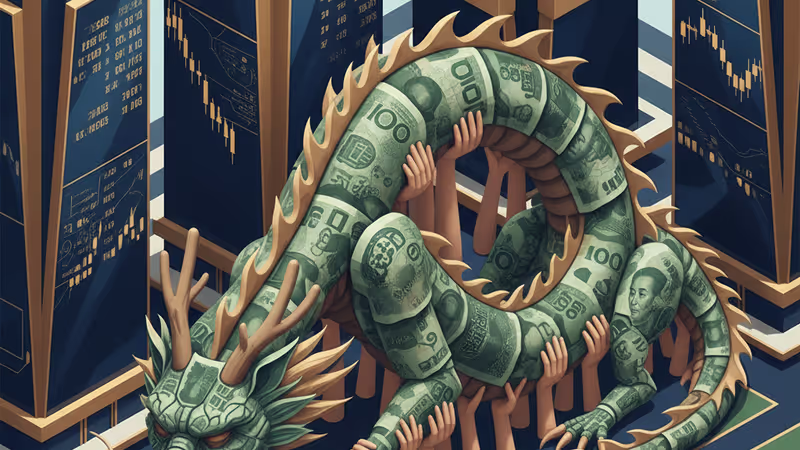
China Enters 'Japan-Style' Era of Frequent, Small-Scale Stimulus, ANZ Warns
China has entered a 'Japan-style' phase of frequent, smaller stimulus packages instead of large-scale bailouts, warns ANZ's Chief Economist. This changes the investment calculus for Chinese assets.
China's economic playbook has fundamentally shifted, moving away from massive 'bazooka' stimulus to a new phase of frequent, smaller interventions—a strategy that mirrors Japan's prolonged battle with stagnation, according to a new analysis from ANZ Banking Group.
Richard Yetsenga, Chief Economist at ANZ, argued in a December 23rd note that China's future growth now depends less on fundamentals and more on the "frequency and vigor" of government stimulus. The shift comes as Beijing grapples with faltering domestic demand and severe overproduction in key industries. As evidence, Yetsenga points to the solar sector: `Only two of the country's 10 largest solar panel manufacturers reported a profit in the first half of 2025.`
This new approach signals that the days of expecting a single, powerful policy move to reignite broad-based growth are over. Instead, Beijing appears to be entering a "Japan-style frequent-stimulus phase," applying targeted support whenever the economy shows signs of faltering. This 'Japanification' suggests a potential future of slower growth and a persistent reliance on state intervention to avoid a hard landing.
For investors, the game has changed. A strategy based on waiting for a single, massive stimulus to fuel a market-wide rally is likely to fail. Success in this new era will depend on tactically positioning ahead of smaller, targeted policy announcements. The key metric to watch is no longer just GDP, but the *rhythm* of Beijing's support. The winners will be those who can anticipate which sectors will receive a targeted injection of capital, turning Chinese market investing into a game of reading policy tea leaves rather than betting on a macro recovery.
This content is AI-generated based on source articles. While we strive for accuracy, errors may occur. We recommend verifying with the original source.
Related Articles

China's central bank kept its benchmark Loan Prime Rate (LPR) unchanged for the seventh straight month, reflecting a cautious approach to stimulus amid property woes and a weak yuan. We analyze the impact on global investors.

China's $30B luxury resale boom is more than a trend; it's a deep economic reset. Our analysis breaks down the impact on LVMH, Kering, and investors.

Japan's Q3 GDP was revised down to an annualized -2.3%, prompting the government to plan a record ¥122 trillion budget. However, conflicting signals, such as a review of solar subsidies, are creating market uncertainty.

Japan's SMFG is partnering with Bain Capital and Muzinich & Co. on a $3.5 billion fund to finance European M&A deals, capitalizing on financial leeway from higher domestic interest rates.