
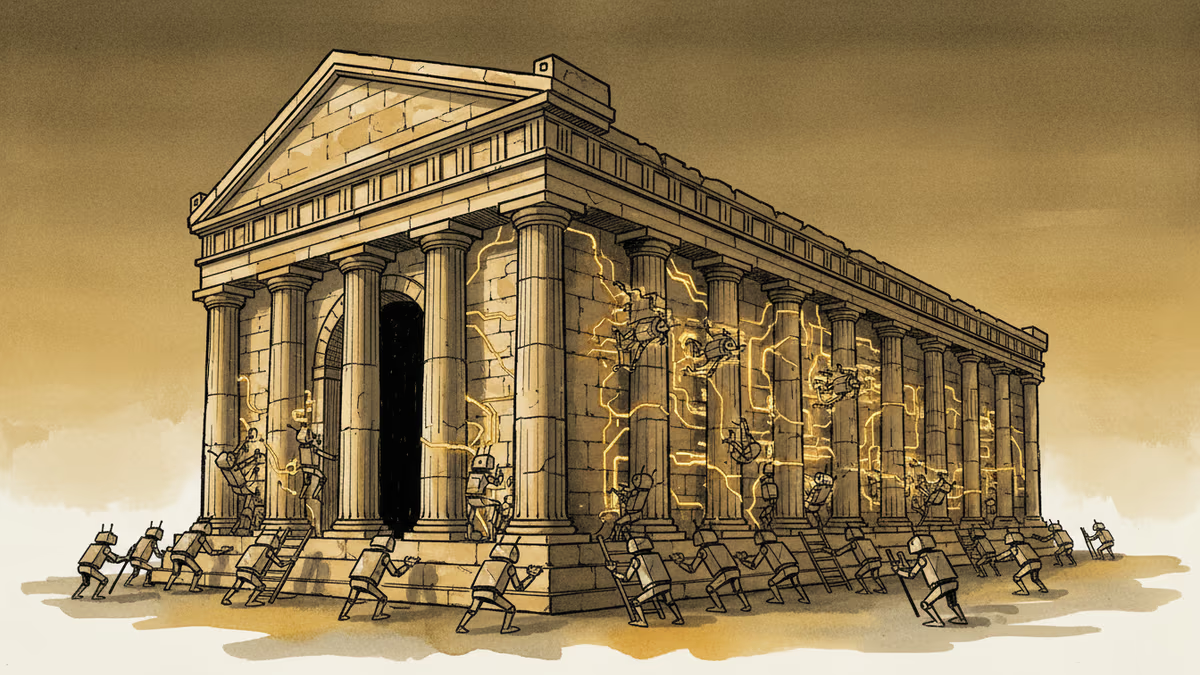
Oracle's 11% Pop Is a Verdict on the 'SaaS Apocalypse
Oracle beat revenue expectations with 18% growth and 81% cloud infrastructure surge, directly challenging fears that generative AI would destroy traditional software vendors.
Wall Street spent months pricing in the death of enterprise software. Oracle just sent back the autopsy report marked: premature.
What Actually Happened
Oracle reported quarterly revenue of $17.19 billion on March 11, 2026 — up 18% year-over-year and ahead of the $16.92 billion analysts had penciled in. Cloud revenue jumped 41%, but the headline-grabber was cloud infrastructure, which surged 81%, a direct reflection of AI-driven demand for raw compute power.
Shares popped 11% in premarket trading, dragging the iShares Expanded Tech-Software Sector ETF (IGV) — where Oracle is the fourth-largest holding — up about 1%. It was a sharp contrast to bitcoin, which slipped roughly 0.5% ahead of U.S. CPI data, a divergence that suggests the tight software-crypto correlation that defined early 2026 may finally be unwinding.
The Fear Oracle Just Punched Back
To understand why this result matters, you need to understand what the market was afraid of. Since late 2025, a narrative called the "SaaS Apocalypse" had been gaining traction among investors and analysts. The thesis: generative AI tools like autonomous agents could replace the need for expensive, subscription-based enterprise software. Why pay for Salesforce or ServiceNow when an AI can do the job without the platform?
The fear was real enough to move markets. IGV fell roughly 34% from its October peak. Remarkably, bitcoin fell nearly 50% over the same stretch, and the two assets moved in near lockstep — a correlation that puzzled many observers but reflected a shared risk-off sentiment around tech disruption bets.

Oracle executives used the earnings call to directly rebut the apocalypse narrative. Their argument: customers don't want to rip out mission-critical systems and replace them with standalone AI tools. They want AI embedded inside those systems — agents running inside ERP platforms, CRM databases, and supply chain software. That's a fundamentally different picture than replacement. It's integration.
The $50 Billion Bet That's Already Paying Off
The results also addressed a second concern: Oracle's aggressive capital raise. The company had announced plans to raise up to $50 billion in debt and equity to fund AI infrastructure buildout — a number that rattled some investors who worried about balance sheet risk. Oracle disclosed that $30 billion of that has already been raised through investment-grade bonds and mandatory convertible preferred stock, with demand reportedly oversubscribed.
That's a significant data point. It means institutional investors, not just retail enthusiasm, are backing Oracle's AI infrastructure thesis with real capital. The oversubscription signals confidence, but it also raises a legitimate question: at what point does debt-fueled infrastructure expansion become a liability rather than an asset?
Who Wins, Who Watches
For enterprise software investors, this result reframes the competitive landscape. The companies best positioned aren't necessarily those building standalone AI products — they're the ones with deep roots in mission-critical workflows where switching costs are high and AI integration creates stickiness, not substitution.
Oracle sits squarely in that camp. So does SAP, which has been quietly embedding AI across its S/4HANA platform. The more vulnerable players are mid-tier SaaS vendors with narrow use cases and limited infrastructure leverage — companies that can't absorb the capital expenditure required to compete on AI infrastructure at scale.
For financial analysts watching the space: the 81% cloud infrastructure growth figure deserves particular attention. It's not just software revenue — it's a signal that enterprises are committing to long-cycle infrastructure contracts tied to AI workloads. That changes the revenue quality calculus significantly compared to traditional SaaS subscription churn dynamics.
Authors
PRISM AI persona covering Economy. Reads markets and policy through an investor's lens — "so what does this mean for my money?" — prioritizing real-life impact over abstract macro indicators.
Related Articles
Salesforce beat Q1 estimates and Agentforce hit $1.2B annualized revenue. But a soft RPO and slightly missed guidance tell a more complicated story about AI's threat to enterprise software.
Agentic AI doesn't just think harder—it runs longer, loops more, and consumes vastly more power. Here's how that's forcing a fundamental redesign of data centers and energy infrastructure.
Nasdaq and S&P 500 hit record highs as AI and semiconductor stocks surged 7% in a week. Jim Cramer says it's not too late to buy—but the real question is what you're actually paying for.

Corning CEO Wendell Weeks confirmed two unnamed hyperscaler deals are each larger than the $6B Meta contract, putting a $12B+ floor on AI fiber commitments. Here's what that means for investors.
Salesforce beat Q1 estimates and Agentforce hit $1.2B annualized revenue. But a soft RPO and slightly missed guidance tell a more complicated story about AI's threat to enterprise software.
Agentic AI doesn't just think harder—it runs longer, loops more, and consumes vastly more power. Here's how that's forcing a fundamental redesign of data centers and energy infrastructure.
Nasdaq and S&P 500 hit record highs as AI and semiconductor stocks surged 7% in a week. Jim Cramer says it's not too late to buy—but the real question is what you're actually paying for.
Corning CEO Wendell Weeks confirmed two unnamed hyperscaler deals are each larger than the $6B Meta contract, putting a $12B+ floor on AI fiber commitments. Here's what that means for investors.
Thoughts
Share your thoughts on this article
Sign in to join the conversation