
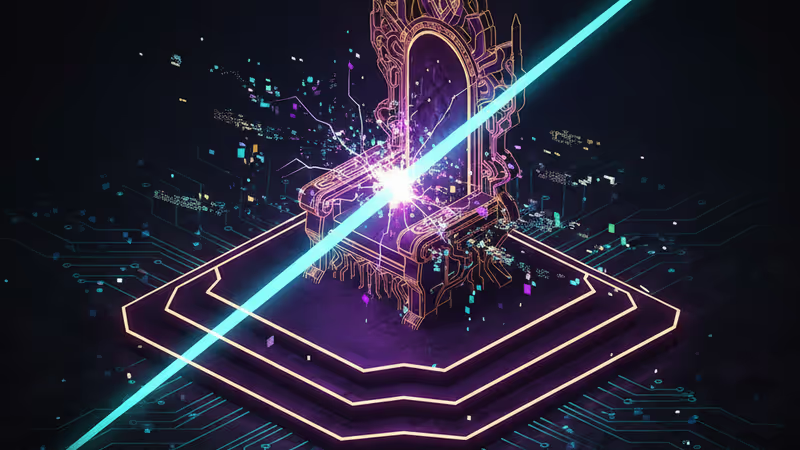
OpenAI's New Image Model Isn't Just Faster—It's a Direct Assault on Midjourney's Throne
OpenAI's new image model is 4x faster, but the real story is its strategic attack on Midjourney's creative dominance. Here's why it's a game-changer.
The Lede: Beyond the Hype
OpenAI just announced a major upgrade to its image generation model within ChatGPT, boasting a 4x speed increase and superior detail consistency. While faster image creation is a welcome update for consumers, the real story isn't about speed. It's a calculated, strategic strike aimed directly at the heart of the professional creative market—a space long dominated by Midjourney—and a signal that the AI platform wars are entering a new, more aggressive phase.
Why It Matters
This move fundamentally alters the competitive landscape. For months, the consensus was that ChatGPT was a jack-of-all-trades, while specialized tools like Midjourney held the crown for professional-grade quality and artistic consistency. OpenAI's update directly challenges that narrative. Here are the second-order effects most are missing:
- Commoditization of High-End AI Art: By integrating a 'flagship' model directly into the widely accessible ChatGPT and its API, OpenAI is turning what was a specialized skill (prompt engineering on Midjourney) into a commoditized utility.
- The API is the Trojan Horse: The consumer-facing update gets the headlines, but the release of GPT-Image-1.5 via the API is the real enterprise play. It allows businesses to build reliable, fast, and consistent visual generation directly into their products, a capability Midjourney has been slow to offer.
- Forcing the Hand of Competitors: Midjourney and Stability AI can no longer compete solely on image quality. The new battleground is a three-front war: quality, speed, and platform integration. OpenAI is now weaponizing its scale and infrastructure.
The Analysis: Deconstructing the Attack
The Battle for Creative Consistency
The earliest days of AI image generation were defined by novelty and randomness. The key challenge for professional use has always been consistency—the ability to generate the same character, style, or object across multiple images. Midjourney excelled here, making it the tool of choice for designers and storytellers. OpenAI’s explicit focus on “consistent details” and “more precise edits” is a direct declaration that it is no longer ceding this crucial professional market. This isn't an iteration; it's an invasion of a competitor's core territory.
Speed as a Strategic Weapon
A 4x speed increase isn't just a quality-of-life improvement. In the world of AI, speed is synonymous with cost and scalability. For an enterprise using the API, faster generation means lower latency for their applications and a lower cost-per-image. For OpenAI, it means significantly reduced compute costs, allowing them to scale the service more profitably. This efficiency creates a moat that smaller, less-capitalized players will struggle to cross. It transforms image generation from a slow, deliberate process into a near-instantaneous utility, unlocking new use cases in real-time content moderation, dynamic advertising, and rapid prototyping.
PRISM Insight: The Shift from Generative to Controllable AI
Industry Implications: The Squeeze on Stock Photos and Agencies
With this level of speed and consistency available via an API, the threat to traditional content providers like Shutterstock and Getty Images intensifies dramatically. Why license a generic stock photo when you can generate a perfectly tailored, brand-consistent image in seconds for a fraction of the cost? This move also puts pressure on marketing and design agencies. The baseline for creative work is now elevated; routine design tasks that once required billable hours can be automated, forcing agencies to move up the value chain to pure strategy and high-concept creative direction.
Technology Trend: The End of the 'Magic Box' Era
This update signals the maturation of generative AI. The market is moving beyond the 'magic box' approach, where users type a prompt and hope for the best. The emphasis on “precise edits” points to a future of controllable AI. Professionals don't need a slot machine; they need a scalpel. The next frontier isn't just about generating an image, but about giving creators granular control over composition, lighting, character posing, and style. By building these features into their flagship model, OpenAI is positioning itself as the foundational platform for this next generation of professional-grade creative tools.
PRISM's Take
OpenAI is done playing nice. This isn't just another feature drop; it's a consolidation of power. By integrating a high-performance, consistent, and fast image model into its ubiquitous ChatGPT platform and developer-friendly API, OpenAI is executing a classic platform strategy: absorb the features of niche competitors and offer them at scale. The company is betting that accessibility and integration will ultimately triumph over the walled-garden approach of rivals like Midjourney. The era of standalone AI art tools is drawing to a close. The war for the all-encompassing AI creative platform has just begun, and OpenAI has fired its most powerful shot yet.
Related Articles
OpenAI's new image editing AI commoditizes photorealistic manipulation, challenging the future of media, trust, and the very concept of photographic proof.
OpenAI's ChatGPT app store is more than a feature. It's a strategic move to build the next OS, igniting a new platform war and a developer gold rush.
Adobe's AI lawsuit over pirated books highlights a systemic risk. Our analysis explores the 'original sin' of training data and why data provenance is critical.
BNY is arming 20,000 employees with OpenAI tools. This isn't just about efficiency—it's a radical bet on citizen developers that redefines Wall Street's tech race.