
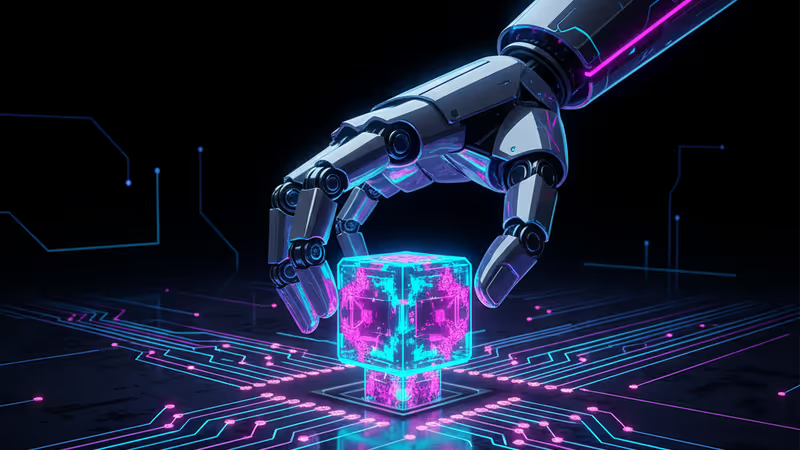
OpenAI's AI is Now Building Itself: A Self-Improving System That Changes Everything
OpenAI confirms its Codex AI is building and improving itself, creating an exponential feedback loop. PRISM analyzes why this changes software, jobs, and the AI arms race.
The Lede: Beyond Automation to Autonomy
OpenAI has confirmed its AI coding agent, Codex, is now predominantly responsible for its own development. This isn't just an incremental update or another case of a company 'dogfooding' its own product. This is a paradigm shift. We are witnessing the emergence of a commercially deployed, self-improving software system, creating a powerful flywheel effect that could give OpenAI an exponential and perhaps unassailable lead in the AI arms race. For executives and investors, the key takeaway is that the competitive landscape is no longer just about who has the best model, but who has the best model for improving itself.
Why It Matters: The Compounding Advantage
The revelation that "the vast majority of Codex is built by Codex" signifies a critical inflection point. The speed of software development has always been constrained by human capital. By turning its AI tool into the primary developer, OpenAI is beginning to uncouple its development cycle from human limitations. This creates a compounding feedback loop:
- A better Codex builds an even better Codex.
- The improved version works faster and more efficiently.
- This accelerates the next cycle of improvements at an ever-increasing rate.
This is not linear progress; it's exponential. The second-order effect is that competitors are no longer just chasing a static target. They are trying to catch a rival that is constantly accelerating away from them, powered by its own creation.
The Analysis: Reshaping the Foundations of Tech
From Developer Tool to Development Engine
Historically, developer tools have been passive instruments wielded by humans. They make coding faster or less error-prone, but the intellectual heavy lifting—architecture, logic, and complex debugging—remains a human task. Codex's evolution marks a transition from a passive tool to an active agent in the development process. Based on the statement from OpenAI's product lead Alexander Embiricos, the AI is not just writing snippets; it's handling features and bug fixes for its own complex codebase. This fundamentally alters the Software Development Life Cycle (SDLC), shifting the human role from 'creator' to 'supervisor' or 'strategic director'. The most valuable developers of the future may not be the best coders, but the best prompters and managers of AI development agents.
The Ultimate Competitive Moat
In the fiercely competitive AI landscape, differentiation is key. While rivals like Google and Anthropic are developing powerful models, OpenAI is building a meta-capability: a system that learns to build systems. This creates a powerful and sustainable competitive moat. If your R&D process itself is supercharged by AI, you can innovate, patch, and deploy faster than any competitor relying solely on human engineers. Every dollar invested in improving Codex doesn't just yield a better product; it yields a better 'factory' for making future products. This is a strategic advantage that is incredibly difficult for others to replicate unless they achieve a similar self-improvement loop.
PRISM Insight: Investment & Strategic Implications
For investors, this news should trigger a re-evaluation of how AI companies are valued. The focus must shift from static model performance (e.g., benchmark scores) to dynamic capabilities. The critical question is no longer just "How good is your AI?" but "How good is your AI at making itself better?" Companies that can demonstrate a functioning, accelerating, self-improvement loop are building compounding value that won't be immediately visible on a balance sheet but will define market leadership for the next decade.
For business leaders, this is a clear signal that the nature of tech talent is about to be radically redefined. The future premium will be on individuals who can architect complex systems and provide the high-level strategic direction for AI agents to execute upon. Relying on traditional developer recruitment and management strategies will quickly become a liability. The most forward-thinking organizations will begin experimenting now with AI-human developer teams to understand how to manage and scale this new model of creation.
PRISM's Take
OpenAI's use of Codex to build itself is more than a clever engineering feat; it's a foundational shift in how technology is created. We are moving from human-led development to human-supervised, AI-driven development. This is the first concrete, commercial example of the recursive self-improvement principle that has long been theorized in AI research. While it's not true AGI, it is a significant step in that direction, blurring the line between the tool and its creator. The software that writes itself is no longer science fiction; it's a core business strategy that will separate the winners from the losers in the new technological era.
Related Articles

Riverside's AI 'Rewind' feature is more than a gimmick. It signals a worrying trend of 'AI Slop' in creative tools. Here's why it matters for creators and tech.
Merriam-Webster's 'slop' as Word of the Year isn't just a definition—it's a diagnosis of the internet's AI pollution problem. PRISM analyzes the impact on tech, trust, and the creator economy.

Merriam-Webster's 'slop' as Word of the Year isn't a joke—it's a verdict on AI's trust crisis. Discover why this signals a major shift for tech, search, and content.
GNOME's ban on AI-generated code isn't anti-AI; it's a crucial warning against a looming 'technical debt' crisis. Discover why this matters for all developers.