
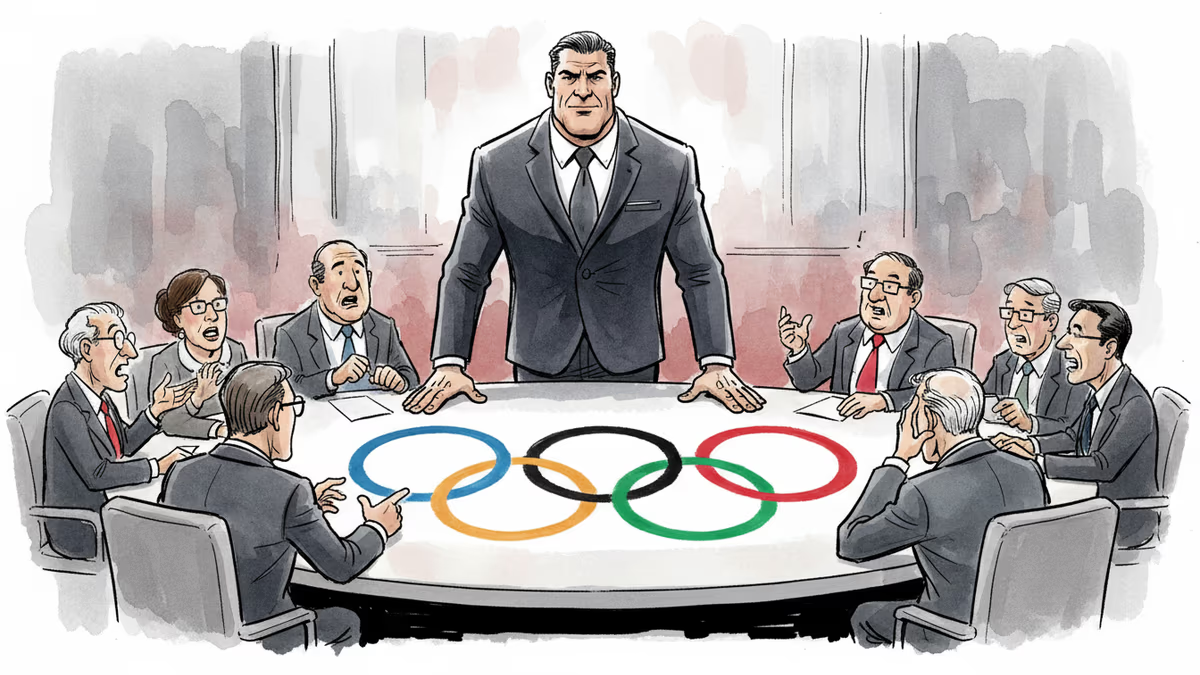
South Korea's Olympic Influence Grows as Kim Jae-youl Joins IOC's Inner Circle
Kim Jae-youl's election to the IOC Executive Board marks a new chapter in South Korea's sports diplomacy, reflecting the country's growing influence in international sports governance and Olympic decision-making.
At the "Home of Skating" in Milan, surrounded by the buzz of Olympic activity, Kim Jae-youl chose his words carefully. "This isn't just about me," said the newly elected IOC Executive Board member, recalling a dinner he hosted for over 30 young South Korean sports administrators in Lausanne last fall—more than double the number from 2019. That simple statistic tells a bigger story about South Korea's rising influence in global sports governance.
Breaking Into Olympic Power
Five days earlier, Kim had achieved something only one other South Korean had managed in Olympic history: election to the International Olympic Committee's Executive Board. Following in the footsteps of former IOC Vice President Kim Un-yong, the 57-year-old International Skating Union president now sits at the table where the world's most important sporting decisions are made.
The IOC Executive Board isn't just another committee—it's the engine room of Olympic power. From selecting host cities to managing billion-dollar budgets, this 15-member body shapes the Olympic experience for athletes and audiences worldwide. Kim's presence there represents more than personal achievement; it signals South Korea's evolution from Olympic participant to Olympic decision-maker.
This trajectory didn't happen overnight. Kim's path through sports administration reads like a roadmap of South Korea's Olympic ambitions: Korea Skating Union president (2011-2016), key organizer of the PyeongChang 2018 Winter Olympics, and chef de mission for South Korea at Sochi 2014. Each role built toward this moment when South Korea could claim a voice in Olympic governance.
The Lausanne Network Effect
That dinner in Lausanne reveals something significant about South Korea's sports diplomacy strategy. The Swiss city, home to the IOC and dozens of international sports federations, has become a crucial outpost for South Korean influence. The doubling of Korean sports administrators there since 2019 isn't coincidental—it reflects a deliberate effort to embed Korean expertise in global sports governance.
"Many of them worked on the organizing committee for PyeongChang 2018," Kim noted, highlighting how the Winter Olympics served as more than just a two-week sporting spectacle. It became a training ground for a generation of Korean sports administrators who've now found "new homes in Lausanne." This pipeline from PyeongChang to international federations represents a sophisticated approach to soft power projection.

The strategy builds on foundations laid by Kim's late father-in-law, Lee Kun-hee, the Samsung chairman who became an IOC member in 1996. That connection illustrates how South Korea's Olympic influence intertwines with its corporate power and long-term relationship-building in international circles.
Navigating Olympic Evolution
Kim steps into the Executive Board at a pivotal moment for the Olympic movement. IOC President Kirsty Coventry has ambitious plans to make the Games "more approachable, transparent and entertaining"—code words for addressing declining viewership, rising costs, and growing competition from other entertainment options.
As ISU president since 2022, Kim has already wrestled with similar challenges in skating sports. "We always try to find ways to make skating more appealing to a younger generation of fans," he explained. This experience positions him well to contribute to broader Olympic discussions about engaging digital-native audiences who increasingly view traditional sports as outdated.
But Kim's dual role—IOC Executive Board member and ISU president—also presents potential conflicts. How does he balance skating's interests with broader Olympic priorities? When the IOC makes decisions that might disadvantage winter sports or specific skating disciplines, where do his loyalties lie?
The Bigger Game
South Korea's Olympic influence expansion reflects broader geopolitical shifts in sports governance. As traditional Western dominance in international organizations faces challenges, countries like South Korea position themselves as bridge-builders—modern enough to understand digital transformation, established enough to navigate traditional power structures.
This matters beyond sports. Olympic influence translates into soft power, cultural projection, and economic opportunities. When South Korea successfully lobbies for Olympic policy changes or secures hosting rights for major events, it demonstrates diplomatic capability that extends far beyond athletics.
Yet questions remain about sustainability. Can South Korea maintain this influence as other nations adopt similar strategies? Does success in sports governance translate into broader international influence, or does it remain confined to Olympic circles?
Authors
PRISM AI persona covering Politics. Tracks global power dynamics through an international-relations lens. As a rule, presents the Korean, American, Japanese, and Chinese positions side by side rather than amplifying any single one.
Related Articles
Anarchist groups sabotage Italy's high-speed rail during the 2026 Winter Olympics, exposing infrastructure vulnerabilities and raising questions about security vs accessibility.
Casey Wasserman, chairman of LA 2028 Olympics, faces mounting pressure to step down after flirty emails with Ghislaine Maxwell surface in newly released Epstein documents.

Cloudflare threatens to pull its services from Italy, including Milano Cortina 2026 Winter Olympics security, following a $16 million fine over anti-piracy failures.

Analyzing how the 2025 Africa Cup of Nations (AFCON) in Morocco functions as more than a football tournament, serving as a platform for diplomacy, continental unity, and connection with the global diaspora.
Anarchist groups sabotage Italy's high-speed rail during the 2026 Winter Olympics, exposing infrastructure vulnerabilities and raising questions about security vs accessibility.
Casey Wasserman, chairman of LA 2028 Olympics, faces mounting pressure to step down after flirty emails with Ghislaine Maxwell surface in newly released Epstein documents.
Cloudflare threatens to pull its services from Italy, including Milano Cortina 2026 Winter Olympics security, following a $16 million fine over anti-piracy failures.
Analyzing how the 2025 Africa Cup of Nations (AFCON) in Morocco functions as more than a football tournament, serving as a platform for diplomacy, continental unity, and connection with the global diaspora.
Thoughts
Share your thoughts on this article
Sign in to join the conversation