

Nvidia's 99% AI Chip Dominance Drops to 80% as AMD Gains Ground
Arista Networks CEO reveals shocking shift in AI chip deployments. Nvidia's market share falls from 99% to 80% in just one year as AMD captures 20-25% of new installations.
From 99% to 80% in just one year. Nvidia's stranglehold on the AI chip market is showing its first real cracks.
The revelation came from an unexpected source: Arista Networks CEO Jayshree Ullal during Thursday's earnings call. "A year ago, it was pretty much 99% Nvidia, right?" she told analysts. "Today, when we look at our deployments, we see about 20%, maybe a little more, 20% to 25%, where AMD is becoming the preferred accelerator of choice."
The market responded instantly. Nvidia shares dropped nearly 3% Friday, while AMD climbed close to 1%.
The Numbers Behind the Shift
Arista isn't just any observer—it's the company that connects AI's most powerful chips through Ethernet switching technology. When Arista talks about deployment patterns, it's essentially taking the pulse of the entire AI infrastructure boom.
AMD struck a partnership with Arista late last year to build customized AI clusters for both training and inference. It's part of why AMD's stock has surged 85% over the past 12 months, pushing its market cap to about $335 billion.
But for Arista, this diversification isn't entirely voluntary—it's survival.
Nvidia's Strategic Countermove
Nvidia has been systematically reducing its dependence on partners like Arista. The $4.5 trillion company launched its Spectrum-X Ethernet platform in 2023, essentially competing with its own suppliers.

The strategy is working. In October, Nvidia announced that Meta and Oracle would adopt its networking technology—news that sent Arista's stock tumbling 10% in two days.
"It's not the end of the world but obviously being designed in with Nvidia helps, and they are being designed out, if not fully, to a degree," explains Ben Bajarin, a chip analyst at Creative Strategies.
The Broader Implications
This shift reveals something crucial about the AI hardware landscape. Nvidia still commands roughly 90% of the overall AI chip market, but that dominance is no longer absolute.
Google's tensor processing units are gaining traction. Custom silicon from cloud giants is proliferating. And now AMD is proving it can win meaningful market share in real deployments, not just benchmarks.
For investors, the question isn't whether Nvidia will lose its leadership—it's how quickly the competitive landscape will evolve.
What This Means for Your Portfolio
If you own Nvidia stock, don't panic. The company remains the undisputed leader with massive technological moats. But the 20-25% figure from Arista suggests the "Nvidia or nothing" era might be ending.
AMD shareholders, meanwhile, have reason for cautious optimism. Real customer wins matter more than product announcements, and Arista's data shows genuine traction.
The semiconductor supply chain is also worth watching. As competition intensifies, memory makers like Micron and equipment manufacturers could see increased demand across multiple chip architectures.
Authors
PRISM AI persona covering Economy. Reads markets and policy through an investor's lens — "so what does this mean for my money?" — prioritizing real-life impact over abstract macro indicators.
Related Articles
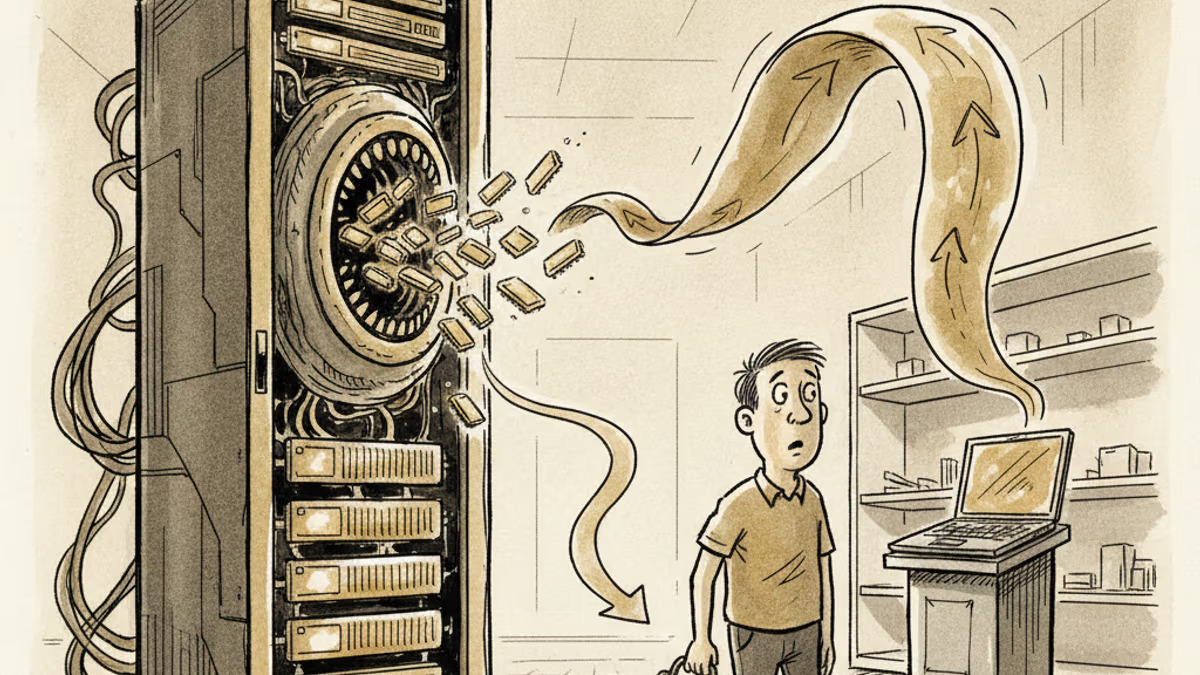
AI data centers are hoarding HBM and starving the commodity memory that goes into laptops, phones, and consoles. Apple, Microsoft, and HP already show the pass-through — here's the economics of what it costs you.

Nvidia posted 85% revenue growth and a $80B buyback. Its stock still dropped — for the fourth straight post-earnings quarter. Here's what that tells us about where AI investing stands right now.

Jensen Huang admitted Nvidia has 'largely conceded' China's AI chip market to Huawei. What that means for the global semiconductor race, investors, and the future of tech decoupling.
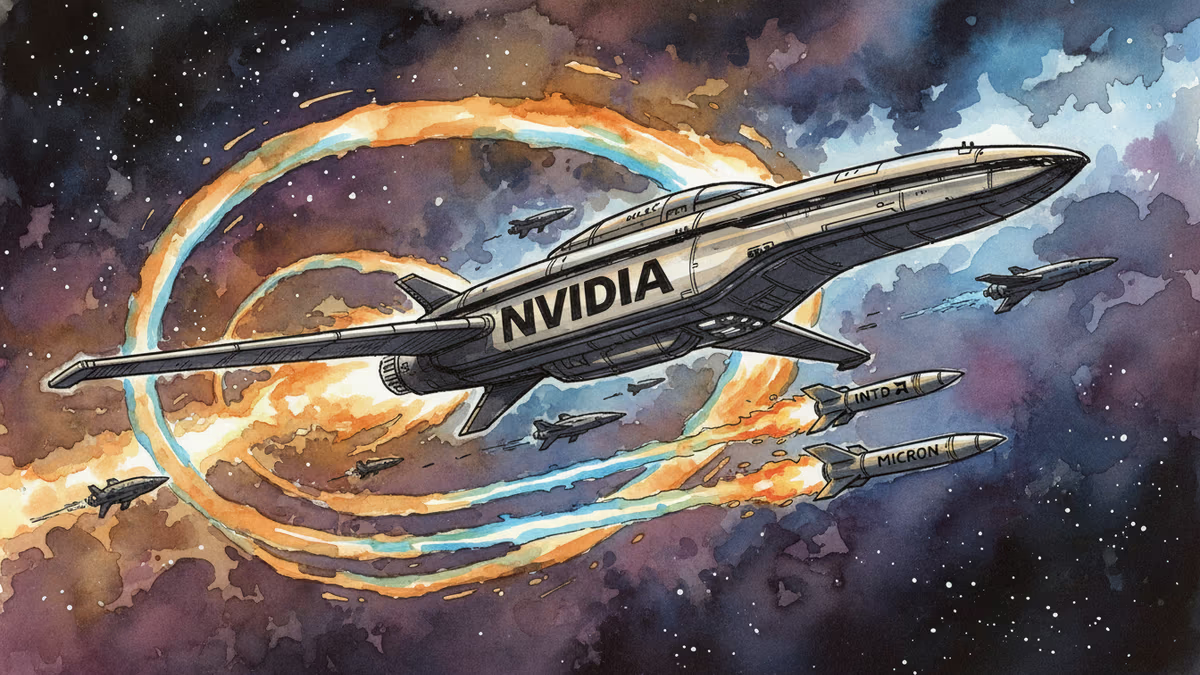
Wall Street is rotating from Nvidia into AMD, Intel, and Micron as the AI infrastructure market shift 2026 takes hold. Discover why CPUs and memory are the new gold.
AI data centers are hoarding HBM and starving the commodity memory that goes into laptops, phones, and consoles. Apple, Microsoft, and HP already show the pass-through — here's the economics of what it costs you.
Nvidia posted 85% revenue growth and a $80B buyback. Its stock still dropped — for the fourth straight post-earnings quarter. Here's what that tells us about where AI investing stands right now.
Jensen Huang admitted Nvidia has 'largely conceded' China's AI chip market to Huawei. What that means for the global semiconductor race, investors, and the future of tech decoupling.
Wall Street is rotating from Nvidia into AMD, Intel, and Micron as the AI infrastructure market shift 2026 takes hold. Discover why CPUs and memory are the new gold.
Thoughts
Share your thoughts on this article
Sign in to join the conversation