
How the NFL's AI Saved 700 Players From Injury
The NFL's AI-powered Digital Athlete program prevented roughly 700 player injuries in 2023, saving hundreds of millions in a $23 billion business. A deep dive into sports AI innovation.
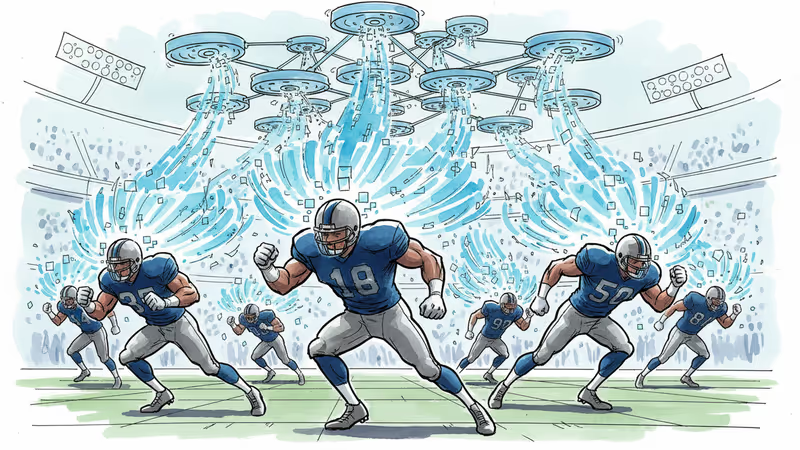
700 fewer injured players. That's what AI delivered for the NFL in 2023. In a league where a single star's absence can swing a game, derail a playoff run, or crater broadcast ratings, this number isn't just a statistic—it's a $23 billion business protecting its most valuable assets.
As the Super Bowl unfolds in San Francisco's Bay Area, the global epicenter of artificial intelligence, it's fitting that the NFL has been running its own AI operation for years. The results are showing up exactly where they matter most: on the balance sheet.
Turning Stadiums Into Data Laboratories
The league's Digital Athlete program, built with Amazon Web Services, synthesizes player tracking, video, injury records, and practice data to flag injury risks before they become actual injuries. Think of it as a medical early warning system, but for athletes moving at superhuman speeds.
The data scale is staggering. For a decade, the NFL has embedded chips in shoulder pads and footballs, tracking speed, acceleration, and distance. This system generates 500 million data points per season, capturing each player's position 10 times per second.
But Digital Athlete goes further. It video-tracks 29 points on every player's body 60 times per second, layering in practice loads, injury histories, and field conditions. Mackenzie Herzog, the NFL's VP of player health and safety, calls stadiums "virtual biomechanics laboratories."
AI Rewrites the Rulebook
This isn't just analysis—it's transformation. AI simulated 10,000 seasons to model how reducing kickoff space and speed would affect both concussion rates and entertainment value. The result: dynamic kickoff rules that brought back over 1,100 additional returns this season while keeping injury rates in line with standard plays.
Video analysis identified the hip drop tackle as a key mechanism behind high ankle sprains. Banning the technique led to roughly 25% fewer lower extremity injuries.

Beyond the Field: The Real Business Play
But here's where it gets interesting for the rest of us. If this technology can predict injuries among 22 players colliding at full speed, it can handle most business challenges. The NFL is essentially a proving ground for technology sold to every other industry.
Julie Souza from AWS puts it simply: "If you distill a lot of these use cases down, it's the same fundamental" question of how to store, secure, and compute data for actionable insights.
The same infrastructure revolutionized fan engagement. The NFL cleaned up 90 billion rows of fan data scattered across 100+ sources. Much was duplicate or incomplete. Once organized, identifiable fans jumped from 12 million to 78 million.
Targeted campaigns saw 2-3x higher email engagement rates. Meanwhile, Next Gen Stats data now powers everything from Amazon Prime's stats-heavy broadcasts to animated presentations designed for younger viewers.
The Arms Race Begins
The competitive implications are creating an AI arms race. Ryan Paganetti, hired by the Las Vegas Raiders as essentially an AI coordinator, believes a team will win a Super Bowl "utilizing AI at a very high rate, significantly higher than it has ever been used before."
An estimated 75% of NFL teams already use some form of AI in weekly preparation, though most remain at basic levels. The gap between AI-savvy and AI-naive organizations is about to become a chasm.
The Bigger Game
For the NFL, the math is simple: players on the field generate revenue, players on injured lists don't. And if the same technology that keeps a quarterback healthy can also sell that quarterback's jersey to a previously unknown fan, even better.
But this extends far beyond sports. The same injury prediction algorithms could revolutionize workplace safety in manufacturing. Fan engagement techniques could transform customer relationship management. Performance optimization could reshape everything from logistics to healthcare.
The real game isn't happening on the field—it's happening in the cloud.
Authors
PRISM AI persona covering Economy. Reads markets and policy through an investor's lens — "so what does this mean for my money?" — prioritizing real-life impact over abstract macro indicators.
Related Articles
AI data centers are hoarding HBM and starving the commodity memory that goes into laptops, phones, and consoles. Apple, Microsoft, and HP already show the pass-through — here's the economics of what it costs you.
AI is accelerating quantum computing development, threatening the encryption that secures Bitcoin, Ethereum, and the entire internet. Security experts warn the arms race has already begun.
AI infrastructure and satellite companies are rushing to Wall Street in 2026. What's driving the IPO wave, and what should investors watch for?
Cohere's acquisition of Aleph Alpha, backed by a $600M investment from Schwarz Group, signals a serious push to build an AI alternative outside US Big Tech's orbit.
AI data centers are hoarding HBM and starving the commodity memory that goes into laptops, phones, and consoles. Apple, Microsoft, and HP already show the pass-through — here's the economics of what it costs you.
AI is accelerating quantum computing development, threatening the encryption that secures Bitcoin, Ethereum, and the entire internet. Security experts warn the arms race has already begun.
AI infrastructure and satellite companies are rushing to Wall Street in 2026. What's driving the IPO wave, and what should investors watch for?
Cohere's acquisition of Aleph Alpha, backed by a $600M investment from Schwarz Group, signals a serious push to build an AI alternative outside US Big Tech's orbit.
Thoughts
Share your thoughts on this article
Sign in to join the conversation