
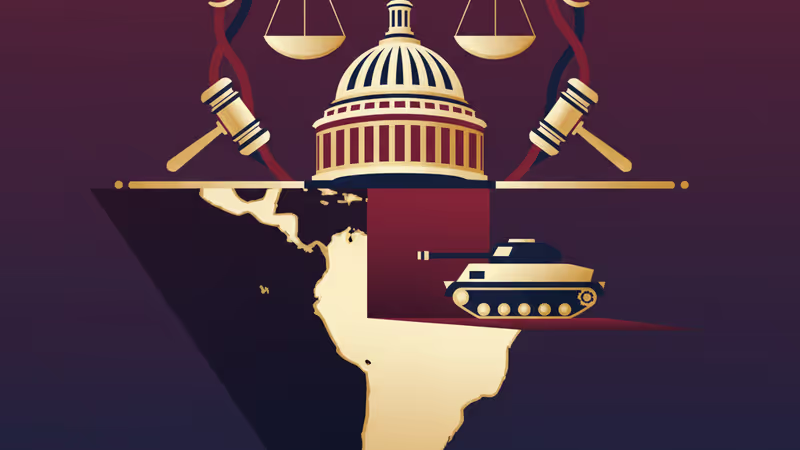
Moulton Bill Explained: Congress Moves to Block Trump Administration Funds for Military Action in Venezuela
Democratic Rep. Seth Moulton has introduced a bill to block the Trump administration from using federal funds for military action in Venezuela, reigniting the U.S. debate on presidential war powers.
In a direct challenge to presidential authority, Democratic Congressman Seth Moulton of Massachusetts has introduced legislation aimed at preventing the Trump administration from using federal funds for military action against Venezuela. The move, announced on December 23, 2025, escalates the ongoing debate over war powers between the White House and Congress.
A Legislative Check on Executive Power
According to NPR, which spoke with the congressman, the bill explicitly seeks to prohibit the use of federal dollars to "wage war with Venezuela." This legislative strategy leverages one of Congress's most significant constitutional powers—the power of the purse. By controlling federal spending, lawmakers aim to create a legal barrier against any potential military intervention that has not received their explicit authorization.
For context, relations between the United States and Venezuela have been strained for years, marked by diplomatic tensions, economic sanctions, and differing political ideologies. This bill arises from concerns within some U.S. political circles about the potential for these tensions to escalate into armed conflict.
The Broader War Powers Debate
This move is not occurring in a vacuum. It taps into a long-standing constitutional debate in the U.S. over the separation of powers. While the President serves as Commander-in-Chief of the armed forces, the U.S. Constitution grants Congress the sole power to declare war. Congressman Moulton's bill represents an attempt by the legislative branch to reassert this authority and place a preemptive check on the executive's ability to initiate military hostilities independently.
The bill's passage is uncertain and will likely face significant political opposition. However, its introduction alone serves as a powerful political statement and a clear signal from a faction within the Democratic Party regarding the limits of presidential power in foreign policy.
This legislation is less about Venezuela itself and more a litmus test for congressional relevance in 21st-century foreign policy. If successful, it could establish a modern precedent for lawmakers to preemptively restrict military options in other global hotspots, potentially shifting the balance of power from the White House back to Capitol Hill.
This content is AI-generated based on source articles. While we strive for accuracy, errors may occur. We recommend verifying with the original source.
Related Articles

President Donald Trump has declared Greenland essential for U.S. national security and appointed a special envoy, drawing a fierce rebuke from Denmark and Greenland, who called the move a violation of sovereignty.
Donald Trump announced the US will retain or sell seized Venezuelan oil tankers and their cargo, escalating a pressure campaign against Nicolás Maduro's government. The move, condemned as 'piracy' by Caracas, has led to an emergency UN Security Council meeting.

Former South Korean President Yoon Suk Yeol denies allegations he sent drones into North Korea to create a pretext for martial law, citing a phone call with Donald Trump as part of his defense.

Veteran GOP strategist Marc Short discusses the Republican Party's current state and emerging leaders in an NPR interview, offering clues to its future direction ahead of the 2026 and 2028 elections.