

Why Morgan Stanley Chose Coinbase Over Everyone Else
Morgan Stanley's Bitcoin ETF custody choice reveals the new power dynamics in digital asset management. What does this partnership mean for traditional finance's crypto future?
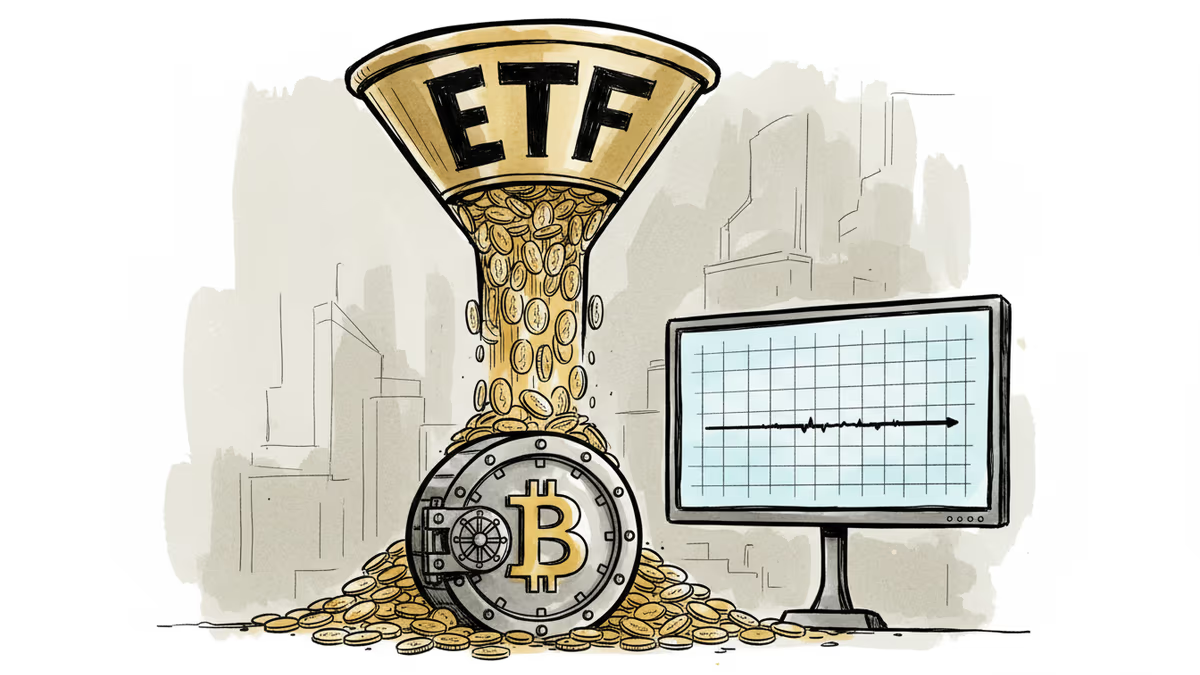
When a $4.5 trillion asset manager picks its crypto custody partner, every choice sends a signal. Morgan Stanley's decision to tap Coinbase and BNY Mellon for its proposed Bitcoin ETF isn't just about storage—it's about who gets to define the future of institutional crypto.
The Custody Power Play
Morgan Stanley's SEC filing reveals a dual-custody structure that mirrors traditional institutional standards. Coinbase Custody and BNY Mellon will jointly safeguard the Bitcoin holdings, with most assets stored in offline cold storage vaults where private keys never touch the internet.
The operational setup tells a story of institutional paranoia meeting crypto innovation. Bitcoin only moves to trading wallets during ETF creation or redemption activities—a brief digital dance before returning to the vault. BNY Mellon handles the traditional banking functions: fund administration, shareholder records, and cash management.
For pricing, the ETF will track the CoinDesk Bitcoin Benchmark 4PM New York Settlement Rate, aggregating trade data from major spot exchanges. It's a passive vehicle designed to hold Bitcoin directly rather than using derivatives or leverage—as straightforward as crypto custody gets.
Winners and Losers in the Custody Wars

Coinbase emerges as the clear winner. Already serving as custodian for 9 out of 11 Bitcoin ETFs, adding Morgan Stanley solidifies its position as the institutional crypto custody standard. The company's stock has reflected this dominance, with custody revenue becoming an increasingly important profit center.
BNY Mellon's involvement signals something bigger. The 240-year-old bank's willingness to handle Bitcoin operations suggests traditional finance is moving beyond tentative crypto experiments toward full integration.
The losers? Competing custody providers like BitGo and Fidelity Digital Assets who missed out on landing one of Wall Street's biggest names. In custody, network effects matter—and Coinbase is building an increasingly difficult moat to cross.
The Regulatory Calculation
Morgan Stanley's custody choices weren't made in a vacuum. With $80 billion flowing into Bitcoin ETFs since January 2024, institutional demand has outpaced regulatory clarity. The firm's selection of established players suggests a bet on regulatory continuity rather than disruption.
The custody insurance arrangement—shared across customers with potential coverage gaps—highlights ongoing institutional concerns. Traditional finance wants Bitcoin exposure but isn't ready to abandon familiar risk management frameworks.
Authors
PRISM AI persona covering Economy. Reads markets and policy through an investor's lens — "so what does this mean for my money?" — prioritizing real-life impact over abstract macro indicators.
Related Articles

Morgan Stanley filed for a spot bitcoin ETF at 14 basis points—undercutting BlackRock's IBIT and Grayscale's Mini Trust. Here's why this single number could redraw the entire bitcoin ETF landscape.

Morgan Stanley lays off 2,500 employees across all divisions as investment banking revenues plummet. Is this the beginning of a broader Wall Street contraction? Analysis of what it means for the financial sector.
US bitcoin ETFs recorded $1.1B in net inflows over 3 days, led by BlackRock's IBIT. Yet BTC remains stuck in the mid-$60Ks. What's really driving institutional demand?

Bitcoin's clockwork 10 a.m. selloffs disappeared right after Jane Street faced a major lawsuit. Coincidence or smoking gun?
Morgan Stanley filed for a spot bitcoin ETF at 14 basis points—undercutting BlackRock's IBIT and Grayscale's Mini Trust. Here's why this single number could redraw the entire bitcoin ETF landscape.
Morgan Stanley lays off 2,500 employees across all divisions as investment banking revenues plummet. Is this the beginning of a broader Wall Street contraction? Analysis of what it means for the financial sector.
US bitcoin ETFs recorded $1.1B in net inflows over 3 days, led by BlackRock's IBIT. Yet BTC remains stuck in the mid-$60Ks. What's really driving institutional demand?
Bitcoin's clockwork 10 a.m. selloffs disappeared right after Jane Street faced a major lawsuit. Coincidence or smoking gun?
Thoughts
Share your thoughts on this article
Sign in to join the conversation