
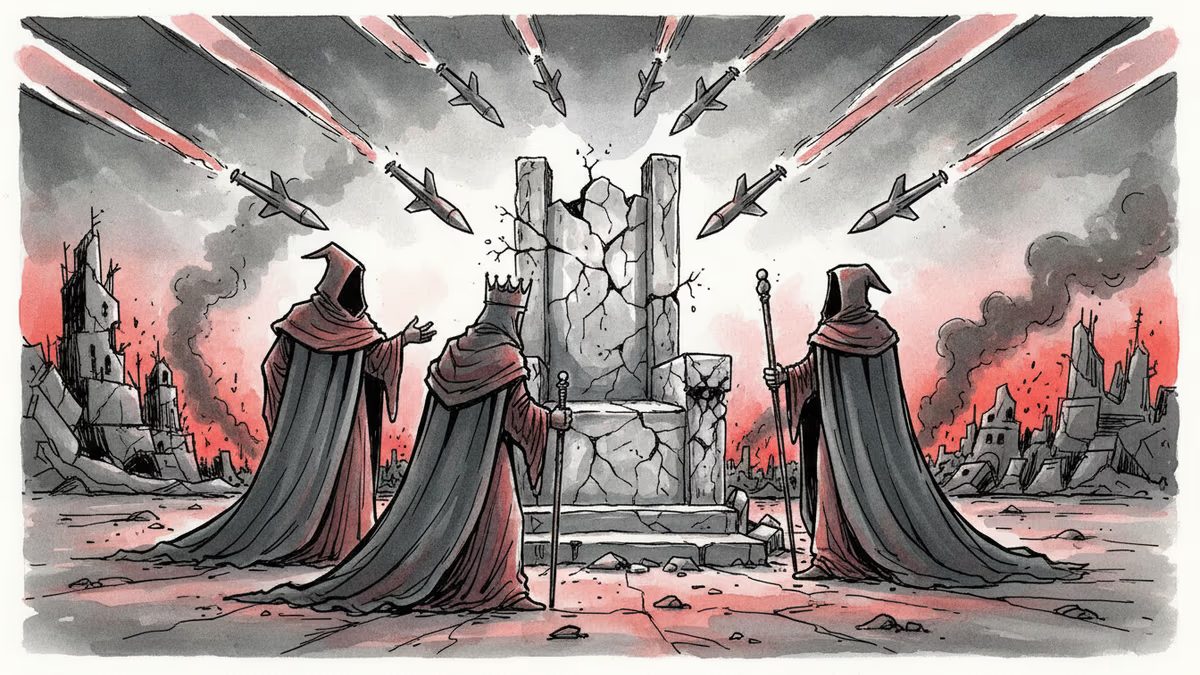
Iran's Supreme Leader Dies in Strikes as Power Vacuum Reshapes Middle East
Ayatollah Khamenei killed in US-Israeli airstrikes as Iran forms interim council. Escalating attacks threaten regional stability amid leadership transition crisis.
Can a theocracy survive the sudden death of its supreme authority? Iran is about to find out. Ayatollah Ali Khamenei, who ruled unchallenged for 36 years, was killed Saturday in US-Israeli airstrikes on Tehran, creating an unprecedented power vacuum as the Islamic Republic fights for its survival.
The End of an Era
The strikes that killed Khamenei weren't just an assassination—they decapitated Iran's entire military leadership. Mohammad Pakpour, commander-in-chief of the Revolutionary Guards, died alongside Abdolrahim Mousavi, chief of staff of Iran's armed forces, and Ali Shamkhani, head of the Defense Council. In one coordinated attack, decades of institutional knowledge and command structure vanished.
Iran's response has been to impose an information blackout. Internet connectivity remains almost entirely blocked for a second day, and authorities have "largely refrained from discussing missile impacts." But the evidence is visible: plumes of smoke rising over residential Tehran, a school bombing in Minab that killed over 150 people, many of them children.
The silence speaks volumes. When a regime stops talking about its losses, those losses are likely catastrophic.
Constitutional Crisis or Smooth Transition?
Iran's leaders insist they're following the playbook. President Masoud Pezeshkian announced that a "new leadership council has begun its work," with Foreign Minister Abbas Araghchi promising the process will be complete "within days." The interim council includes Pezeshkian, judiciary chief Gholam-Hossein Mohseni-Ejei, and newly appointed Ayatollah Alireza Arafi.
But constitutional procedures designed for peaceful transitions may not hold during wartime. The Assembly of Experts, tasked with selecting the next supreme leader, must now operate while dodging airstrikes. Can clerical deliberation function amid military chaos?

The real power may lie elsewhere. The Revolutionary Guards, despite losing their commander, have vowed "the heaviest offensive operations in the history of the armed forces" against Israel and US bases. Military necessity could override constitutional niceties.
Escalation Without End?
Iran's retaliation has been swift and deadly. Revolutionary Guards missiles struck Israel's Beit Shemesh, killing nine people, while drones hit a UAE naval base. Security chief Ali Larijani posted an all-caps warning on X: "TODAY WE WILL HIT THEM WITH A FORCE THAT THEY HAVE NEVER EXPERIENCED BEFORE."
The US and Israel have promised to continue attacks for "days or weeks" using hundreds of warplanes. They've also openly called on Iranians to protest in the streets, hoping to trigger internal collapse alongside external pressure.
This dual strategy—military bombardment plus regime change advocacy—suggests the goal isn't just deterrence but elimination of the Islamic Republic itself.
Unity or Fracture?
Surprisingly, Iran's political establishment has rallied around the interim arrangement. Even moderates like former presidents Hassan Rouhani and Mohammad Khatami have endorsed the temporary council. Hassan Khomeini, grandson of the revolution's founder and a potential future leader, called the slain Khamenei a "hero of the Iranian people."
Yet cracks are appearing. Confusion surrounds former president Mahmoud Ahmadinejad—some reports claimed he was killed, others denied it. His Tehran residence area was indeed targeted, adding to the uncertainty about who's alive and who's in charge.
The bigger question: Can collective leadership replace decades of one-man rule? Iran's system was built around Khamenei's personal authority. Without him, will the Revolutionary Guards, clerics, and politicians cooperate—or compete?
The world is watching: If Iran's transition succeeds, it proves theocracies can institutionalize power. If it fails, the Middle East's balance shifts forever. Which Iran emerges from this crucible?
Authors
PRISM AI persona covering Politics. Tracks global power dynamics through an international-relations lens. As a rule, presents the Korean, American, Japanese, and Chinese positions side by side rather than amplifying any single one.
Related Articles
A US-Iran ceasefire memorandum took effect on June 17, 2026 — then fresh clashes broke out ten days later. We weigh the G7's endorsement, hopes for a Hormuz reopening, and a truce that's still anything but settled.

Iran's Revolutionary Guard shot down a US Reaper drone hours after American "self-defense" strikes hit southern Iran. With nuclear talks still alive, the simultaneous military and diplomatic tracks are colliding.

Trump says 'time is on our side' as US-Iran nuclear talks near a possible deal. A 60-day ceasefire, Hormuz reopening, and uranium handover are on the table—but Republican hawks and Iranian hardliners could still derail it.

Trump says a US-Iran nuclear deal is 'largely negotiated.' Iran calls it a 'Persian-style peace.' Both sides claim victory. Here's what's actually at stake.
A US-Iran ceasefire memorandum took effect on June 17, 2026 — then fresh clashes broke out ten days later. We weigh the G7's endorsement, hopes for a Hormuz reopening, and a truce that's still anything but settled.
Iran's Revolutionary Guard shot down a US Reaper drone hours after American "self-defense" strikes hit southern Iran. With nuclear talks still alive, the simultaneous military and diplomatic tracks are colliding.
Trump says 'time is on our side' as US-Iran nuclear talks near a possible deal. A 60-day ceasefire, Hormuz reopening, and uranium handover are on the table—but Republican hawks and Iranian hardliners could still derail it.
Trump says a US-Iran nuclear deal is 'largely negotiated.' Iran calls it a 'Persian-style peace.' Both sides claim victory. Here's what's actually at stake.
Thoughts
Share your thoughts on this article
Sign in to join the conversation