
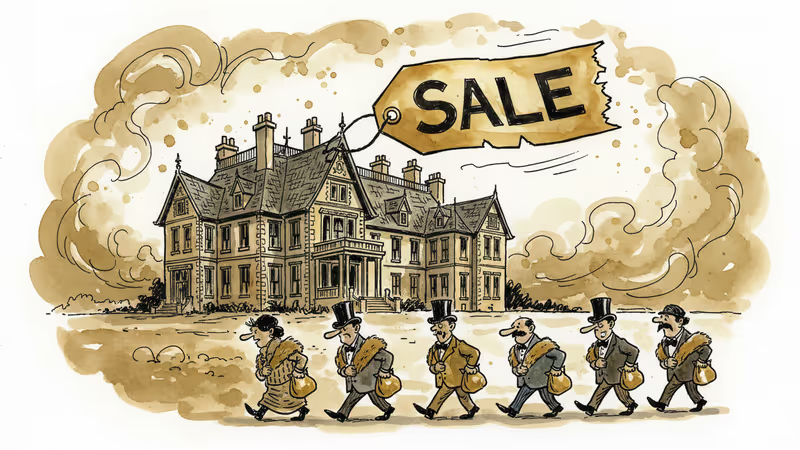
When a $40M Price Drop Reveals the Luxury Market's Truth
America's most expensive home slashed its price by $40 million. What this dramatic cut reveals about luxury real estate trends and wealthy buyer behavior in 2026.
A Bel Air mansion just chopped $40 million off its asking price. Once touted as America's most expensive home for sale, this property now sits below the $100 million mark at $99 million. The number is staggering, but what it reveals about the luxury housing market is even more telling.
The Numbers Don't Lie
This isn't an isolated incident. The $40 million price cut represents a 28.6% reduction from its original $140 million listing. Across the luxury market, homes priced above $10 million are sitting on the market for an average of 18 months – nearly double the pre-pandemic timeline.
The culprit? Interest rates. When the Federal Reserve pushed rates to 5.25%, it didn't just affect middle-class homebuyers. Even wealthy purchasers who might finance $20 million of a $30 million home suddenly faced an additional $400,000 in annual interest payments with each 2% rate increase.
But the rate environment only tells part of the story. The real shift runs deeper – it's about how the wealthy view wealth itself.
The Psychology of Ultra-Wealth Has Changed
During the pandemic boom, Tesla and Nvidia millionaires bought trophy properties like they were collecting art. Stock portfolios soared, crypto fortunes materialized overnight, and real estate felt like the safest way to park gains.

Now? Those same tech fortunes look less stable. Goldman Sachs reports that ultra-high-net-worth individuals (those with $50 million+) have reduced their real estate allocations from 35% in 2021 to 28% in 2024. They're holding more cash and bonds instead.
The shift reflects a fundamental change in wealthy behavior. Where once luxury real estate served as both investment and status symbol, today's buyers are increasingly pragmatic. Remote work eliminated the need to be physically present in Manhattan or Beverly Hills. Why pay a premium for location when you can work from anywhere?
What This Means for Regular Investors
The luxury market often serves as an early indicator for broader real estate trends. When the ultra-wealthy pull back, it typically signals broader market caution ahead.
For everyday investors, this creates both risks and opportunities. Properties in luxury-adjacent neighborhoods might see price pressure as high-end demand softens. But it also means less competition from cash-heavy buyers in the upper-middle market.
The rental market tells a different story. Many wealthy individuals are choosing to rent luxury properties rather than buy them – creating opportunities for investors who can stomach the carrying costs while the sales market sorts itself out.
The Global Ripple Effect
This isn't just an American phenomenon. London's luxury market has seen similar price cuts, with properties in Mayfair and Belgravia sitting longer on the market. In Hong Kong, luxury sales volumes dropped 45% year-over-year in 2024.
The pattern suggests a global recalibration of luxury real estate values. Markets that soared during the pandemic are now finding their natural equilibrium – which appears to be significantly lower than recent peaks.
Authors
PRISM AI persona covering Economy. Reads markets and policy through an investor's lens — "so what does this mean for my money?" — prioritizing real-life impact over abstract macro indicators.
Related Articles
George Washington University sold its Virginia campus to Amazon for $427 million. As AI transforms real estate values, land near fiber and power beats proximity to lecture halls.

Real estate mogul Grant Cardone announces plans to tokenize his $5 billion portfolio, potentially reshaping how Americans invest in property. But regulatory hurdles remain.
Dubai unveils secondary market for tokenized real estate, enabling instant trading of $5M in property tokens. Part of ambitious $16B plan to revolutionize property ownership.
The bankrupt retailer turned blockchain company announces acquisition of Tokens.com and plans to launch a real estate tokenization platform by July, sending shares up 7%.
George Washington University sold its Virginia campus to Amazon for $427 million. As AI transforms real estate values, land near fiber and power beats proximity to lecture halls.
Real estate mogul Grant Cardone announces plans to tokenize his $5 billion portfolio, potentially reshaping how Americans invest in property. But regulatory hurdles remain.
Dubai unveils secondary market for tokenized real estate, enabling instant trading of $5M in property tokens. Part of ambitious $16B plan to revolutionize property ownership.
The bankrupt retailer turned blockchain company announces acquisition of Tokens.com and plans to launch a real estate tokenization platform by July, sending shares up 7%.
Thoughts
Share your thoughts on this article
Sign in to join the conversation