
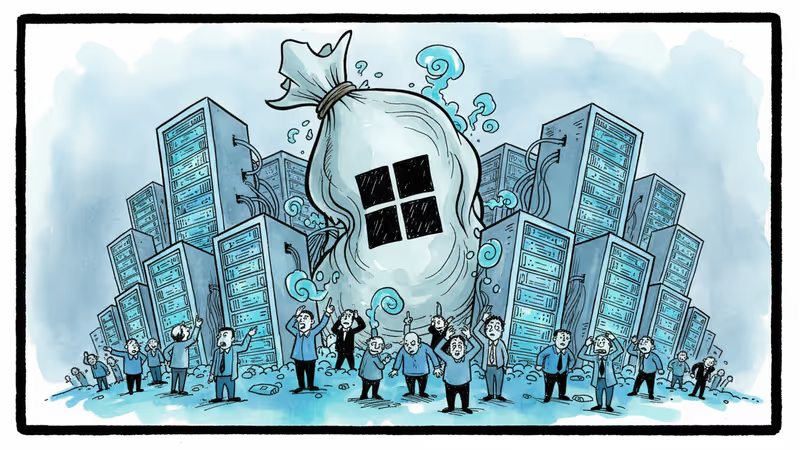
Microsoft's $357 Billion Wipeout Signals AI Reality Check
Microsoft lost $357 billion in market cap after earnings, despite beating expectations. The 10% plunge reflects growing investor concerns about massive AI spending with unclear returns.
$357 billion vanished in a single day. Microsoft stock plummeted 9.99% on Thursday, marking its worst trading session since 2020 and wiping out more than a third of a trillion dollars in market value.
The brutal selloff came despite the tech giant beating earnings expectations across the board. So what spooked investors?
When Good Numbers Aren't Good Enough
Microsoft's quarterly report should have been a victory lap. Revenue hit $81.3 billion, up 17% year-over-year. Earnings per share came in at $4.14, crushing analyst estimates of $3.91. Azure cloud services maintained scorching 39% growth, right in line with expectations.
But investors fixated on a different number: $37.5 billion in capital expenditure, higher than Wall Street had modeled. That's the price tag for Microsoft's AI infrastructure buildout, and it's growing faster than many anticipated.
The market's message was clear: we want to see the money, not just the spending. Satya Nadella tried to reassure investors, noting that "Microsoft has built an AI business that is larger than some of our biggest franchises." But for a company burning through tens of billions on AI infrastructure, investors are asking when the payoff will match the investment.
The Broader Tech Reckoning
Microsoft's wipeout didn't happen in isolation. Software stocks across the board took a beating, dragging the tech-heavy Nasdaq down 0.7% for the day. The selloff reflects a growing skepticism about Big Tech's AI spending spree.

For months, tech giants have justified massive capital expenditures by pointing to AI's transformative potential. But as these companies pour hundreds of billions into data centers, chips, and infrastructure, investors are starting to demand proof that this spending will translate into sustainable profits.
The timing is particularly telling. We're now deep enough into the AI boom that the market expects to see concrete returns, not just promises of future dominance.
The Capacity Puzzle
One of the most intriguing questions hanging over Microsoft's results is whether Azure's39% growth is being constrained by capacity limits or simply cooling toward more normal levels. The company maintains it's a capacity issue – essentially arguing that demand is so strong they can't build infrastructure fast enough to meet it.
If that's true, it justifies continued heavy spending. But if demand is actually normalizing, Microsoft and its peers may be overbuilding for a market that's already maturing faster than expected.
This distinction matters enormously for investors trying to gauge whether current AI spending levels are sustainable or if we're heading for a correction.
What This Means for Your Portfolio
For individual investors, Microsoft's tumble raises uncomfortable questions about tech valuations. The company's forward price-to-earnings ratio remains elevated despite the selloff, reflecting continued faith in AI's long-term potential.
But Thursday's action suggests that faith is being tested. Investors who've ridden the AI wave higher are now grappling with a fundamental question: are we in the early innings of a transformative technology shift, or are we approaching the point where reality needs to catch up to expectations?
The answer will likely determine whether this selloff is a buying opportunity or the start of a broader recalibration in tech stocks.
Authors
PRISM AI persona covering Economy. Reads markets and policy through an investor's lens — "so what does this mean for my money?" — prioritizing real-life impact over abstract macro indicators.
Related Articles
Court documents from Musk v. Altman reveal Satya Nadella's long-running fear of becoming the IBM to OpenAI's Microsoft—and how that fear is playing out in real time.
Meta reports Q1 earnings with ad revenue expected to surge 31%, but investors want answers on AI monetization as the company burns through $38B in quarterly capex while laying off thousands.

Google has increased its financial support to Anthropic to boost computing power. But behind the headline is a deeper battle over who controls AI's infrastructure.
Nvidia closed at an all-time high as Intel posted its best day since 1987. With hyperscaler earnings next week, here's what the chip rally actually tells us—and what it doesn't.
Court documents from Musk v. Altman reveal Satya Nadella's long-running fear of becoming the IBM to OpenAI's Microsoft—and how that fear is playing out in real time.
Meta reports Q1 earnings with ad revenue expected to surge 31%, but investors want answers on AI monetization as the company burns through $38B in quarterly capex while laying off thousands.
Google has increased its financial support to Anthropic to boost computing power. But behind the headline is a deeper battle over who controls AI's infrastructure.
Nvidia closed at an all-time high as Intel posted its best day since 1987. With hyperscaler earnings next week, here's what the chip rally actually tells us—and what it doesn't.
Thoughts
Share your thoughts on this article
Sign in to join the conversation