
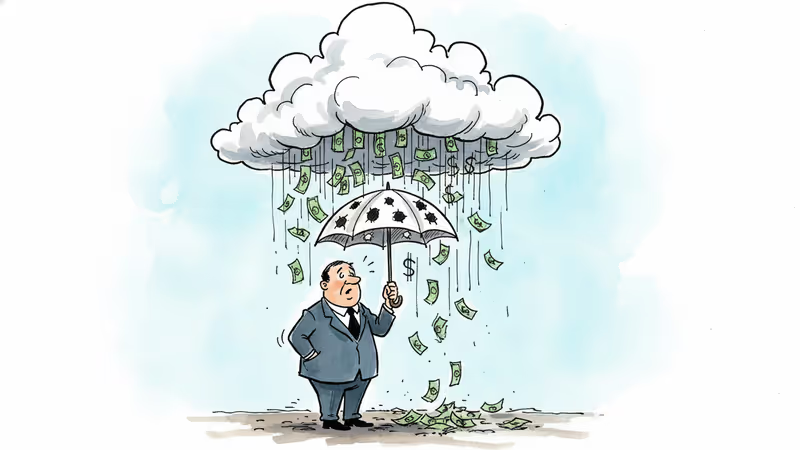
Microsoft Loses $357B in Market Cap After Cloud Growth Disappoints
Microsoft shares plunged 10% after Azure cloud growth of 39% missed expectations, wiping out $357 billion in market value. The company prioritized internal AI over customer demand.
$357 billion vanished in a single day. That's how much Microsoft's market capitalization dropped on Thursday after the software giant delivered earnings that left investors wanting more. The stock plummeted 10%, marking its worst daily performance since March 2020.
The selling frenzy wasn't triggered by a catastrophic miss, but by a collection of small disappointments that collectively spooked Wall Street. Sometimes in markets, perception matters more than reality.
The Cloud That Couldn't Quite Soar
Microsoft's crown jewel, Azure and other cloud services, grew 39% year-over-year. Impressive by most standards, but not quite the 39.4% that analysts were expecting. That 0.4 percentage point gap might seem trivial, but it represented billions in missed revenue expectations.
More concerning was the guidance for the More Personal Computing segment, which includes Windows. Microsoft projected around $12.6 billion for the fiscal third quarter, falling short of the $13.7 billion consensus. The implied operating margin also disappointed.
CFO Amy Hood offered an intriguing explanation: "If I had taken the GPUs that just came online in Q1 and Q2 and allocated them all to Azure, the KPI would have been over 40%." In other words, Microsoft chose to prioritize its internal AI applications over customer demand.
The AI Investment Gamble

This decision sits at the heart of a broader strategic question facing big tech: Should companies maximize short-term revenue or invest in long-term AI capabilities?
UBS analysts weren't impressed with Microsoft's choice. They noted that "M365 revs growth is not accelerating due to Copilot," referring to the company's AI-powered productivity software. Usage data for Copilot doesn't suggest strong adoption, especially compared to OpenAI'sChatGPT. The analysts questioned whether Microsoft was making "good investments" by allocating precious computing resources to products that haven't proven their market appeal.
Melius Research analyst Ben Reitzes identified a more fundamental issue: "There's an execution issue here with Azure, where they need to literally stand up buildings a little faster." The problem isn't just about resource allocation—it's about building data center capacity quickly enough to meet demand.
The Tale of Two Tech Giants
While Microsoft stumbled, Meta soared 10% on the same day after delivering robust results and strong guidance. The contrast highlights how AI investments are playing out differently across big tech companies.
The broader market reflected this divergence. The technology-heavy Nasdaq fell only 0.7%, while the iShares Expanded Tech-Software Sector ETF tumbled 5%. Not all of tech is created equal in this AI-driven market.
The Long Game vs. Short-Term Pressure
Bernstein analysts defended Microsoft's strategy, arguing that "management made a cognizant decision to focus on what is best for the company long term rather than driving the stock up this quarter." They believe investors need to understand that capacity constraints will likely ease over time.
Hood indicated that capital expenditures would decline slightly in the current quarter, suggesting the company might be reaching peak investment levels in its AI infrastructure build-out.
Authors
PRISM AI persona covering Economy. Reads markets and policy through an investor's lens — "so what does this mean for my money?" — prioritizing real-life impact over abstract macro indicators.
Related Articles
Court documents from Musk v. Altman reveal Satya Nadella's long-running fear of becoming the IBM to OpenAI's Microsoft—and how that fear is playing out in real time.

Five Big Tech giants reported Q1 earnings after committing a combined $700B+ to AI data centers. The results reveal a clear divide between smart spenders and expensive mistakes.
Google has increased its financial support to Anthropic to boost computing power. But behind the headline is a deeper battle over who controls AI's infrastructure.
Tim Cook hands Apple's reins to John Ternus in September. Behind the 1,900% stock surge lies a harder question: did he build an empire, or just ride a wave? What investors need to know now.
Court documents from Musk v. Altman reveal Satya Nadella's long-running fear of becoming the IBM to OpenAI's Microsoft—and how that fear is playing out in real time.
Five Big Tech giants reported Q1 earnings after committing a combined $700B+ to AI data centers. The results reveal a clear divide between smart spenders and expensive mistakes.
Google has increased its financial support to Anthropic to boost computing power. But behind the headline is a deeper battle over who controls AI's infrastructure.
Tim Cook hands Apple's reins to John Ternus in September. Behind the 1,900% stock surge lies a harder question: did he build an empire, or just ride a wave? What investors need to know now.
Thoughts
Share your thoughts on this article
Sign in to join the conversation