
Understanding Manifold Theory Applications in Modern Tech and Physics
Explore the profound impact of Manifold Theory applications, from Riemann's 1854 lecture to Einstein's spacetime and modern data science breakthroughs.
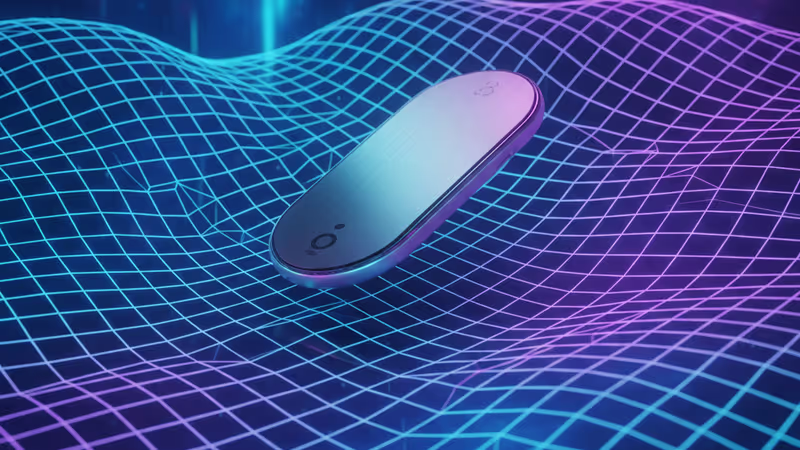
Standing in a field, the Earth feels flat. We're so small that we lose sight of the global curve. Mathematicians call these shapes manifolds—objects that look Euclidean (flat) when you zoom in but possess complex structures on a larger scale. Since Bernhard Riemann introduced them in 1854, they've become the fundamental alphabet of modern science.
The Riemann Legacy and Manifold Theory Applications
Before the 19th century, geometry was synonymous with physical space where parallel lines never meet and triangles always add up to 180 degrees. Bernhard Riemann shattered this view by proposing a theory that generalizes curved surfaces to any number of dimensions. While his peers initially dismissed his work as abstract nonsense, it laid the groundwork for the most significant breakthroughs in human history.

From Spacetime to High-Dimensional Data
The real-world validation of manifolds arrived in 1915 when Albert Einstein utilized Riemannian geometry for his general theory of relativity. Gravity wasn't a mysterious force but the curvature of a four-dimensional manifold representing spacetime. Today, the same logic applies to cutting-edge tech:
- Robotics: Mapping the configuration space of movements as a torus manifold.
- Data Science: Analyzing thousands of neural activity points by projecting them onto a lower-dimensional manifold.
- Quantum Physics: Describing the states of particles using complex geometric manifolds.
Authors
Related Articles
Google launches the revamped Trends Explore page on January 14, 2026, featuring Gemini AI integration. Compare up to 8 terms and get AI-powered insights automatically.

Chinese researchers release world's first software to handle the 56-microsecond daily difference in lunar time, crucial for precise navigation and landings.
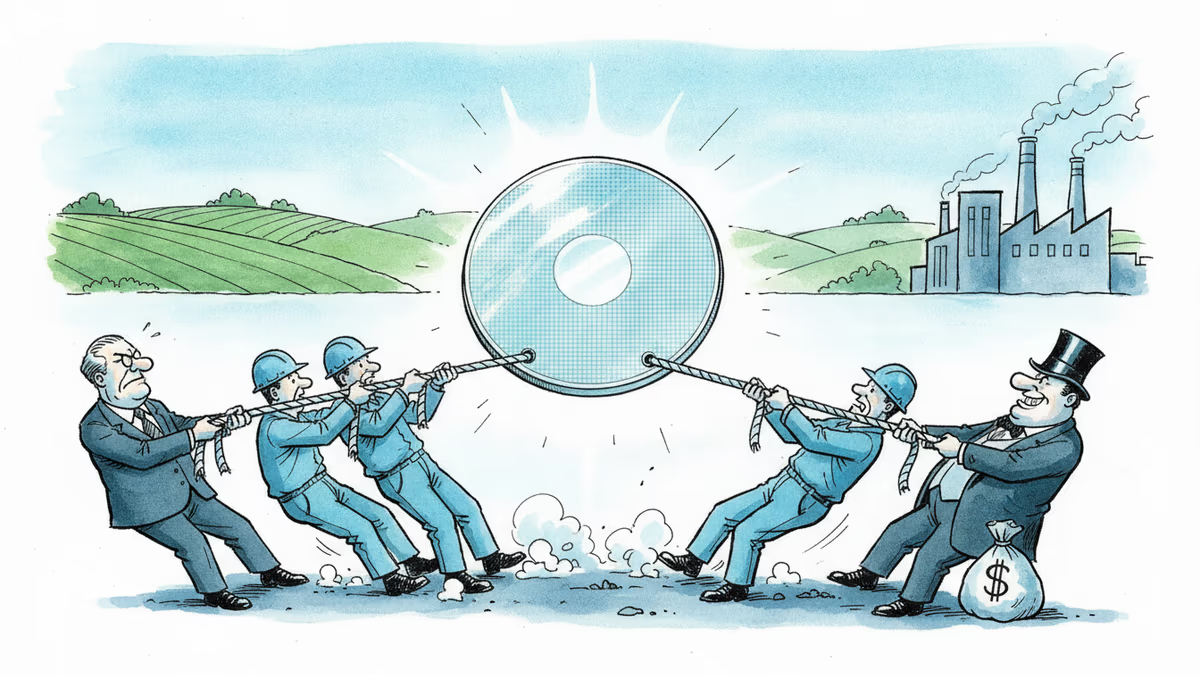
Samsung Electronics' union branch revealed that 84% of survey respondents oppose the government's roughly $290 billion (₩400 trillion) semiconductor megaproject in Gwangju. Government, management, the union and shareholders are all reading the same national project in sharply different ways.
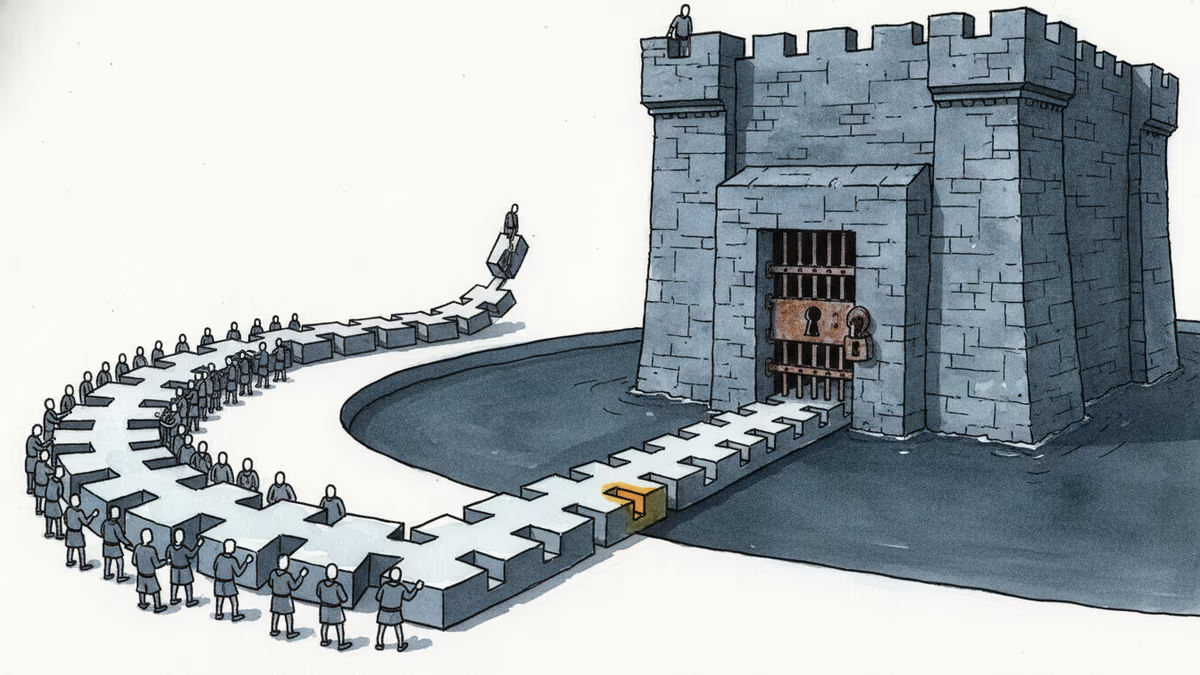
Nvidia shipped roughly a billion RISC-V cores in 2024, then announced it would run CUDA on the open standard. We break down how royalty-free instruction sets and open software stacks are trying to route around CUDA's lock-in. Part 2 of the Semiconductor Sovereignty series.
Google launches the revamped Trends Explore page on January 14, 2026, featuring Gemini AI integration. Compare up to 8 terms and get AI-powered insights automatically.
Chinese researchers release world's first software to handle the 56-microsecond daily difference in lunar time, crucial for precise navigation and landings.
Samsung Electronics' union branch revealed that 84% of survey respondents oppose the government's roughly $290 billion (₩400 trillion) semiconductor megaproject in Gwangju. Government, management, the union and shareholders are all reading the same national project in sharply different ways.
Nvidia shipped roughly a billion RISC-V cores in 2024, then announced it would run CUDA on the open standard. We break down how royalty-free instruction sets and open software stacks are trying to route around CUDA's lock-in. Part 2 of the Semiconductor Sovereignty series.
Thoughts
Share your thoughts on this article
Sign in to join the conversation