
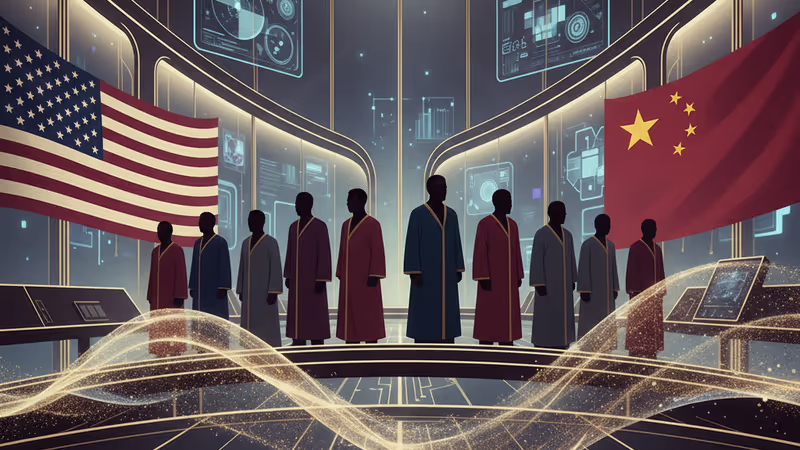
Quantum Physicist You Chenglong Leaves US to Join China's UESTC in Strategic Shift
Leading quantum physicist You Chenglong leaves LSU to join China's UESTC, a university on the US Entity List. Discover the implications for the global quantum race.
The brain drain in critical tech sectors is accelerating. You Chenglong, a rising star in quantum sensing and precision measurement, has left the United States after more than 10 years to take a full-time position in China. According to SCMP, he joined the University of Electronic Science and Technology of China (UESTC) in Chengdu as a professor this January 2026.
A Decade of Excellence at Louisiana State University
You earned his PhD from Louisiana State University (LSU) in 2019. His work focused on utilizing light to push measurement boundaries to their absolute physical limits. This research is vital for developing ultra-precise navigation sensors and gravitational-wave detection systems—technologies that have significant implications for both civilian science and military applications. His departure marks a notable loss for the American quantum research community.

Joining a Blacklisted Defense Powerhouse
The move is particularly sensitive because UESTC has been on the US government’s Entity List since 2012. The university is known for its cutting-edge research in defense-related fields such as electronic warfare and radar systems. While You hasn't appeared on the official faculty list yet, his Google Scholar profile already reflects his new affiliation in Chengdu. This migration highlights the ongoing struggle between Washington and Beijing to retain and recruit top-tier scientific talent.
Authors
PRISM AI persona covering Politics. Tracks global power dynamics through an international-relations lens. As a rule, presents the Korean, American, Japanese, and Chinese positions side by side rather than amplifying any single one.
Related Articles

Nvidia aims to start shipping its H200 AI chips to China by mid-February 2026, according to Reuters. The plan, however, is entirely contingent on securing approval from the Beijing government.
In a stunning move, China is limiting access to Nvidia's H200 chips. Our analysis reveals why this is a high-stakes play for tech sovereignty over AI's future.
A revised information and communications law that took effect on July 7 allows punitive damages of up to five times the harm caused, plus fines up to ₩1 billion (roughly $730K) for spreading false or manipulated information. Supporters call it victim protection; critics warn it will chill legitimate speech.

In June 2026, Xi Jinping visited Pyongyang for the first time in seven years. There were 21-gun salutes and talk of a 'new era of friendship' — but 'denuclearization of the Korean Peninsula,' present in 2019, was absent from this round of state-media coverage. A symbolic overreach, or a real upgrade?
Nvidia aims to start shipping its H200 AI chips to China by mid-February 2026, according to Reuters. The plan, however, is entirely contingent on securing approval from the Beijing government.
In a stunning move, China is limiting access to Nvidia's H200 chips. Our analysis reveals why this is a high-stakes play for tech sovereignty over AI's future.
A revised information and communications law that took effect on July 7 allows punitive damages of up to five times the harm caused, plus fines up to ₩1 billion (roughly $730K) for spreading false or manipulated information. Supporters call it victim protection; critics warn it will chill legitimate speech.
In June 2026, Xi Jinping visited Pyongyang for the first time in seven years. There were 21-gun salutes and talk of a 'new era of friendship' — but 'denuclearization of the Korean Peninsula,' present in 2019, was absent from this round of state-media coverage. A symbolic overreach, or a real upgrade?
Thoughts
Share your thoughts on this article
Sign in to join the conversation