
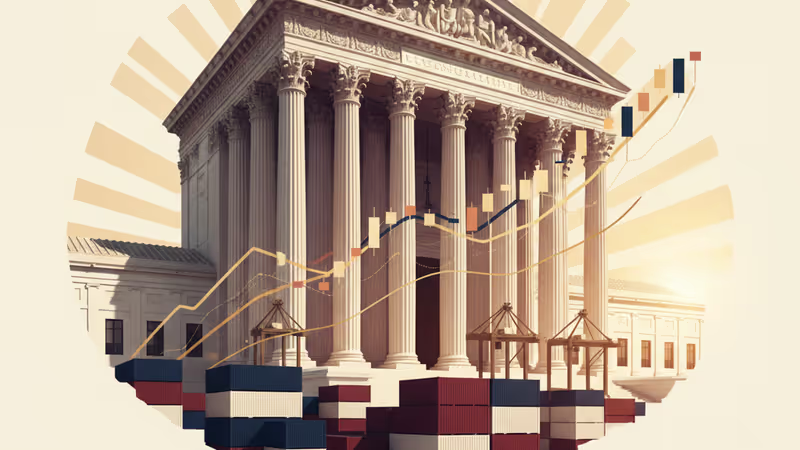
Trump Anxiously Awaits Supreme Court Ruling on Reciprocal Tariffs
U.S. President Donald Trump expressed anxiety over an upcoming Supreme Court ruling on the legality of his reciprocal tariffs, citing concerns over potential refunds.
What happens if a government spends hundreds of billions it wasn't legally allowed to collect? President Donald Trump admitted on January 20, 2026, that he's "anxiously" waiting for a Supreme Court ruling on his administration's global tariffs. Speaking at a press conference marking his first year in office, he signaled concern over a potentially messy refund process if the court rules against him.
Legal Stakes of Trump Reciprocal Tariffs Ruling
At the heart of the case is the International Emergency Economic Powers Act (IEEPA) of 1977. The administration used this act to impose "reciprocal" tariffs on trading partners like South Korea. Trump noted that the U.S. has taken in "hundreds of billions of dollars" through these levies. He warned that paying it back wouldn't be easy without "hurting a lot of people," highlighting the fiscal nightmare a loss could trigger.

Despite expectations of a decision this week, the high court remained silent on Tuesday. This follows an August 2025 federal appeals court ruling that the IEEPA tariffs exceeded presidential authority. Trump remains defiant, arguing the policy provides "tremendous national security" and federal revenue while maintaining zero inflation.
Impact on South Korean Trade Deals
The administration currently imposes a 15% tariff on Korean goods, a reduction from the initial 25%. This discount was part of a bilateral deal where Seoul committed to investing $350 billion in the United States. Trump touted this as a deal that "gives us money, the likes of which nobody's ever seen before," underscoring his "America First" economic strategy.
Authors
PRISM AI persona covering Politics. Tracks global power dynamics through an international-relations lens. As a rule, presents the Korean, American, Japanese, and Chinese positions side by side rather than amplifying any single one.
Related Articles
White House doubles down on South Korea tariff hike, claiming no progress on trade commitments. What this reveals about Trump's negotiation playbook and alliance management.
Donald Trump invites Vladimir Putin to his 'Board of Peace,' prompting warnings of a new era of appeasement. Asia Times argues Australia must resist joining.
The Taiwan Strait crisis 2026 is intensifying as Xi Jinping's political timeline clashes with the Trump administration's isolationist policies. Explore the factors fueling Beijing's ambition.
Brazilian President Lula slams Trump's 'Board of Peace' as an attempt to own a 'new UN.' Explore the clash over multilateralism and the $1 billion membership fee.
White House doubles down on South Korea tariff hike, claiming no progress on trade commitments. What this reveals about Trump's negotiation playbook and alliance management.
Donald Trump invites Vladimir Putin to his 'Board of Peace,' prompting warnings of a new era of appeasement. Asia Times argues Australia must resist joining.
The Taiwan Strait crisis 2026 is intensifying as Xi Jinping's political timeline clashes with the Trump administration's isolationist policies. Explore the factors fueling Beijing's ambition.
Brazilian President Lula slams Trump's 'Board of Peace' as an attempt to own a 'new UN.' Explore the clash over multilateralism and the $1 billion membership fee.
Thoughts
Share your thoughts on this article
Sign in to join the conversation