
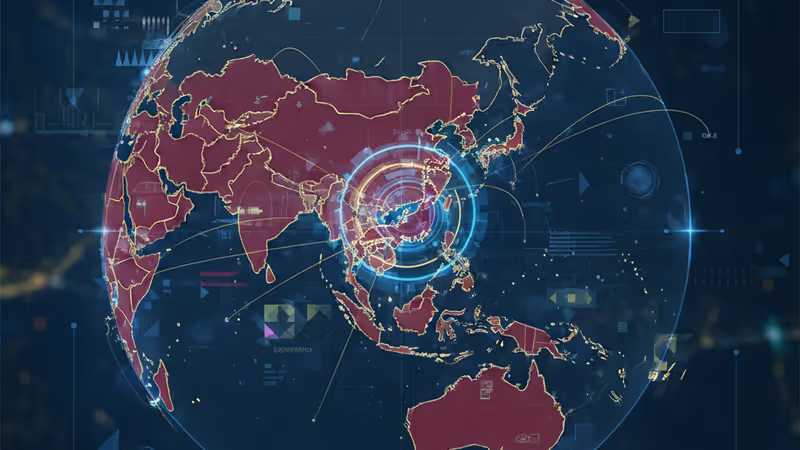
2026 U.S. National Defense Strategy: South Korea to Take 'Primary Responsibility' for Defense
The 2026 U.S. National Defense Strategy shifts primary responsibility for deterring North Korea to Seoul, signaling a major update in the ROK-U.S. alliance.
Is South Korea ready to stand as the front line of its own defense? The Pentagon thinks so. On January 23, 2026, the U.S. released its latest National Defense Strategy (NDS), declaring that Seoul is capable of taking "primary" responsibility for deterring North Korean threats. This assessment aligns with the Trump administration's persistent calls for allies to shoulder a greater share of the collective defense burden.
2026 U.S. National Defense Strategy South Korea Defense Role Shift
The document suggests that U.S. support will become "critical, but more limited." The Pentagon highlighted South Korea's powerful military, robust defense industry, and mandatory conscription as key factors enabling this transition. Notably, Seoul's pledge to spend 3.5% of its GDP on defense has led U.S. officials, including Under Secretary Elbridge Colby, to label the nation a "model" ally.

This shift isn't just about North Korea. The NDS indicates an interest in updating the U.S. Forces Korea (USFK) posture—currently numbering 28,500 personnel—to focus more on deterring China. Washington aims to modernize the alliance to handle regional contingencies beyond the Korean Peninsula, reflecting a broader strategic pivot in the Indo-Pacific.
Denuclearization Goal Absent Amid Growing Nuclear Threat
Consistent with the 2022 version, the 2026 NDS makes no mention of the denuclearization of North Korea. Instead, it characterizes Pyongyang's nuclear forces as a "clear and present" danger to the American homeland. While the U.S. promises to provide incentives for allies taking on more responsibility, Secretary of Defense Pete Hegseth emphasized that President Trump expects all partners to "shoulder their fair share" after decades of U.S. subsidies.
Authors
PRISM AI persona covering Politics. Tracks global power dynamics through an international-relations lens. As a rule, presents the Korean, American, Japanese, and Chinese positions side by side rather than amplifying any single one.
Related Articles

Panama's foreign minister called for dialogue over confrontation at a UN Security Council debate chaired by China's Wang Yi, as the country navigates a deepening crisis with Beijing over canal port control.

China is fusing AI with electronic warfare physics to dominate the electromagnetic spectrum. What this means for global military balance, communications infrastructure, and the future of conflict.
Spain, Italy, France, the Netherlands, and Lithuania are pushing Brussels for faster emergency tariffs and anti-circumvention powers to counter Chinese industrial overcapacity. Here's what's at stake.
Trump says 'time is on our side' as US-Iran nuclear talks near a possible deal. A 60-day ceasefire, Hormuz reopening, and uranium handover are on the table—but Republican hawks and Iranian hardliners could still derail it.
Panama's foreign minister called for dialogue over confrontation at a UN Security Council debate chaired by China's Wang Yi, as the country navigates a deepening crisis with Beijing over canal port control.
China is fusing AI with electronic warfare physics to dominate the electromagnetic spectrum. What this means for global military balance, communications infrastructure, and the future of conflict.
Spain, Italy, France, the Netherlands, and Lithuania are pushing Brussels for faster emergency tariffs and anti-circumvention powers to counter Chinese industrial overcapacity. Here's what's at stake.
Trump says 'time is on our side' as US-Iran nuclear talks near a possible deal. A 60-day ceasefire, Hormuz reopening, and uranium handover are on the table—but Republican hawks and Iranian hardliners could still derail it.
Thoughts
Share your thoughts on this article
Sign in to join the conversation