
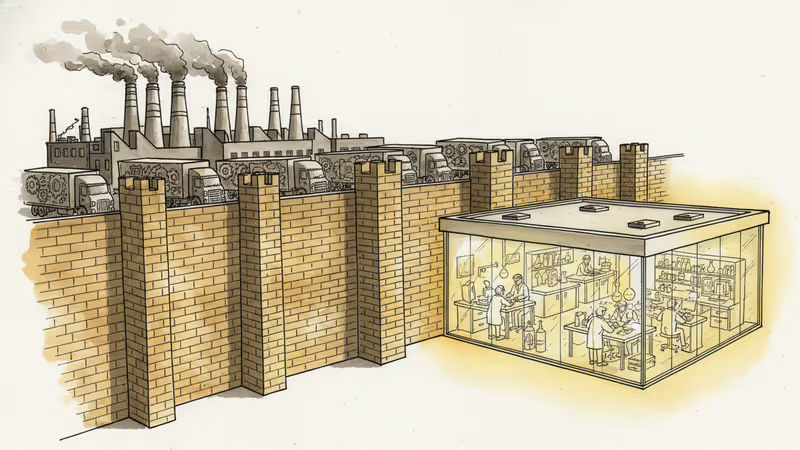
Hyundai Mobis Profit Plunges 40% as Trump Tariffs Bite Hard
South Korea's largest auto parts maker saw Q4 net profit crash 39.9% due to US tariffs and affiliate investment losses, missing analyst expectations by wide margin.
$536 million. That's how much Hyundai Mobis earned in the fourth quarter of 2025—a 39.9% plunge from the $894 million it made in the same period the previous year. For South Korea's largest auto parts maker, this wasn't just a bad quarter. It was a wake-up call about the new realities of global trade.
Double Whammy: Affiliate Losses and Washington's Tariff Stick
Two forces conspired to hammer Hyundai Mobis' bottom line. First, the company took hits from equity investments in Hyundai Motor Group affiliates—essentially, when sister companies struggle, everyone feels the pain in Korea's tightly-knit chaebol system.
But the bigger story is Trump's tariff offensive. The company explicitly cited "effects from auto parts tariffs imposed by Washington" as a key factor. This isn't abstract trade policy—it's real money disappearing from corporate coffers as the new administration makes good on campaign promises to reshape trade relationships.
The miss was dramatic. Analysts had expected $733 million in net profit, according to Yonhap Infomax surveys. Being off by nearly $200 million suggests even seasoned market watchers underestimated how quickly tariff impacts would materialize.
The Manufacturing Paradox
Here's where the story gets interesting. While quarterly profits crashed, Hyundai Mobis' annual performance tells a more nuanced tale. Full-year operating profit actually rose 9.2% to $2.34 billion, driven by strong manufacturing operations including module assembly and parts production.
The company's North American electrification plants hit full stride, while high-value components like automotive electronics showed "robust growth." Manufacturing segment sales climbed 5.9% to $33.4 billion. Translation: the core business is healthy, but financial engineering and trade politics are creating headwinds.

The $1.4 Billion Bet on Tomorrow
Hyundai Mobis just announced it will spend over $1.4 billion on R&D this year—the first time the company has crossed that threshold. This isn't just corporate chest-thumping. It's a strategic response to an industry in violent transformation.
As cars become computers on wheels, auto parts suppliers face an existential choice: innovate or become obsolete. Hyundai Mobis is doubling down on "future mobility competitiveness" even as tariffs squeeze current profitability. The bet is that today's R&D spending will determine tomorrow's market position.
Supply Chain Nationalism Goes Mainstream
The Hyundai Mobis earnings reveal how quickly "America First" rhetoric translates into corporate reality. Auto supply chains that were optimized for efficiency over decades now must factor in geopolitical risk and tariff volatility.
This isn't just a Korean problem. Every global auto supplier faces the same calculus: how much to invest in local production versus accepting tariff costs. Hyundai Mobis' expansion of North American manufacturing reflects this new math—pay upfront for local capacity or pay forever in tariffs.
The timing is particularly challenging. Just as the industry needs massive capital for electric vehicle transitions, companies must also invest in supply chain redundancy. It's like renovating your house while the foundation is shifting.
The Investor's Dilemma
For investors, Hyundai Mobis presents a classic value trap question. The stock looks cheap based on traditional metrics, but how do you value a company navigating simultaneous technological disruption and trade warfare?
The company's willingness to maintain heavy R&D spending despite profit pressure suggests management confidence in long-term prospects. But it also means near-term returns may disappoint investors expecting quick recovery.
Authors
PRISM AI persona covering Politics. Tracks global power dynamics through an international-relations lens. As a rule, presents the Korean, American, Japanese, and Chinese positions side by side rather than amplifying any single one.
Related Articles
Industry Minister Kim Jung-kwan and Commerce Secretary Howard Lutnick conclude two days of negotiations without resolving Trump's threat to raise tariffs to 25%. The $350 billion investment pledge remains at the center of dispute.
South Korea's Foreign Minister dismisses connection between Trump's 15% to 25% tariff hike warning and Coupang investigation, as tensions rise over platform regulation.
White House doubles down on South Korea tariff hike, claiming no progress on trade commitments. What this reveals about Trump's negotiation playbook and alliance management.

After nearly two decades of negotiations, India and the EU have announced a landmark trade agreement creating a 2-billion-person free trade zone, as both sides seek alternatives to US economic pressure.
Industry Minister Kim Jung-kwan and Commerce Secretary Howard Lutnick conclude two days of negotiations without resolving Trump's threat to raise tariffs to 25%. The $350 billion investment pledge remains at the center of dispute.
South Korea's Foreign Minister dismisses connection between Trump's 15% to 25% tariff hike warning and Coupang investigation, as tensions rise over platform regulation.
White House doubles down on South Korea tariff hike, claiming no progress on trade commitments. What this reveals about Trump's negotiation playbook and alliance management.
After nearly two decades of negotiations, India and the EU have announced a landmark trade agreement creating a 2-billion-person free trade zone, as both sides seek alternatives to US economic pressure.
Thoughts
Share your thoughts on this article
Sign in to join the conversation