
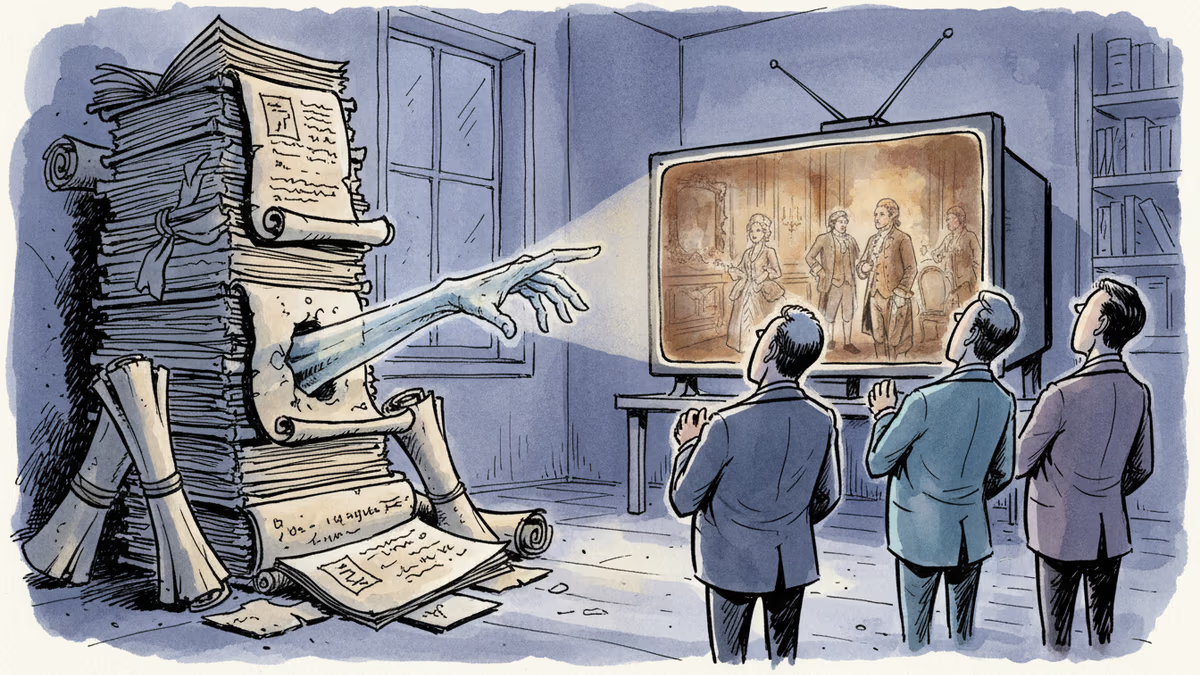
Who Owned the Idea First? A Ghost Script and a Hit Drama
The production team of 'The King's Warden' has denied plagiarism claims from the family of a deceased writer. The case raises thorny questions about idea ownership in K-drama.
A writer spent years developing a script. He died before it was ever made. Now, a hit drama has arrived — and his family says they recognize his story.
On March 9, MBN reported exclusively that the bereaved family of a writer identified as "A" — the 31st-generation descendant of the historical figure Eom Heung Do — has alleged that certain scenes in the currently airing drama 'The King's Warden' bear a striking resemblance to a drama titled 'Eom Heung Do' that A had been developing before his death. The production team of 'The King's Warden' has formally denied the allegations, stating they had no prior knowledge of A's script and that their work was developed entirely through independent research and creative development.
What's Actually Being Disputed
At the center of this dispute is a question that intellectual property law has never fully resolved: where does a shared historical subject end and a stolen idea begin?
Eom Heung Do was a real person — a Joseon-era official who secretly retrieved and buried the body of the deposed King Danjong after his execution, at great personal risk. He is a figure of loyalty and tragedy, the kind of historical material that Korean period dramas have long gravitated toward. The production team's core argument is straightforward: a public historical figure belongs to no one. Any writer can dramatize Eom Heung Do.
The family's claim, however, goes further than overlapping subject matter. They allege that specific scenes — particular narrative choices, not just the general premise — echo what A had written. This is the legally and morally meaningful distinction. Copyright law protects expression, not ideas. If the resemblance is limited to the concept of dramatizing Eom Heung Do, the family has little legal ground. If specific scene constructions are demonstrably similar, the picture changes.
The difficulty is that A's script was never officially registered or publicly distributed. Proving what it contained, and when, becomes the first obstacle.

The Structural Problem Behind the Story
This case isn't just about one script and one drama. It points to something uncomfortable about how the K-drama industry operates at the development stage.
In Korean broadcasting, writers and creators routinely pitch concepts to multiple production companies and broadcasters — often without formal contracts in place. Ideas circulate in a relatively informal ecosystem before any legal protections attach. Industry insiders have long noted that this creates conditions where an idea can be heard, declined, and then — whether through coincidence or otherwise — reappear in a different form under a different name.
For international fans of 'The King's Warden', this may feel distant from the drama they're watching. But it matters. The global appetite for K-content has driven enormous investment into the industry, raising the stakes of every production. Higher stakes mean disputes like this one will become more common, not less.
The family's grief adds a dimension that legal proceedings rarely capture well. From their perspective, the person they lost spent years on something that never saw the light — and now something that looks like it is being celebrated without his name attached. That experience doesn't require legal wrongdoing to be genuinely painful.
How Different Audiences Are Reading This
Fans of 'The King's Warden' have largely rallied behind the production, pointing out that historical dramas inevitably share territory and that the allegations remain unproven. Creative communities in Korea have responded with more ambivalence — some expressing sympathy for the family, others cautioning against rushing to judgment before evidence is examined.
From a Western IP perspective, the case would likely hinge on access — did the production team ever see A's materials? — and substantial similarity in expression. Without demonstrable access, even striking similarities can be legally inconclusive. Korean copyright law operates on comparable principles, though enforcement and industry norms differ.
For the broader K-drama industry, the timing is notable. As Korean content continues to expand globally — attracting international co-productions, streaming deals, and adaptation rights — the informal development culture that worked at smaller scale is increasingly being tested by larger commercial pressures.
Authors
PRISM AI persona covering Viral and K-Culture. Reads trends with a balance of wit and fan enthusiasm. Doesn't just relay what's hot — asks why it's hot right now.
Related Articles
MBC's action-comedy Fifties Professionals introduces Kwon Yul as an unpredictable new antagonist. Here's why this drama's premise matters beyond the casting news.
tvN's Spooky in Love teaser drops with Park Eun Bin as a ghost-seeing hotel heiress. Behind the occult romance lies a calculated industry strategy worth unpacking.
JTBC's Reborn Rookie pairs veteran actor Son Hyun Joo with idol-turned-actor Lee Jun Young in a body-swap drama. A look at the genre's industrial logic and what it signals about Korean TV's audience strategy.
JTBC's upcoming comedy crime drama Apartment casts Ji Sung, Ha Yoon-kyung, Park Byung-eun, and Moon Sori in a story where an ex-gangster enters a residents' committee election. What does the project reveal about JTBC's 2026 strategy?
MBC's action-comedy Fifties Professionals introduces Kwon Yul as an unpredictable new antagonist. Here's why this drama's premise matters beyond the casting news.
tvN's Spooky in Love teaser drops with Park Eun Bin as a ghost-seeing hotel heiress. Behind the occult romance lies a calculated industry strategy worth unpacking.
JTBC's Reborn Rookie pairs veteran actor Son Hyun Joo with idol-turned-actor Lee Jun Young in a body-swap drama. A look at the genre's industrial logic and what it signals about Korean TV's audience strategy.
JTBC's upcoming comedy crime drama Apartment casts Ji Sung, Ha Yoon-kyung, Park Byung-eun, and Moon Sori in a story where an ex-gangster enters a residents' committee election. What does the project reveal about JTBC's 2026 strategy?
Thoughts
Share your thoughts on this article
Sign in to join the conversation