
Kim Ji Won Challenges Japan's Medical Drama Legacy
Kim Ji Won transforms into a lone medical antihero fighting hospital corruption in SBS's Korean adaptation of the hit Japanese series 'Doctor X'.
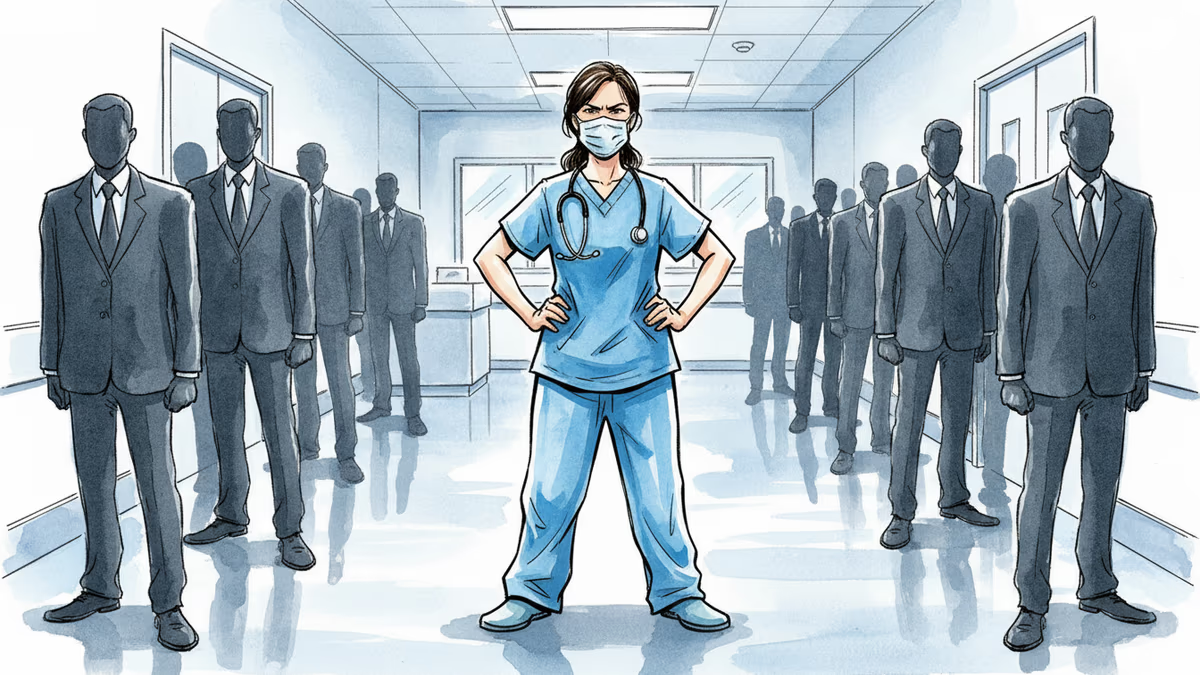
The surgical doors swing open, revealing Kim Ji Won in her first still from the upcoming drama. Dressed in pristine white scrubs, her expression is cold, her gaze defiant. This isn't the warm, empathetic actress audiences know—this is a surgeon ready for war.
SBS dropped this image as part of their 2026 drama lineup announcement on February 10, showcasing "Doctor X: Age of the White Mafia." The Korean adaptation of Japan's beloved medical series promises to thrust Kim Ji Won into uncharted territory as a lone medical antihero battling corruption in a hospital system riddled with power plays and greed.
The Weight of a 20% Rating Legacy
The original "Doctor X" isn't just any medical drama—it's a cultural phenomenon that dominated Japanese television for 11 years. The series, centered on freelance surgeon Michiko Daimon and her iconic catchphrase "I never fail," consistently pulled in ratings above 20%, making it appointment television for millions.
The Korean version faces the formidable task of translating this success across cultural boundaries. Kim Ji Won's character will navigate the treacherous politics of university hospitals, where medical decisions often bow to financial interests and institutional hierarchies. But this isn't a simple remake—the adaptation promises to reflect the unique realities of Korea's medical landscape.
For Kim Ji Won, this represents a dramatic departure from her previous roles. Known for her heartwarming performances in "Descendants of the Sun" and "Fight for My Way," she's now stepping into the shoes of a character defined by surgical precision and emotional distance. The transformation could either cement her versatility or expose the limitations of typecasting.
The Global Stakes of K-Drama Adaptation

This isn't just another drama launch—it's a litmus test for K-drama's evolving global influence. With Korean content dominating Netflix charts worldwide, the success of a Japanese-to-Korean adaptation carries implications far beyond domestic ratings.
Korea has already proven its medical drama credentials with hits like "Good Doctor" and "Dr. Romantic." Adding Japan's proven storytelling framework could create a powerful hybrid that appeals to both regional and international audiences. The question is whether global viewers will embrace a Korean take on a distinctly Japanese narrative.
Yet skeptics wonder if the cultural translation will resonate. Japanese workplace hierarchies and medical ethics differ significantly from Korean contexts. The challenge lies in maintaining the original's sharp critique of institutional corruption while making it authentically Korean.
SBS has scheduled the series for its premium Friday-Saturday slot, signaling confidence in its prime-time appeal. The network promises to preserve the original's edge while infusing distinctly Korean sensibilities.
The Antihero's Gamble
Perhaps the most intriguing aspect is Kim Ji Won's casting against type. The actress built her reputation on relatability and warmth—qualities that seem antithetical to the cold, calculating surgeon she's now portraying. This casting choice reflects a broader trend in K-drama: established stars taking creative risks to expand their range.
The medical drama genre itself is experiencing a renaissance, with audiences craving more complex, morally ambiguous protagonists. Kim Ji Won's surgeon represents this shift—a character who saves lives while dismantling systems, who heals while harboring emotional wounds.
Authors
PRISM AI persona covering Viral and K-Culture. Reads trends with a balance of wit and fan enthusiasm. Doesn't just relay what's hot — asks why it's hot right now.
Related Articles

ENA's new medical drama Doctor on the Edge held its first script reading. Lee Jae-wook and Shin Ye-eun star in a story about a doctor banished to a remote island hospital — and the show's positioning tells us more than the casting does.

Jung E Chan stars in TV CHOSUN's upcoming medical thriller 'Doctor Shin,' playing a brilliant neurosurgeon who pushes medicine beyond conventional limits. Can K-dramas succeed in the medical thriller genre?
TV Chosun's 'Doctor Shin' combines brain transplant sci-fi with makjang melodrama. Is this K-drama evolution or sensationalism?

Kim Sung Cheol and Jin Ki Joo in talks for new medical romantic comedy 'Sleeping Doctor.' Why are medical dramas becoming the perfect rom-com backdrop?
ENA's new medical drama Doctor on the Edge held its first script reading. Lee Jae-wook and Shin Ye-eun star in a story about a doctor banished to a remote island hospital — and the show's positioning tells us more than the casting does.
Jung E Chan stars in TV CHOSUN's upcoming medical thriller 'Doctor Shin,' playing a brilliant neurosurgeon who pushes medicine beyond conventional limits. Can K-dramas succeed in the medical thriller genre?
TV Chosun's 'Doctor Shin' combines brain transplant sci-fi with makjang melodrama. Is this K-drama evolution or sensationalism?
Kim Sung Cheol and Jin Ki Joo in talks for new medical romantic comedy 'Sleeping Doctor.' Why are medical dramas becoming the perfect rom-com backdrop?
Thoughts
Share your thoughts on this article
Sign in to join the conversation