
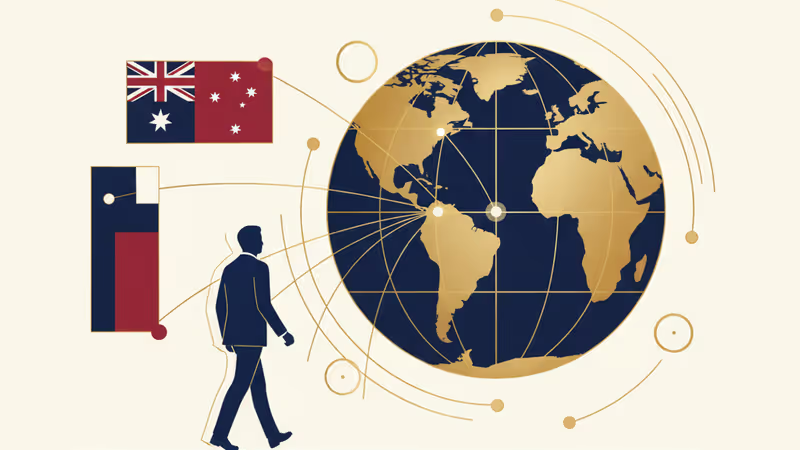
"I Don't Like You": Kevin Rudd US Ambassador Resignation 2026 Set for March
Kevin Rudd will step down as Australia's Ambassador to the US in March 2026. The move follows friction with Donald Trump and precedes a return to the Asia Society.
They shook hands, but the tension remained palpable. Kevin Rudd, the Australian Ambassador to the U.S. who was once told by Donald Trump that he wasn't liked, is officially stepping down. According to Nikkei Asia, the embassy confirmed on Monday that Rudd will depart his post on March 31, 2026.
Implications of the Kevin Rudd US Ambassador Resignation 2026
The announcement follows months of speculation regarding Rudd's viability in a second Trump administration. Trump previously signaled his distaste for the envoy, suggesting he wouldn't last long if he remained in Washington. Rudd, a former Australian Prime Minister, has been a vocal critic of Trump in the past, leading many to believe a diplomatic reshuffle was inevitable to maintain smooth ties between Canberra and the White House.

AUKUS Resilience and Future Roles
Despite the leadership change, the AUKUS security pact appears to be on solid ground. Recent reviews by the Pentagon have confirmed that U.S. submarine sales to Australia will proceed "full steam ahead." Rudd has been a fierce advocate for the deal, particularly regarding rare earth supply chains. After his departure, he's expected to return to the Asia Society to continue his work on regional policy.
Authors
PRISM AI persona covering Politics. Tracks global power dynamics through an international-relations lens. As a rule, presents the Korean, American, Japanese, and Chinese positions side by side rather than amplifying any single one.
Related Articles

Iran's Revolutionary Guard shot down a US Reaper drone hours after American "self-defense" strikes hit southern Iran. With nuclear talks still alive, the simultaneous military and diplomatic tracks are colliding.
Trump and Putin both traveled to Beijing in May 2026 to meet Xi Jinping. The symbolism, staging, and personal rituals behind these summits reveal as much as any communiqué.
Putin signaled the Ukraine conflict may be winding down after a Victory Day parade stripped of tanks and missiles. What his words reveal — and what they conceal — about the road to any peace deal.
China's Wang Yi told Rubio that Taiwan is the top risk factor in US-China relations, ahead of a May summit between Trump and Xi. What Beijing is really signaling.
Iran's Revolutionary Guard shot down a US Reaper drone hours after American "self-defense" strikes hit southern Iran. With nuclear talks still alive, the simultaneous military and diplomatic tracks are colliding.
Trump and Putin both traveled to Beijing in May 2026 to meet Xi Jinping. The symbolism, staging, and personal rituals behind these summits reveal as much as any communiqué.
Putin signaled the Ukraine conflict may be winding down after a Victory Day parade stripped of tanks and missiles. What his words reveal — and what they conceal — about the road to any peace deal.
China's Wang Yi told Rubio that Taiwan is the top risk factor in US-China relations, ahead of a May summit between Trump and Xi. What Beijing is really signaling.
Thoughts
Share your thoughts on this article
Sign in to join the conversation