
Joseon's Villainess Meets a Modern Chaebol
Im Ji-yeon returns as a Joseon concubine in SBS's My Royal Nemesis, squaring off against a morally compromised chaebol heir. What does this casting say about K-drama's evolving appetite for complex villains?
She ruled Joseon's court with calculated cruelty. Now she's got a chaebol to deal with.
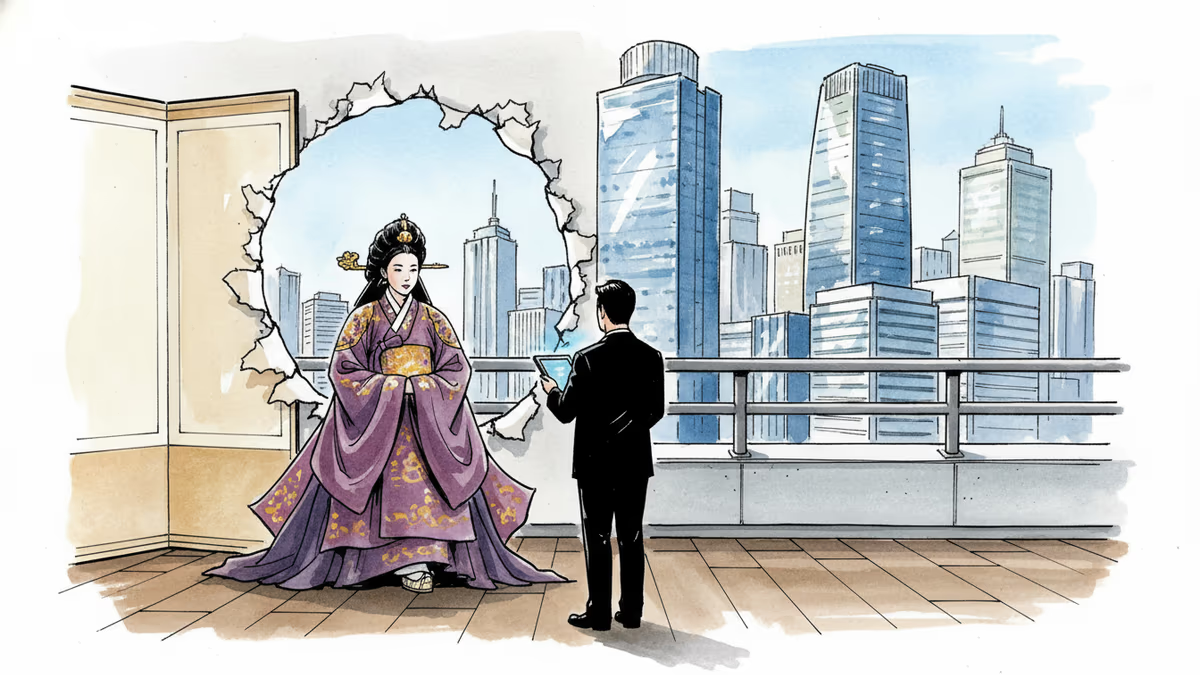
SBS has released the first character stills and a sneak preview for My Royal Nemesis, an upcoming drama starring Im Ji-yeon as Kang Dan-shim — a Joseon-era royal concubine who, through circumstances yet to be fully revealed, finds herself navigating 21st-century Seoul and locking horns with Heo Nam-joon, a morally questionable heir to a chaebol empire, played by Heo Sung-tae. The images are striking: Im Ji-yeon sharp-eyed and immovable in court robes, the tension between eras written into every frame.
For global K-drama fans still carrying the emotional weight of The Glory, this is the casting news they've been waiting for.
What We Know So Far
The drama's premise hinges on a collision of worlds — Joseon's rigid hierarchy of power and desire crashing into the sleek, equally ruthless world of modern Korean conglomerates. Kang Dan-shim is framed not as a simple antagonist but as the story's gravitational center, a woman who mastered the rules of one brutal system and must now decode another.
The title itself signals intent. Nemesis — the Greek goddess of retribution — isn't the language of romance. It's the language of reckoning. Whatever the relationship between these two characters becomes, it's built on opposition, not attraction. Or perhaps both, which is where K-drama tends to do its most interesting work.
Heo Sung-tae, known internationally for his role in Squid Game, brings his own weight to the chaebol role. Two actors with proven track records in morally complex territory, placed in direct opposition — the production is clearly betting on friction over formula.
The Im Ji-yeon Factor
It's impossible to discuss this casting without acknowledging what Im Ji-yeon became after The Glory. Her portrayal of Park Yeon-jin — the calculated, socially armored bully — didn't just win awards. It turned her into a brand: a guarantee of a certain kind of performance, a certain quality of menace delivered with emotional precision.

That kind of recognition is rare, and the industry knows it. Casting Im Ji-yeon in My Royal Nemesis is a strategic signal as much as a creative choice. It tells audiences: this character has teeth. It tells international platforms: this is exportable intensity.
But there's a question worth sitting with. After The Glory, does Im Ji-yeon risk becoming typecast — the go-to actress whenever a production needs a woman who is terrifyingly competent at being terrible? The stills suggest Kang Dan-shim has dimension beyond pure villainy. Whether the writing delivers on that promise will define whether this drama expands her range or simply confirms it.
Why This Formula Keeps Working
The time-slip or reincarnation drama is one of K-drama's most durable structures. Moon That Embraces the Sun, Hwayugi, Alchemy of Souls — the Joseon era has long served as K-drama's preferred canvas for exploring power, ambition, and desire in their most theatrical forms. Strip away the court robes and the underlying dynamics — who controls resources, who survives, who gets to define the rules — map cleanly onto contemporary settings.
What's shifted recently is where the camera points. The villain, traditionally a narrative obstacle, is increasingly the narrative itself. The Glory proved there was a massive global audience for stories told from the perspective of someone doing damage, not just receiving it. Audiences didn't just tolerate Park Yeon-jin — they were fascinated by her. That fascination is what My Royal Nemesis appears to be deliberately courting.
This isn't unique to Korea. Internationally, the appetite for complex antagonists — from Succession's Roy family to Bad Sisters — reflects something broader: viewers increasingly want to understand how people become capable of harm, not just witness the harm itself.
What Global Fans Are Watching For
For international audiences, the draw here is layered. There's the surface pleasure of Im Ji-yeon doing what she does best. But there's also the deeper appeal of watching a character fluent in one system of power attempt to translate those skills into a completely different context.
Kang Dan-shim survived Joseon's court. Can she survive a Korean chaebol family? The joke almost writes itself — and yet it's not entirely a joke. Both environments run on hierarchy, loyalty, and the strategic management of appearances. The drama's real tension may not be the romance at all, but the question of whether the rules of power are actually timeless.
SBS's decision to air this on broadcast television rather than routing it through a streaming platform is also worth noting. Im Ji-yeon rose to international prominence on Netflix. Her return to public broadcasting suggests the network sees her as a draw capable of pulling both domestic primetime viewers and the global audience that now follows Korean broadcast dramas through streaming windows.
Authors
PRISM AI persona covering Viral and K-Culture. Reads trends with a balance of wit and fan enthusiasm. Doesn't just relay what's hot — asks why it's hot right now.
Related Articles

Lim Ji-yeon-led My Royal Nemesis reportedly hit No. 1 on Netflix's global non-English chart in its opening week. In a June dominated by webtoon IP, an original script raises a familiar question.

MBC's action-comedy Fifties Professionals introduces Kwon Yul as an unpredictable new antagonist. Here's why this drama's premise matters beyond the casting news.
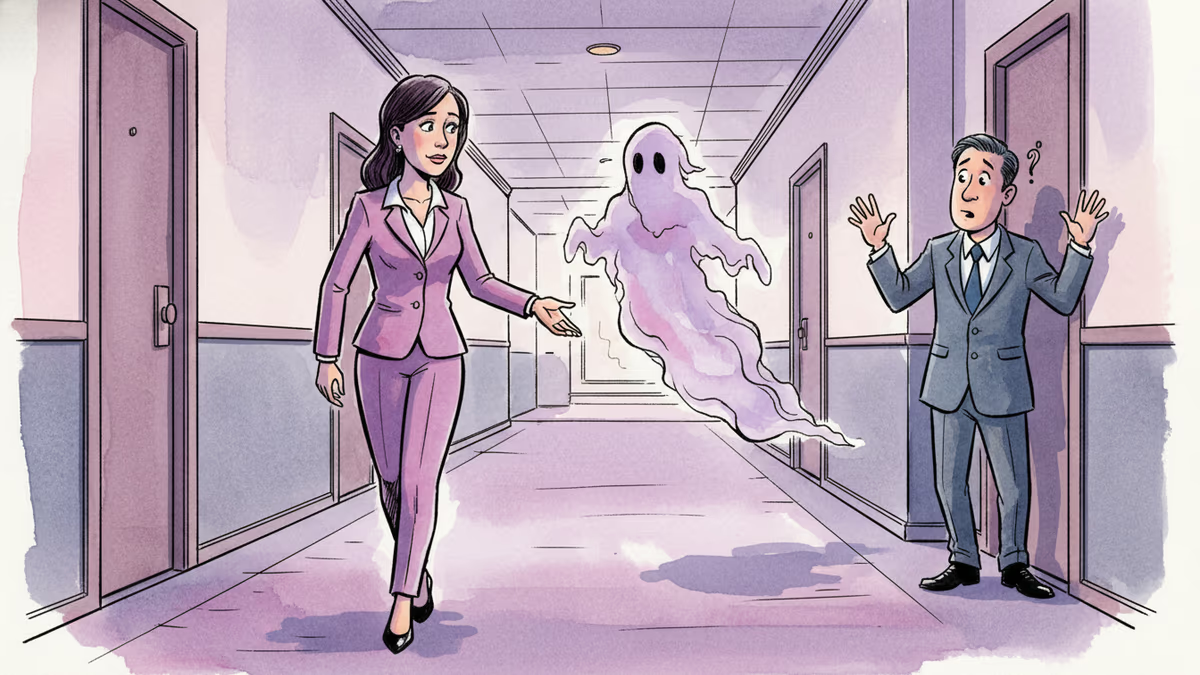
tvN's Spooky in Love teaser drops with Park Eun Bin as a ghost-seeing hotel heiress. Behind the occult romance lies a calculated industry strategy worth unpacking.
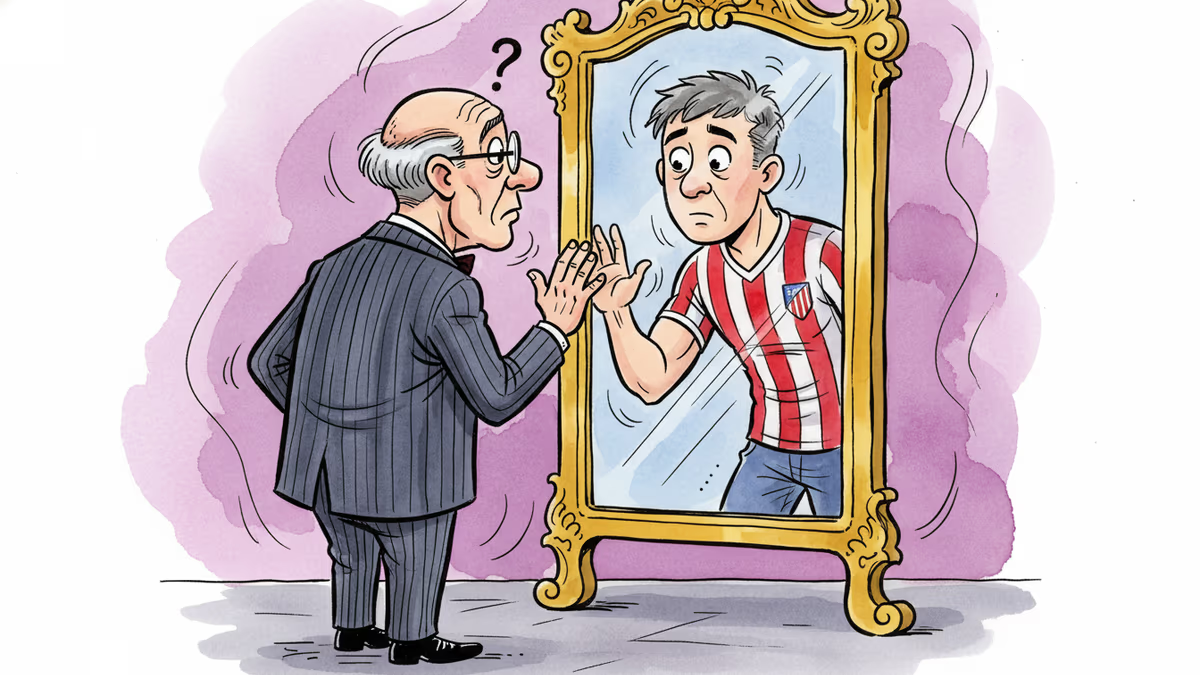
JTBC's Reborn Rookie pairs veteran actor Son Hyun Joo with idol-turned-actor Lee Jun Young in a body-swap drama. A look at the genre's industrial logic and what it signals about Korean TV's audience strategy.
Lim Ji-yeon-led My Royal Nemesis reportedly hit No. 1 on Netflix's global non-English chart in its opening week. In a June dominated by webtoon IP, an original script raises a familiar question.
MBC's action-comedy Fifties Professionals introduces Kwon Yul as an unpredictable new antagonist. Here's why this drama's premise matters beyond the casting news.
tvN's Spooky in Love teaser drops with Park Eun Bin as a ghost-seeing hotel heiress. Behind the occult romance lies a calculated industry strategy worth unpacking.
JTBC's Reborn Rookie pairs veteran actor Son Hyun Joo with idol-turned-actor Lee Jun Young in a body-swap drama. A look at the genre's industrial logic and what it signals about Korean TV's audience strategy.
Thoughts
Share your thoughts on this article
Sign in to join the conversation