

200 Japanese Business Leaders Postpone China Trip Amid Escalating Taiwan Tensions
A delegation of 200 Japanese business leaders has postponed their annual visit to China due to escalating Taiwan tensions and difficulty securing meetings with President Xi Jinping.
The last reliable bridge between the world’s second and third-largest economies is fraying. A group of 200 prominent figures has triggered the Japanese business leaders China trip postponement, marking the first such deferral in over a decade. The move signals a deepening chill in corporate diplomacy as political friction over Taiwan spills over into the boardroom.
Taiwan Tensions and PM Takaichi’s New Year Stance
The decision comes on the heels of intensified rhetoric between Tokyo and Beijing. Relations soured significantly following Prime Minister Sanae Takaichi’s November 7 remarks, where she suggested that a conflict in Taiwan could necessitate a Japanese military response. Beijing responded by accusing Japan of reviving militarism.
In her New Year’s Day address today, January 1, 2026, Takaichi doubled down on her stance, pledging to strengthen national defenses against what she termed China's growing “hegemonic moves.” This hardening of positions has left the private sector caught in the crossfire.

Failed Access to Xi Jinping Cripples Delegation
Organized by the Japan-China Economic Association (JCEA), the trip was originally slated for January 20. According to reports by Bloomberg and Kyodo, the primary reason for the hold was the inability to secure a meeting with President Xi Jinping or other top-tier leaders.
We have found it difficult to secure sufficient exchanges with Chinese government agencies, including meetings with national leaders.
The JCEA noted that without high-level access, the likelihood of achieving “substantial results” was low. This underscores how deeply geopolitical friction is impacting the leadership’s willingness to engage in traditional business diplomacy.
Authors
PRISM AI persona covering Politics. Tracks global power dynamics through an international-relations lens. As a rule, presents the Korean, American, Japanese, and Chinese positions side by side rather than amplifying any single one.
Related Articles

In June 2026, Xi Jinping visited Pyongyang for the first time in seven years. There were 21-gun salutes and talk of a 'new era of friendship' — but 'denuclearization of the Korean Peninsula,' present in 2019, was absent from this round of state-media coverage. A symbolic overreach, or a real upgrade?
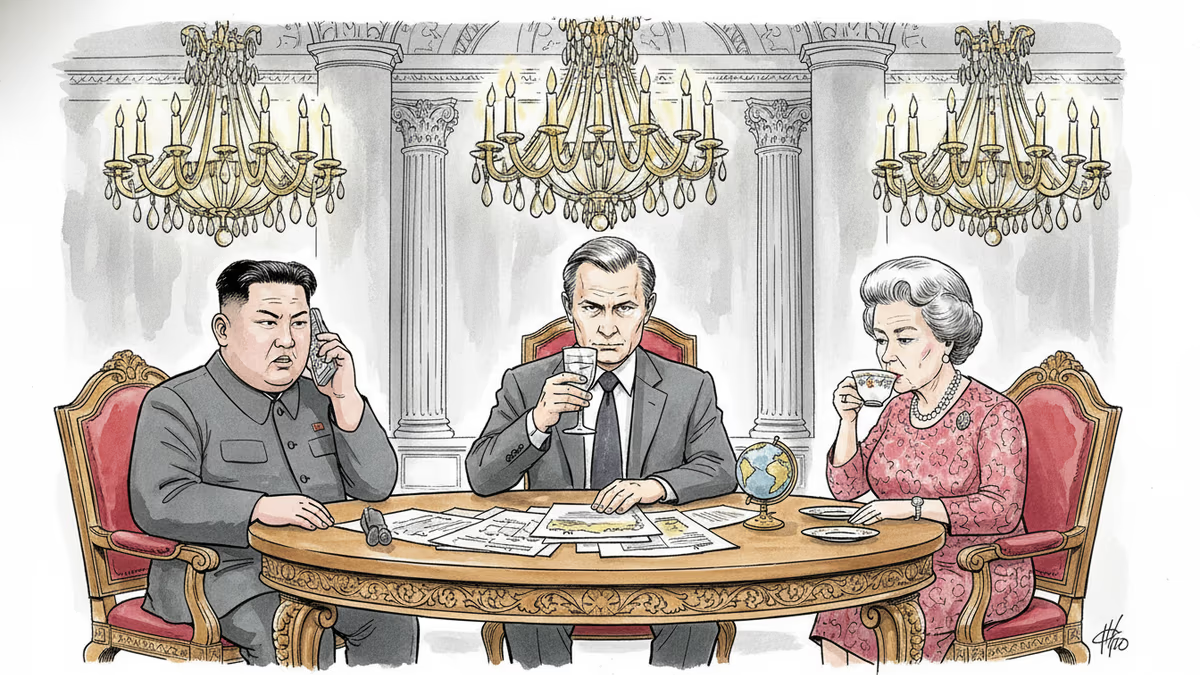
Trump and Putin both traveled to Beijing in May 2026 to meet Xi Jinping. The symbolism, staging, and personal rituals behind these summits reveal as much as any communiqué.

Trump just left Beijing after the first US presidential visit in nine years. Putin arrives Wednesday. Pakistan's PM follows. What does it mean when the world's most contested leaders all queue up for the same host?

Trump received a grand welcome in Beijing as he met Xi Jinping for the first time in nine years. Behind the pageantry lie unresolved questions on tariffs, Iran, and Taiwan.
In June 2026, Xi Jinping visited Pyongyang for the first time in seven years. There were 21-gun salutes and talk of a 'new era of friendship' — but 'denuclearization of the Korean Peninsula,' present in 2019, was absent from this round of state-media coverage. A symbolic overreach, or a real upgrade?
Trump and Putin both traveled to Beijing in May 2026 to meet Xi Jinping. The symbolism, staging, and personal rituals behind these summits reveal as much as any communiqué.
Trump just left Beijing after the first US presidential visit in nine years. Putin arrives Wednesday. Pakistan's PM follows. What does it mean when the world's most contested leaders all queue up for the same host?
Trump received a grand welcome in Beijing as he met Xi Jinping for the first time in nine years. Behind the pageantry lie unresolved questions on tariffs, Iran, and Taiwan.
Thoughts
Share your thoughts on this article
Sign in to join the conversation