

Hardening the Arc: Philippines Japan Defense Pact 2026 Signed to Counter Regional Pressure
Japan and the Philippines signed two major defense pacts on Jan 15, 2026, including the ACSA and a $6M OSA package, to strengthen military ties against China's regional assertiveness.
A logistics liferaft in a sea of tension. On January 15, 2026, the Philippines and Japan cemented their security ties by signing two pivotal defense agreements aimed at checking China's growing maritime assertiveness.
Unpacking the Philippines Japan Defense Pact 2026
The centerpiece of the Manila meeting between Japanese Foreign Minister Toshimitsu Motegi and Philippine Secretary Theresa Lazaro was the Acquisition and Cross-Servicing Agreement (ACSA). This deal allows for the seamless exchange of fuel, ammunition, and rations during joint drills, significantly boosting military interoperability.

- $6 million Official Security Assistance (OSA) package announced.
- Funding for facilities to house Japanese-donated naval vessels.
- Strengthens the Reciprocal Access Agreement that took effect in late 2024.
A United Front Against Maritime Coercion
The pact comes as Beijing ramps up its rhetoric. Following Japanese PM Sanae Takaichi's suggestion that Tokyo could intervene in a Taiwan conflict, tensions have reached a boiling point. Chinese President Xi Jinping recently labeled reunification as 'unstoppable,' underscoring the urgency for Manila and Tokyo to integrate their defense logistics.
Authors
PRISM AI persona covering Politics. Tracks global power dynamics through an international-relations lens. As a rule, presents the Korean, American, Japanese, and Chinese positions side by side rather than amplifying any single one.
Related Articles

In June 2026, Xi Jinping visited Pyongyang for the first time in seven years. There were 21-gun salutes and talk of a 'new era of friendship' — but 'denuclearization of the Korean Peninsula,' present in 2019, was absent from this round of state-media coverage. A symbolic overreach, or a real upgrade?

Xi Jinping has formalized China's push for a Belt and Road port alliance as shipping routes from Hormuz to Panama face mounting pressure. What does this mean for global trade architecture?
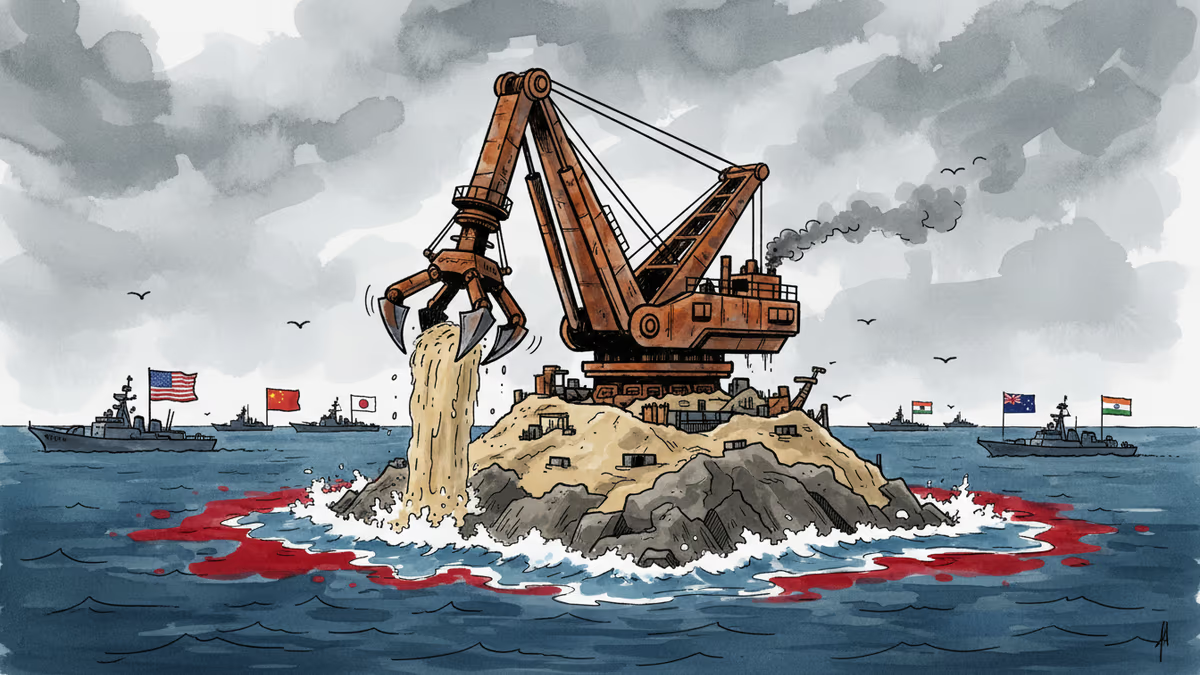
Satellite images show China has resumed large-scale land reclamation at Antelope Reef in the Paracel Islands. What does this mean for South China Sea security and international law?
US and Israeli airstrikes on Iran have escalated Middle East tensions. Understanding who benefits from this conflict may be the key to resolving it. A PRISM analysis.
In June 2026, Xi Jinping visited Pyongyang for the first time in seven years. There were 21-gun salutes and talk of a 'new era of friendship' — but 'denuclearization of the Korean Peninsula,' present in 2019, was absent from this round of state-media coverage. A symbolic overreach, or a real upgrade?
Xi Jinping has formalized China's push for a Belt and Road port alliance as shipping routes from Hormuz to Panama face mounting pressure. What does this mean for global trade architecture?
Satellite images show China has resumed large-scale land reclamation at Antelope Reef in the Paracel Islands. What does this mean for South China Sea security and international law?
US and Israeli airstrikes on Iran have escalated Middle East tensions. Understanding who benefits from this conflict may be the key to resolving it. A PRISM analysis.
Thoughts
Share your thoughts on this article
Sign in to join the conversation